
E926 | What a $96K Month Compounding Clinic Actually Looks Like
Jun 09, 2026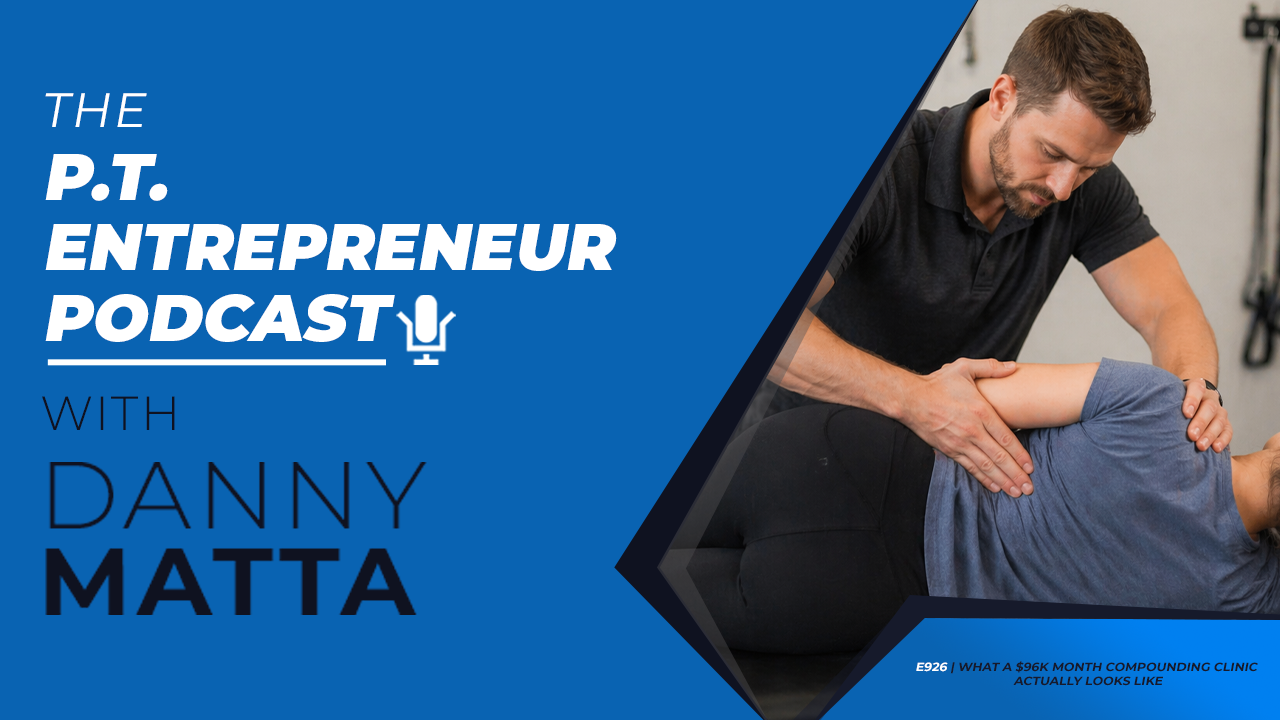
The Anatomy of a $96,000/Month Cash PT Clinic
What does a highly profitable cash-based physical therapy clinic actually look like?
Not theory.
Not best-case assumptions.
A real clinic model built from patterns observed across more than 1,000 cash-based practices.
In this episode, Doc Danny walks through the numbers behind a clinic generating roughly $96,000 per month, including:
- New patient volume
- Recurring revenue
- Staffing structure
- Profitability
- Provider productivity
- Stability systems
Most importantly, he shows why recurring revenue changes everything.
The Goal Isn't Maximum Revenue
Many clinic owners focus on growing top-line revenue.
But revenue alone doesn't tell the whole story.
A business generating millions in revenue can still operate on razor-thin margins.
Danny shares an example of a $20 million business generating only 8–10% profit.
Meanwhile, a cash-based PT clinic can generate substantially higher profit percentages with far less complexity.
The question isn't:
"How much revenue do you make?"
The better question is:
"How much do you keep?"
Breaking Down the $96K Monthly Revenue Model
This clinic generates revenue from two primary sources:
Recurring Revenue
$38,000/month
New Revenue
$58,000/month
Total:
$96,000/month
Or roughly:
$1.15 million annually
Recurring Revenue: The Foundation
Danny repeatedly emphasizes that recurring revenue is the most important part of the entire clinic model.
The recurring side includes two primary systems.
Stability System #1: Small Group Training
The clinic runs:
- 2 morning training sessions
- 4 days per week
- 6 participants per group
- 24 total clients
Each client pays approximately:
$400/month
Result:
$10,000/month recurring revenue
What's interesting is that this uses hours many clinics leave unused.
Early mornings become productive revenue-generating time without requiring additional clinic space.
Stability System #2: Recurring Visits
The second recurring revenue source comes from continuity care.
The model includes:
- 140 recurring visits/month
- Average recurring visit value: $200
Result:
$28,000/month recurring revenue
Combined with small group training, the clinic starts every month with:
$38,000 already accounted for
That dramatically reduces pressure on constantly finding new patients.
New Revenue: Only 32 New Patients Per Month
This is where most clinic owners are surprised.
The clinic only requires:
32 new patients per month
Not 60.
Not 80.
Not 100.
Just 32.
Why?
Because the business isn't built around replacing every discharged patient.
Instead, it focuses on converting the right patients into long-term relationships.
The Cash Conversion System
Of the 32 new patients:
- 60% purchase a plan of care
- Roughly 19 patients convert
Average plan of care value:
$2,400
Result:
$46,000/month from plan-of-care buyers.
Non-Plan-of-Care Buyers Still Matter
Not everyone needs a full plan of care.
The remaining patients typically purchase:
- 2–3 visits
- Average value: $750–$900
These patients contribute:
$12,000/month in additional revenue.
Combined with plan-of-care buyers:
$58,000/month in new revenue
Average Revenue Per Visit
The clinic generates:
- $96,000 total revenue
- 363 total treatment/training hours
That creates an average revenue per hour of:
$264/hour
This is significantly higher than many traditional cash-pay clinics because of two factors:
1. Outcome-Based Plans of Care
Patients buy outcomes rather than individual visits.
2. Small Group Training
One provider serves multiple people simultaneously.
That creates excellent revenue efficiency.
Staffing Structure
Danny outlines two viable models.
Option 1: Non-Treating Owner
- 1 owner
- 1 admin
- 4 full-time clinicians
Each clinician averages:
90 productive hours per month
Option 2: Owner Still Treating
- 1 owner
- 1 admin
- 3 full-time clinicians
- Owner works half schedule
Clinicians average:
103 productive hours/month
Owner averages:
50 productive hours/month
Both structures support the same revenue model.
The Profitability Benchmark
This is where the model becomes powerful.
At stabilization, Danny estimates:
25–40% owner's discretionary income
On a clinic generating:
$1.15M annually
That translates to approximately:
$300,000–$450,000 per year to the owner.
And that's before discussing additional growth opportunities.
The Compounding Clinic Framework
Everything in this model revolves around three layers:
New Patient Acquisition
People entering the business.
Cash Conversion
Converting those patients into meaningful plans of care.
Stability
Creating recurring revenue and long-term relationships.
Danny argues that most clinic owners obsess over the first layer while ignoring the third.
The third layer is where stability, profitability, and predictability are created.
Why Recurring Revenue Changes Everything
One of the strongest points in the episode is Danny's challenge to traditional thinking around discharge.
Many clinicians believe recurring care somehow reduces patient independence.
Danny argues the opposite.
Patients often want ongoing guidance.
They want:
- Accountability
- Expert advice
- Injury prevention
- Longevity support
- Trusted relationships
And when recurring services are done ethically, patients gladly continue investing in their health.
Technology Spotlight
Documentation shouldn't take attention away from patients.
Claire AI is an AI scribe trained specifically for physical therapists that helps reduce documentation time and improve patient interactions.
👉 Try Claire free for 7 days
https://www.meetclaire.ai/?utm_source=preroll&utm_medium=podcast&utm_campaign=pt_entrepreneurs
More PT Biz Training
👉 PT Biz Training YouTube
https://www.youtube.com/@ptbiztraining
Final Takeaway
A $96,000/month clinic isn't built by constantly chasing more patients.
It's built through:
- Efficient acquisition
- Strong cash conversion
- High-value plans of care
- Recurring revenue systems
- Long-term patient relationships
The real secret isn't finding more patients.
It's building a clinic where patients want to stay.