E892 | The One Exercise Your Clinic Needs To Do Together
Feb 12, 2026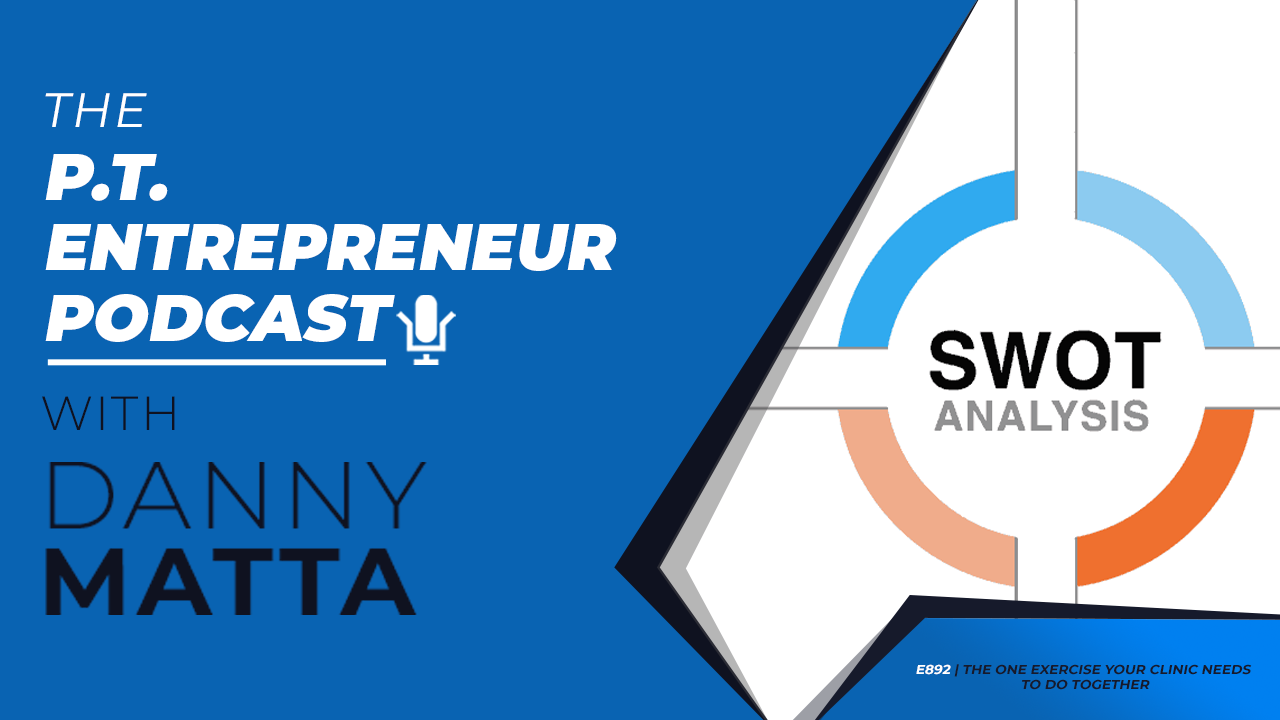
The Team Exercise That Exposed Our Blind Spots (And Made the Business Stronger)
If you want a smarter team, better decisions, and fewer blind spots in your business, this episode is required listening.
In this episode of the PT Entrepreneur Podcast, Doc Danny breaks down one of the most impactful team exercises PT Biz has ever run. It happened during a staff retreat in Breckenridge, Colorado, and it revealed more about the business than any dashboard, KPI report, or meeting ever has.
The exercise was simple. The insights were not.
Why Most Teams Never Get This Level of Clarity
Most clinic owners are busy. Buried in documentation. Buried in admin. Buried in decision-making.
Even well-run practices rarely create space for deep thinking as a team.
This retreat changed that.
The structure was intentional. Mornings were spent moving together. Snowboarding. Skiing. Fully focused, no distractions. Activities that force presence and attention.
That kind of movement does something important to the brain. It clears noise. It creates focus. And it opens the door to better conversations later in the day.
After movement came shared meals. After meals came focused work blocks. Several hours at a time. No multitasking. No surface-level discussions.
That cadence alone is powerful.
But the exercise itself is what made the biggest difference.
The Exercise Every Clinic Owner Should Run
The team completed a SWOT analysis together.
Strengths.
Weaknesses.
Opportunities.
Threats.
It’s a standard business-school framework, but most clinic owners only do it alone or with a business partner. Rarely with their full staff.
That’s a mistake.
When you involve your team, you learn quickly that not everyone sees the business the same way you do.
And that’s exactly the point.
Why Different Perspectives Matter More Than You Think
Some people naturally see opportunity everywhere. Strengths come easily. Threats barely register.
Others are wired the opposite way. They spot risk immediately. Weaknesses stand out. Threats feel obvious.
Neither is wrong.
In fact, you need both.
Businesses fail when everyone sees the world the same way. When blind spots go unchecked. When optimism isn’t balanced by caution, or caution isn’t balanced by vision.
This exercise exposed exactly where those differences existed on the team.
And that made the business stronger.
The Hiring Mistake That Quietly Hurts Growth
One of the most important takeaways from this episode is about hiring.
Many owners hire people just like themselves. Same mindset. Same strengths. Same blind spots.
It feels good. It feels comfortable. It feels like culture fit.
But it limits growth.
Strong teams are built with people who think differently, see differently, and challenge assumptions respectfully. The SWOT exercise made that impossible to ignore.
When everyone independently identifies the same strength, weakness, opportunity, or threat, that’s where owners should pay attention. That alignment is a signal.
How to Run This Exercise in Your Own Clinic
You don’t need a ski trip to do this.
You can run this in a weekly meeting. A quarterly planning session. Or even one-on-one with a trusted colleague or client who understands business.
Here’s the structure:
-
Have everyone independently list strengths
-
Discuss and compare
-
Repeat for weaknesses
-
Repeat for opportunities
-
Repeat for threats
Patterns will emerge quickly.
Those patterns show you where to focus next.
Why This Builds Better Culture Too
This exercise does more than improve strategy.
It builds trust.
Staff want to know their opinions matter. They want to feel like contributors, not just employees executing tasks.
Inviting them into meaningful conversations about the business signals respect and ownership.
That matters more than most owners realize.
Presence Still Matters (Even for Leadership)
One reason many owners never run exercises like this is simple.
They’re overwhelmed.
Documentation steals time. Admin steals energy. Leadership gets pushed to the side.
That’s why tools like Claire matter.
Claire is an AI scribe trained specifically for physical therapists. It removes the bulk of documentation work so clinicians and owners can stay present with patients and actually lead their teams.
Final Thought
Strong businesses aren’t built by accident.
They’re built by leaders who slow down long enough to see clearly, listen deeply, and invite perspectives beyond their own.
If you want better decisions, stronger culture, and fewer blind spots, run this exercise.
You’ll be surprised what you learn.
Do you enjoy the podcast?
Leave us a 5-star review on iTunes and share it with a colleague who would benefit.
Ready to take the next step?
Book a call with one of our expert consultants and start building a practice that supports both your patients and your life.
Do you enjoy the podcast? If so, leave us a 5-star review on iTunes and tell a friend to do the same!
Ready to elevate your practice? Book a call at the link below with one of our expert consultants today and start your journey to delivering unparalleled physical therapy.

Podcast Transcript
Danny: [00:00:00] Hey, what's going on? Doc Danny here with the PT Entrepreneur Podcast and today [00:00:05] we are talking about, uh, an exercise that we had a chance to do at our staff retreat last [00:00:10] week. And this is something that was probably the, the most beneficial exercise that we did, that you [00:00:15] can, uh, take and do this with your own team.
I think this will be incredibly helpful.[00:00:20]
First thing is, uh, this past week we took our [00:00:25] entire staff to, uh, Breckenridge, Colorado. And, uh, we took them, [00:00:30] um, snowboarding and skiing. And this is something that, uh, I've been doing with my business partners now for, [00:00:35] um, six years straight. And we do it the beginning of the year. Normally it's just us.
[00:00:40] This is the first year we brought our entire team with us. And um, I think it was just a huge. [00:00:45] Uh, a huge help. It was very, very worth the effort, cost, and, [00:00:50] uh, you know, it's challenge to get everybody to an area like that. Maybe it's not something that everybody can do, but for [00:00:55] us, this is something that, uh, we have found to be incredibly helpful.
And, and I'll, [00:01:00] I'll kinda explain, you know, why I think it's so beneficial and it's, it's not to say that you're in a different environment. It's [00:01:05] that. We go to a place where, uh, we're able to be outside in the [00:01:10] morning to move around to do something that requires your full attention. I don't know, um, you [00:01:15] know, if you've ever been mountain biking or, or snowboarding or surfing or something [00:01:20] like that, like there's, there's something about it where you can't, I can't like focus on other things.
I have [00:01:25] to, uh, focus on where I'm going 'cause I don't wanna hit a tree or a rock or whatever. Right. [00:01:30] And, um, and that's a really. A unique thing. A lot of us are so distracted and we're [00:01:35] constantly bombarded with information. You don't have a choice. Like you have to be fully focused on something. And there's something really [00:01:40] interesting, I think it happens with, uh, with our brain when, when we do that, because not only do we, uh, do we have [00:01:45] this intense period of focus, but then we get on a lift, which takes a little while, and then we [00:01:50] ride back up and we have this opportunity to sit next to each other and talk.
And, uh, [00:01:55] it could be, you know, whatever, just. Just regular conversation. Normally it turns into things that [00:02:00] people are thinking about for the business while we're there, which is really a huge reason why we do this. [00:02:05] And uh, and then in the afternoon we, we all sit down together and grab lunch middle of the day.
[00:02:10] And then we start working together, uh, around two o'clock. And then we do that through throughout the evening. [00:02:15] And. What we have found is this is a really, really helpful cadence for people to be able [00:02:20] to get in the right mindset, to be able to solve problems and be a bit more creative. Um, I, I think it's, [00:02:25] it's a, one of the things that we have done that just has made such a big difference.
You could do this if you just want [00:02:30] to go to a, a place where you can go hiking, uh, you wanna go biking, you want a place where you go running, you could just do [00:02:35] a workout in the morning, uh, together, but, but just something movement related together. And [00:02:40] then, uh, have a meal and then. Get after it. Right? I mean, that, that's it.
If you can get a four [00:02:45] hour chunk of like detailed, like really intense work done, that, that's very, [00:02:50] very meaningful. And you do that over a couple days each day. It's super, super helpful. Plus the, the [00:02:55] conversations people are having that are non-structured are also incredibly valuable and. For your team culture [00:03:00] as well as you and your staff, and being able to really, you know, understand what's going on with them and their jobs and [00:03:05] what they're trying to do and, and what we're trying to do in making sure there's no communication breakdown, which is really hard at scale.
[00:03:10] So for us, we went through an exercise called a SWOT analysis. I don't know if any of you have done this before. [00:03:15] It's a pretty common business school analysis. It's SWOT. So it's [00:03:20] strengths, weaknesses, opportunities, and threats. These are, this is what that stands for. [00:03:25] And I had never done this with. Uh, with, with our staff.
I've only done this [00:03:30] with my business partners, um, or by myself, and this is something I do pretty much [00:03:35] every year, but. I'd never done it with a bigger group. And this was [00:03:40] probably the most interesting thing that we did, the most beneficial thing that we did. And it's because [00:03:45] not everybody views the world the way you do.
Not everybody views your company the way you do [00:03:50] and they can have different personality types and some people. They're incredibly naturally [00:03:55] optimistic. They, they, they, in their, uh, opportunities category, they have like a [00:04:00] dozen things. And in the threats category, they have like one thing, right? They only, they only see one [00:04:05] threat, but they have 12 things that are, that are opportunities and then other people.
[00:04:10] They see the world differently. You know, they may bias towards seeing, uh, danger more or [00:04:15] threats more. They have a dozen things in the threat section and they have, uh, one thing in the opportunity section, right? [00:04:20] And, and this is why it's so important, and I I cannot caveat this or [00:04:25] express the importance of this more.
And that is as you go to hire people to, to [00:04:30] build your company. You must focus on trying to hire [00:04:35] people that have the skillset you're looking for, but are also not necessarily [00:04:40] inherently just like you. Now, this is a huge mistake that I see. People just hire people that [00:04:45] are just like them. They're just like them because they like them and they think to themself, I don't know why I like [00:04:50] this person, but I like them.
And I could see myself hanging out with this person, and that's great maybe for your culture. But [00:04:55] what you have to realize is it's not just about that you need a culture fit, but you also need people that have the [00:05:00] requisite skills that you need and. It's very important to have people that view the world [00:05:05] differently than you.
At least slightly differently than you're not exactly like you. Because if you surround [00:05:10] yourself by a bunch of, with a bunch of people that are just like you, you're gonna see all the same things on a [00:05:15] SWOT analysis that that, that you would see, that they would see. It's gonna be the same versus if you have people that come [00:05:20] from different backgrounds who have different skills that are, are inherently good at their, their job, whatever that might [00:05:25] be, and they are a part of your, of, of your overall company and culture.
That [00:05:30] is where you have this. Uh, respectful sort of, uh, discourse where [00:05:35] people may see things very differently and it's important for you to be, uh, [00:05:40] open-minded enough to think, man, maybe they're right. You know, maybe this is a [00:05:45] blind spot for me. And if you're like me, you probably have a dozen things in the [00:05:50] opportunity section, right?
You have all these strengths that we have all these strengths, we have almost no weaknesses, and there's no [00:05:55] threats. That is not the reality, right? And you need people that see a lot of weaknesses and threats because it [00:06:00] balances you out. And it increases the likelihood that the business is gonna be able to not just like hit [00:06:05] the goals you have, but do so in a manner where it's not going to, uh, you know, put, [00:06:10] put itself in a, in a bad position to where.
Game's over, right? Where businesses go out of business. So these [00:06:15] people that may be different than you are really important. And now you might be somebody who falls more into the [00:06:20] CAT category where you see a lot of weaknesses and, and threats. Maybe you're naturally more biased to see that. [00:06:25] And this is important, this is how we've evolved.
Like we need people that are, are like. Concerned about [00:06:30] threats. They're concerned about like, you know, the saber tooth tiger eating. Everybody. We can't just see everybody where they're like, this is [00:06:35] great. Like, awesome. Look at the, the stars. This is amazing. Like, that is somebody who's more opportunity [00:06:40] driven, you know, that that is, that's more strengths driven and versus somebody that's more weakness and threats driven is gonna be like, yeah, [00:06:45] but that cat's getting really close.
You know, and like, and they keep you alive. You need both. Okay. It's really, [00:06:50] really important. And no matter which one you are, you have to make sure that people on your team and, or if you don't [00:06:55] even have a team, maybe you have somebody. That is a friend of yours or a family member, [00:07:00] it looks at the world a little bit different than, than you do.
And you can sit down and do an exercise [00:07:05] like this with them and really get more of a balanced opinion on where things are at. Or even better if you [00:07:10] have a client that you're close with and you can actually just like say, Hey, I would love, I'll trade you, you [00:07:15] know, uh, a visit for an hour of your time to talk to me about the business and the things that you see in a SWOT analysis, [00:07:20] especially if they have any sort of business acumen or they are an entrepreneur, even better.
And, you know, for, for you, this can [00:07:25] be incredibly valuable exercise because you get to see. The, the business and the world around it [00:07:30] in a lens that is not the same as yours. That is an incredibly valuable thing. If you have a team, [00:07:35] I highly recommend going through this. And here's basically what you do.
You sit down [00:07:40] and you go through one at a time, right? So you say, okay, I want everybody to write down the [00:07:45] strengths that they see. In our company. So everybody write that down for a few minutes and you go [00:07:50] around and everybody says what those are. And we have a little discussion about the strengths of where, why people think that it [00:07:55] is, that why people think that it is not maybe, uh, there's some [00:08:00] disagreement about, about something that we can kind of work through a little bit, or there's a lot of alignment and we see a lot of alignment.
Here's the other thing, [00:08:05] if you see a lot of alignment in any of these categories from everybody who has different [00:08:10] views on the, on the business and the world. That's when you know you should really pay attention to that. [00:08:15] That is a, uh, a strong indicator that this is an important place to focus on, [00:08:20] um, for whatever that might be.
So if everybody from different sort of perspective sees the same thing, that is a, [00:08:25] a really, really cool thing. And that usually is where there's a lot of, uh, traction that can be gained by [00:08:30] focusing on that. So you do that for strengths, you do that for weaknesses, you do that for opportunities, and then you do that for [00:08:35] threats.
And I, I can tell you this, you're gonna have some people, the, the strengths and opportunities people. They're [00:08:40] gonna have a shit ton of stuff for those categories, and they're gonna have very little for weaknesses and threats. And the people that are [00:08:45] more sort of biased towards seeing, uh, the threats that are out there, they're gonna see a lot of weaknesses and they're gonna see a lot of [00:08:50] threats.
And it's very, very eye-opening to sit down with your team and have everybody go through this, [00:08:55] see what overlaps, see what does not. Uh, and then really like see if you can find some common themes where [00:09:00] everybody is in agreement on everything. Um. This was the most beneficial exercise that we did when we were out [00:09:05] there.
I hope that you decide to do this as well. Like I said, you can do this by yourself. I think it's very meaningful to [00:09:10] do it with somebody that views the world a little different than you, if not multiple people, if you have the team to do so. [00:09:15] And to be honest with you, this doesn't even have to be part of your retreat.
You could do this, uh, for a, you know, [00:09:20] a, a weekly, uh, meeting that you, instead of going over your KPIs and everything else, you spend [00:09:25] two hours going through a SWOT analysis with everybody. And it's also great for them to have their opinions and to share, [00:09:30] right? Like. You, I, I, I want a culture where the people that work with us feel [00:09:35] like we value what they have to say because they're independently very smart people.
Uh, your, your staff [00:09:40] wants that. They, they wanna feel like, you know, they're not just there to. You know, whatever, do their job and go [00:09:45] home. Like they're, they're a part of this. This is their small companies and their value, uh, their, [00:09:50] their opinion is valuable. They're, because they are an independently important part of the business.
So, you know, [00:09:55] as you look at the, the exercise you can do, this is one of my favorites. I think this is something that, uh, you'll [00:10:00] get a lot out of. Hopefully you decide to do this with your team. Uh, let me know if you do. I'd love to know how you, uh, you liked [00:10:05] it. If you've got as much added as me and don't, you know.
Don't, uh, don't feel bad. If you wanna steal our [00:10:10] snowboarding, uh, annual, you know, beginning of the year trip. I think it's a game changer. It's been huge for our [00:10:15] business. Highly recommend it if it's something that is within, uh, your scope and your wheelhouse. Alright, thanks for [00:10:20] listening. Catch the next [00:10:25] one.