
E960 | 3 Lessons From The September 2026 PT Biz Live Event
Oct 06, 2026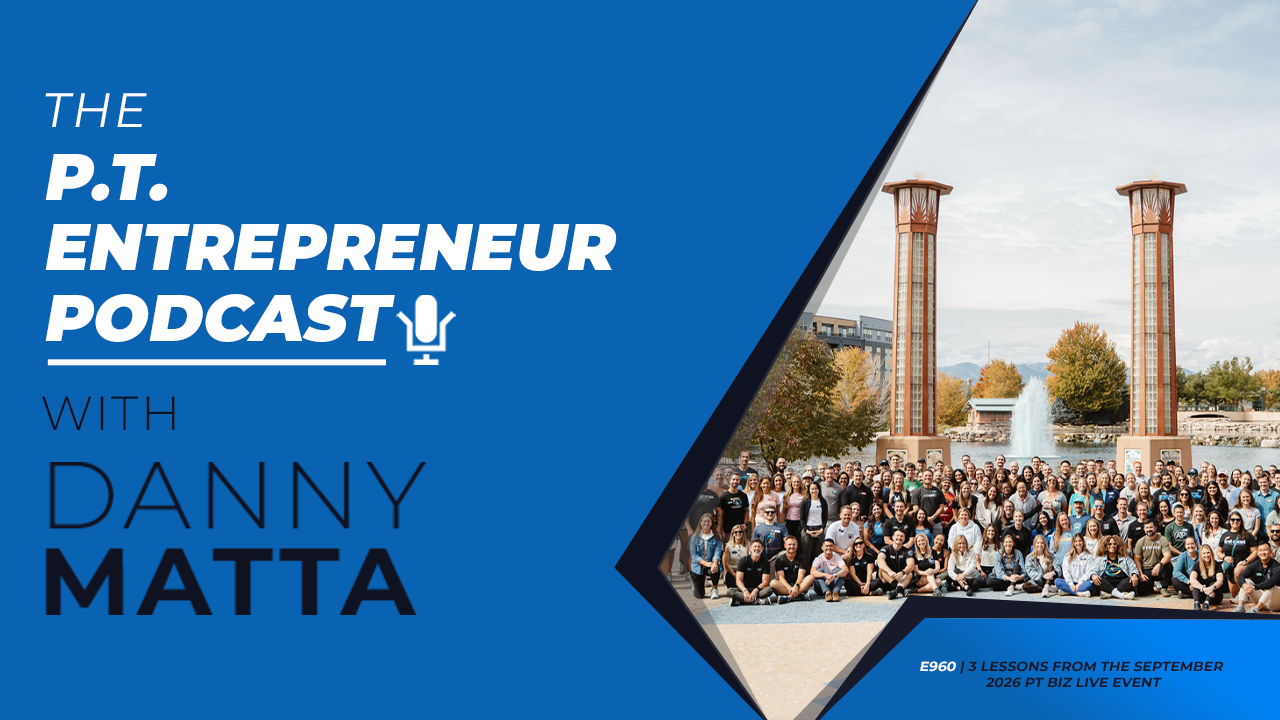
What Successful PT Clinic Owners Learn About Business and Growth
If you put 200 physical therapy clinic owners in the same room, you'd probably expect most of the conversations to revolve around business.
Revenue.
Marketing.
Sales.
Hiring.
Profit margins.
Lead generation.
And yes, all of those things come up.
But after our most recent PT Biz Mastermind event, those weren't the conversations that stood out the most.
What stood out were the patient stories.
The difficult seasons people had survived.
The relationships that had developed between clinic owners.
The people who had built businesses that looked successful today but had taken an incredibly messy road to get there.
After having a few days to think about the event, three lessons kept coming back to me.
And none of them were really about tactics.
They were about what happens to you while you're building the business.
There's Something Different About Getting in a Room Together
We bring our PT Biz Mastermind members together twice a year.
These events are difficult to pull off.
Imagine organizing a wedding for roughly 200 people.
Now make it last two days.
And do it twice a year.
There's a lot that goes into it.
But it's also one of the best things we do.
Because there's something that happens when you take clinic owners from around the country and put them in the same place.
People start talking.
Relationships form.
Someone hears an idea they hadn't considered.
Someone meets another owner who's dealing with the exact problem they're struggling with.
A conversation happens at dinner that changes the way someone thinks about their business.
You can't always predict where the value will come from.
Sometimes You Need to Engineer More Randomness Into Your Life
A friend of mine talks about the idea of intentionally creating randomness.
The basic idea is simple.
Most of our lives become predictable.
We wake up.
Go to work.
Talk to the same people.
Solve the same types of problems.
Drive home.
Repeat.
That's not necessarily bad.
But it limits the number of unexpected interactions we're exposed to.
Put 200 clinic owners together, including 30 or 40 people you've never met, and suddenly there are hundreds of possible conversations that wouldn't have happened otherwise.
That's where some of the best ideas come from.
You Don't Always Know Which Conversation You Need
I've been involved with somewhere around 16 or 17 of these events now.
And every time, something catches me off guard.
It might be something a speaker says.
A conversation with a clinic owner.
Someone I meet for the first time.
A connection I make between two people.
An idea that lands at exactly the right moment.
You can't really schedule those things.
But you can put yourself in environments where they're more likely to happen.
That's one of the biggest benefits of community.
Clinic Ownership Can Be Isolating
Running a practice can feel lonely.
Even when you're surrounded by patients and employees all day.
You're carrying problems that other people in the clinic may not completely understand.
You're wondering whether you're making the right decision.
You're thinking about payroll.
Hiring.
Marketing.
Cash flow.
Leadership.
Your next location.
An employee problem.
A patient issue.
And sometimes you don't have anyone who really understands what those decisions feel like.
Your Spouse Can't Always Be Your Business Mastermind
A lot of owners naturally bring these problems home.
Sometimes that's helpful.
But your spouse has their own life.
Their own stress.
Their own responsibilities.
They may support you completely and still not understand why you're obsessing over your evaluation conversion rate or whether you should hire another clinician.
That's why being around other clinic owners can be so valuable.
You don't have to spend 20 minutes explaining the context.
They already understand it.
The Right Room Changes the Conversation
One of the things I love about our events is the range of businesses represented.
You might have someone doing $100,000 per year sitting next to somebody doing $100,000 per month.
And they're talking to each other.
The larger business isn't automatically the teacher.
The smaller business isn't automatically the student.
They both know things the other person doesn't.
One may have solved a hiring problem the other hasn't.
One may have a fantastic community partnership.
Someone may have figured out a better sales process.
Another may have built a unique clinical program.
Good ideas don't care how much revenue you did last month.
This Is the Network Effect of a Great Community
The more good people you put into the room, the more useful the room becomes.
One person brings an idea.
Another person improves it.
Someone else has already tried it and can explain what went wrong.
Another person knows someone who can help.
That's hard to reproduce when you're sitting alone in your clinic trying to Google the answer.
And over time, those relationships compound.
People become friends.
They refer clinicians to each other.
They share systems.
They compare numbers.
They troubleshoot problems.
They celebrate wins.
They help each other through the ugly parts.
That's where a business community becomes much more valuable than a collection of tactics.
Some People Leave and Eventually Come Back
We've worked with clinic owners who stay with us for a year or two.
They learn what they need.
They build the skills.
They leave and run the clinic on their own.
That's completely fine.
We have a lot of alumni like that.
But we've also had people come back.
And one of the reasons is simple.
They miss the people.
They miss having a group that understands what they're building.
They miss being around clinic owners with similar values, similar backgrounds, and similar goals.
That tells you something.
Information matters.
But information isn't the only thing people need.
The First Big Lesson: It's Not Just a Business
This was probably the biggest thing I noticed at this event.
People weren't only talking about revenue.
They were talking about patients.
A high school athlete who tore an ACL and made it back onto the football field.
Someone who had been dealing with pain and finally returned to something they loved.
Patients who accomplished things they weren't sure they'd be able to do again.
The clinic owners telling these stories were genuinely excited about them.
That's worth paying attention to.
Your Patient Is the Hero
There's a useful way to think about your role as a clinician.
You're not the hero of the patient's story.
They are.
They're the person who has to deal with the injury.
They're the person who's frustrated.
They're the person doing the exercises.
They're the person trying to get back onto the field, into the gym, or simply back to living normally.
You're the guide.
Your expertise matters tremendously.
But your job is to help them navigate the journey.
Great PTs Don't Need to Make Themselves the Hero
This can change the way you communicate with patients.
Instead of:
Look what I fixed.
The story becomes:
Look what this patient accomplished.
You helped.
You gave them the plan.
You used your clinical knowledge.
You adjusted when things weren't working.
You coached them through difficult stretches.
But they did the work.
That's their win.
And there's something incredibly rewarding about getting to participate in that.
This Is One of the Best Parts of the Profession
There are plenty of ways to make money.
Physical therapy is unique because the product of your work can genuinely change somebody's life.
You're helping someone return to a sport.
Keep doing their job.
Play with their kids.
Train again.
Travel.
Compete.
Avoid giving up an activity that matters to them.
That's meaningful work.
And when you're running a clinic, it's easy to lose sight of that.
Business Problems Can Make You Forget Why You Started
Clinic ownership creates a lot of noise.
The schedule has holes.
A clinician calls out.
A lead doesn't answer.
Your lease goes up.
An employee leaves.
Ads stop performing.
Payroll hits.
A patient asks for a refund.
Suddenly you're sitting at your desk looking at spreadsheets and wondering why you ever thought owning a clinic sounded fun.
That's exactly when the patient stories matter.
They reconnect the business to the work.
Revenue Matters
We shouldn't pretend otherwise.
Revenue matters.
Profit matters.
Cash flow matters.
You can't build a sustainable clinic without understanding the numbers.
At our events, we spend significant time talking about financial metrics.
That's part of running a company.
Your business needs to make money.
Your employees need to get paid.
You need enough margin to invest.
You need enough financial stability to support your family.
None of that is optional.
But money isn't the only return you get from building a great clinic.
Meaning Can Be a Competitive Advantage Too
Think about the career you want to have for the next 10, 20, or 30 years.
The work needs to be financially sustainable.
But it also helps tremendously if you actually enjoy it.
Work is still work.
Anything becomes tiring when you do enough of it.
But there's a difference between being tired from work you find meaningful and being completely disconnected from what you do every day.
The patient impact gives this profession something special.
Don't lose that as the business gets bigger.
Growth Should Create More Impact, Not Separate You From It
One of the risks of becoming the owner is gradually moving farther away from patients.
You start with clinical care.
Then you're hiring.
Managing.
Looking at numbers.
Building systems.
Leading meetings.
Working on marketing.
Eventually, you may barely treat at all.
That can be the right move for the business.
But you still need ways to stay connected to the impact.
Listen to the patient stories.
Celebrate outcomes with your clinicians.
Share wins during team meetings.
Read the reviews.
Talk about the people whose lives changed because your clinic exists.
That's part of remembering what all the other work is for.
The Second Big Lesson: Everybody's Road Is Bumpy
One of my favorite parts of our Mastermind events is hearing members present.
Originally, the idea was basically:
Teach everybody something you uniquely know.
That's still part of it.
But over time, the presentations have evolved.
Now we also want to hear the story.
How did you actually get here?
What went right?
What went wrong?
What did you screw up?
What almost broke?
What did you have to figure out?
Those stories are usually far more interesting than the final result.
Business Growth Almost Never Looks Like the Graph You Imagine
When you start a clinic, it's easy to picture growth like this:
Open.
Get patients.
Make money.
Hire.
Get more patients.
Open another location.
Make more money.
Done.
Actual business ownership looks nothing like that.
Something works.
Then it stops working.
You hire somebody.
Then somebody leaves.
You have a record month.
Then the next month is terrible.
You sign a lease.
Then the landlord becomes a nightmare.
You launch something that works incredibly well.
Then you try another idea and nobody buys it.
The line is rarely straight.
You Usually See the Result, Not the Backstory
This is one of the dangers of comparing your business to someone else's.
You see their clinic today.
Multiple providers.
Nice facility.
Full schedule.
Strong revenue.
Great team.
Maybe multiple locations.
What you don't see are the years before that.
The nights they couldn't sleep.
The bad hires.
The cash-flow problems.
The marketing campaigns that failed.
The leases that went wrong.
The months they wondered whether they had made a massive mistake.
The current business makes the path look cleaner than it actually was.
Colleen's Story Made This Obvious
One of the presentations at this event came from Colleen, one of our coaches.
We've worked with her for a long time.
She and her husband have built an incredible business.
But the road wasn't clean.
There were major challenges with leases and standalone clinic spaces.
There were situations with landlords that created serious problems.
There were difficult stretches that you wouldn't know about by simply looking at the business today.
During her presentation, she showed photos and videos from the different stages of the clinic.
That made the story real.
Document the Messy Part
This is something more business owners should do.
Take pictures.
Save the old videos.
Take a picture of the first room you rented.
Save the screenshot from the month where you finally hit your first revenue goal.
Document the buildout.
Take the team photo when there are three of you.
Save the photo from the workshop where four people showed up.
You may feel ridiculous doing it at the time.
Years later, those things tell the story.
The Hard Parts Eventually Become Chapters
When you're in the middle of a terrible situation, you don't think:
This is going to make a great story someday.
You're thinking:
How do I fix this?
That's normal.
But with enough distance, you start seeing those periods differently.
The lease disaster becomes part of the story.
The employee who left becomes part of the story.
The month you almost couldn't make payroll becomes part of the story.
The failed location becomes part of the story.
You learn.
You adjust.
You keep moving.
Nobody Wants to Watch a Movie Where Nothing Goes Wrong
Imagine watching a movie where the main character has a goal.
They try once.
It works perfectly.
Movie over.
Nobody wants to watch that.
The story becomes interesting because something gets in the way.
There are obstacles.
Bad decisions.
Setbacks.
Unexpected problems.
Moments where you're not sure how it's going to work out.
Business isn't intentionally designed like a movie.
But the same principle applies.
The obstacles are part of the journey.
The Road Is Supposed to Be Hard
This doesn't mean you should glorify unnecessary suffering.
Use good systems.
Get help.
Learn from people who have already solved the problem.
Avoid mistakes when you can.
But don't interpret every difficult period as evidence that you're doing something wrong.
You're building a business.
Businesses are hard.
You're dealing with people.
Money.
Competition.
Real estate.
Marketing.
Sales.
Leadership.
Operations.
Clinical care.
Of course there are going to be problems.
Stop Expecting Business Ownership to Feel Easy
Sometimes the expectation creates more frustration than the problem itself.
You think:
I shouldn't be dealing with this anymore.
Why isn't this working?
Everybody else seems to have figured it out.
Maybe I'm not good at this.
Then you sit in a room with other owners and realize they're dealing with their own version of the same thing.
That's reassuring.
Not because you want other people to struggle.
Because it reminds you that struggle isn't unique evidence that you're failing.
It's often simply part of building something difficult.
Your Current Problem May Become the Story You're Proud to Tell
There will probably be parts of your clinic's history that you appreciate much more later than you do today.
Not because they were fun.
Because they forced you to change.
Maybe the employee problem taught you how to lead.
Maybe the financial problem forced you to understand your numbers.
Maybe the bad lease made you better at evaluating future locations.
Maybe the failed marketing campaign forced you to learn your market.
Maybe burnout finally convinced you to hire.
You don't need to enjoy the problem.
But you should look for what it's trying to teach you.
Business Ownership Is Personal Development in Disguise
This may be one of the most underrated parts of entrepreneurship.
You think you're starting a clinic.
Then the business starts exposing you.
Your inability to delegate.
Your avoidance of difficult conversations.
Your relationship with money.
Your need for control.
Your lack of patience.
Your fear of hiring.
Your inability to say no.
Your tendency to procrastinate.
Your difficulty trusting people.
Eventually, the business puts pressure on all of it.
The Business Can Only Grow as Far as the Owner Is Willing to Grow
You can learn another marketing tactic.
You can improve your sales process.
You can raise your prices.
Those things matter.
But eventually, many business problems become leadership problems.
You need to have the conversation you've been avoiding.
You need to hand something off.
You need to trust somebody.
You need to make a decision without perfect information.
You need to admit you were wrong.
You need to stop doing something you're good at so someone else can learn it.
Those aren't tactical problems.
They're personal ones.
That's Why the Bumpy Road Matters
Every difficult stage asks something different from you.
The solopreneur has to learn how to sell.
The busy clinician has to learn how to hire.
The new employer has to learn how to lead.
The growing clinic owner has to learn how to delegate.
The multi-provider owner has to learn how to develop leaders.
The multi-location owner has to learn how to create systems that work without them.
Every level exposes the next weakness.
That's not a flaw in the process.
That's the process.
The Third Big Lesson: Being Here Is a Gift
The third takeaway from the event had almost nothing to do with business.
When you bring a couple hundred people together twice a year, inevitably someone is going through something difficult.
A health issue.
A sick spouse.
A family member struggling.
A death.
Something unexpected that completely changes what matters that week.
It happens because that's life.
And being around enough people at once makes that impossible to ignore.
We Take Normal Life for Granted
Think about what it takes just to attend an event like this.
You have to be healthy enough to travel.
You have to be able to get on a plane or drive.
You have to be cognitively present enough to sit in a room, have conversations, learn, work out, eat dinner with people, and enjoy yourself.
Those things feel completely normal.
Until they aren't.
That's what makes simply being there worth appreciating.
Business Owners Are Really Good at Moving the Goalposts
This happens constantly.
You start your clinic and think:
If I could just get to $10,000 a month, I'd feel great.
Then you get there.
Now you want $20,000.
Then you need your first employee.
Then $30,000.
Then another clinician.
Then a bigger space.
Then a second location.
Then you need better margins.
Then you want more time away.
There is always another target.
That's part of what makes entrepreneurs good at building things.
It's also why we can be terrible at appreciating what we've already built.
Don't Miss the Life You're Building the Business For
The goal of building a successful clinic isn't simply to build a successful clinic.
For most owners, the business is supposed to support something bigger.
Time with your family.
Financial stability.
Control over your schedule.
Meaningful work.
The ability to travel.
The opportunity to create great jobs.
The freedom to choose how you spend more of your time.
But you can become so focused on improving the business that you stop experiencing the life the business was supposed to create.
That's worth paying attention to.
Sometimes You Need Something to Break the Autopilot
Most of us live a lot of our lives on autopilot.
Wake up.
Work.
Solve problems.
Go home.
Get ready for tomorrow.
Repeat.
Then something happens.
Sometimes it's an event.
Sometimes it's a conversation.
Sometimes it's something much harder.
And suddenly you're paying attention again.
You're present.
You recognize the people around you.
You realize how much has changed.
You remember what you're actually working toward.
One of the benefits of getting away from your normal environment is that it can interrupt the routine long enough for you to see your life differently.
The Right Community Gives You People to Share Both Sides With
Business ownership has incredible highs.
A record month.
A great hire.
A new location.
A patient success story.
An employee who develops into a leader.
A goal you've been chasing for years finally becoming real.
It also has some brutal lows.
And you need people for both.
People who understand why the win matters.
And people who understand why the difficult season is difficult.
That's one of the things I saw over and over again at this event.
You Don't Need to Pretend Everything Is Great
There's a strange pressure in entrepreneurship to always look successful.
Especially online.
You see the new clinic.
The new employee.
The revenue milestone.
The packed schedule.
The team retreat.
The award.
You don't always see what happened three weeks earlier.
That's why real relationships with other business owners matter.
You can say:
This month sucked.
I'm having a hard time with this employee.
I don't know what to do next.
I'm exhausted.
I'm worried about this decision.
And instead of getting a generic response, you're talking to somebody who has probably experienced some version of it.
The Best Communities Aren't Built Around Ego
One of the things that makes these events special is that people at completely different stages can talk openly.
The owner doing $100,000 per month doesn't need to prove anything to the owner doing $100,000 per year.
And the smaller clinic owner doesn't need to pretend they know everything.
They're both there to get better.
That's when the room becomes useful.
If everyone is trying to impress everyone else, nobody learns much.
If everyone is willing to share what is actually working and what isn't, everybody gets better.
You Need People Who Expand Your Idea of What's Possible
Community isn't only useful when something is going wrong.
It can also change your expectations.
Maybe you've never imagined having five clinicians.
Then you spend time with someone who has ten.
Maybe you can't imagine getting yourself out of treatment.
Then you meet three people who have done it.
Maybe opening a second location feels impossible.
Then you sit next to someone who has already made every mistake you're worried about making.
That doesn't mean you need to copy them.
It simply expands what you can see.
Proximity Can Change Your Thinking
There's a reason in-person interaction still matters.
You can listen to podcasts.
Watch YouTube videos.
Read books.
Take courses.
All of those things are useful.
But there's something different about having dinner with somebody who's already solved the problem you're facing.
You can ask the question behind the question.
You can explain the weird details.
You can hear what they regret.
You can ask what they would do differently.
And sometimes the most useful conversation isn't even with the person you expected to meet.
This Is Why Relationships Compound Too
We talk a lot about compounding in business.
Recurring revenue compounds.
Patient relationships compound.
Referral relationships compound.
Brand awareness compounds.
But relationships between business owners compound too.
The person you meet today may have nothing immediately useful for you.
Two years later, they may be the exact person you need to call.
Or you may be that person for them.
That's why a strong network becomes more valuable the longer you're part of it.
Money Is Important, but It Wasn't the Most Interesting Thing in the Room
There are clinic owners in this community who have completely changed their family's financial trajectory.
That's real.
And it's worth celebrating.
Building a profitable clinic can create tremendous financial opportunity.
But when I thought about what stood out from this event, I didn't find myself thinking about the cars people drove.
Or the vacations they took.
Or even who had the highest revenue.
I kept thinking about the people.
Financial Success Is Usually a Byproduct of Doing the Right Things for a Long Time
The strongest businesses we see usually aren't built on one clever tactic.
They're built through years of doing difficult things consistently.
Taking care of patients.
Improving the service.
Learning how to sell.
Learning how to market.
Hiring.
Training.
Developing leaders.
Managing cash.
Building relationships.
Fixing mistakes.
Doing the work again tomorrow.
Financial results eventually reflect that.
But they're the output of a much larger process.
Don't Confuse the Scoreboard With the Game
Revenue is a scoreboard.
Profit is a scoreboard.
Conversion rate is a scoreboard.
Average revenue per visit is a scoreboard.
Plan completion is a scoreboard.
Those numbers tell you important things about the health of the company.
But they're not the entire game.
The game is everything happening underneath those numbers.
The patient experience.
The quality of your clinicians.
The culture.
The systems.
The leadership.
The relationships.
The decisions.
The consistency.
If you improve those things, the scoreboard usually starts telling a better story.
The Best Part of Building a Clinic Might Be Who You Become
This is something I never expected when we started helping clinic owners more than a decade ago.
I thought we'd spend most of our time talking about tactics.
Digital marketing.
Sales percentages.
Pricing.
Lead generation.
Hiring.
And we do talk about all of those things.
But after watching people build businesses for years, I've realized that business ownership is one of the most intense forms of personal development you can go through.
The business keeps finding your weaknesses.
Avoiding Hard Things Eventually Gets Expensive
Maybe you hate confrontation.
That works until you have an employee who needs direct feedback.
Maybe you need control.
That works until you have six employees and everything still needs your approval.
Maybe you're uncomfortable talking about money.
That works until your pricing doesn't support your team.
Maybe you avoid looking at your financials.
That works until cash gets tight.
Maybe you struggle to say no.
That works until your calendar belongs to everyone except you.
The business eventually makes your personal weaknesses operational problems.
Growing the Business Often Means Working on Yourself First
This is why some of the biggest breakthroughs don't start with a new marketing strategy.
They start with the owner becoming better.
A better communicator.
A better leader.
More decisive.
More willing to delegate.
More comfortable with accountability.
More financially literate.
More patient.
More disciplined.
More willing to have uncomfortable conversations.
The business changes because the person running it changes.
You Have to Lean Into the Uncomfortable Side
Most of the things owners want are on the other side of something they don't particularly want to do.
You want more time.
You probably need to delegate.
Delegating feels uncomfortable.
You want a stronger team.
You probably need to give more direct feedback.
That conversation feels uncomfortable.
You want better margins.
You may need to raise prices or control expenses.
That feels uncomfortable.
You want the clinic to operate without you.
You have to stop being the answer to every problem.
That definitely feels uncomfortable.
But you can't keep the behavior that's creating the current business and expect a completely different business to appear.
Every Stage Requires a Different Version of You
The skills that get you started aren't necessarily the skills that help you scale.
At first, being willing to do everything is useful.
You answer the phone.
Treat the patient.
Clean the clinic.
Run the ad.
Do the discovery call.
Follow up.
Handle billing.
That's how a lot of practices begin.
But if you're still doing everything when you have six employees, the trait that helped you start can become the thing holding you back.
You have to change with the business.
This Is Why Growth Can Feel So Personal
You aren't simply changing an organizational chart.
You're giving up things that used to define your value.
For years, maybe you were the best clinician in the clinic.
Then your job becomes developing other clinicians.
Maybe you were the person who closed every lead.
Then someone else starts doing discovery calls.
Maybe every patient knew you.
Then people start coming to your company without knowing who you are.
Those changes can be uncomfortable.
But they're also signs that you've built something larger than your own individual effort.
A Compounding Clinic Needs More Than a Great Owner
If the entire patient experience depends on you, growth has a ceiling.
If every referral relationship depends on you, growth has a ceiling.
If every employee needs you to solve problems, growth has a ceiling.
If every sale requires you, growth has a ceiling.
A Compounding Clinic has to create value through the organization, not only through the founder.
That requires systems.
But it also requires people.
And developing those people requires leadership.
The Owner's Development Becomes a Business Strategy
This is why personal development isn't separate from business development.
If you become better at delegation, the company gains capacity.
If you become better at communication, the team gets clearer.
If you become better at financial management, the company gets more stable.
If you become better at hiring, the talent improves.
If you become better at leadership, people stay longer and take on more responsibility.
Working on yourself eventually shows up in the business.
Don't Forget Why You're Doing Any of This
The danger is getting so focused on growth that you stop asking what the growth is for.
Why do you want another location?
Why do you want more revenue?
Why do you want a bigger team?
Why do you want to get out of treatment?
There's nothing wrong with wanting any of those things.
But there should be a reason behind them.
Maybe you want to create great jobs for clinicians.
Maybe you want to serve more people in your community.
Maybe you want financial security for your family.
Maybe you want more time with your kids.
Maybe you want the clinic to become an asset that doesn't require your constant presence.
Know what you're actually building toward.
Success Doesn't Have to Look the Same for Everyone
One of the benefits of being around many different clinic owners is seeing how differently people define success.
One owner may want multiple locations.
Another may want one highly profitable clinic.
Someone else may want a small team and a lot of flexibility.
Another owner may still love treating and never want to completely leave patient care.
There's no requirement that everybody build the same business.
The important thing is being intentional.
Build the clinic that supports the life and impact you actually want.
Take Time to Look Back
Entrepreneurs spend a lot of time looking forward.
What's next?
What's the goal?
What's broken?
What do we need to improve?
Sometimes it's worth looking backward.
Look at where the clinic started.
Look at the first patient.
The first hire.
The first month you thought this might actually work.
The first time you took a vacation and the clinic stayed open.
The difficult season you thought might break the business.
The employees who grew with you.
The patients whose stories you still remember.
You may be much farther along than it feels when you're staring at the next problem.
Then Get Back to Work
Gratitude doesn't mean complacency.
You can appreciate what you've built and still want to improve it.
You can be proud of your team and still hold them to high standards.
You can celebrate the business and still acknowledge its weaknesses.
You can enjoy where you are while continuing to build toward something bigger.
Those ideas aren't in conflict.
In fact, appreciating the opportunity may make you more willing to do the hard work required to protect it.
Three Questions Worth Asking Yourself
After this event, there are three questions I'd encourage every clinic owner to think about.
Are you still connected to the impact your clinic is creating?
Not just the revenue.
Who are you helping?
What are those patients able to do because your clinic exists?
Are you interpreting difficulty as failure, or as part of the process?
The road is going to be bumpy.
Your current problem may be one of the chapters you eventually look back on with the most pride.
Are you actually present for the life you're building?
Don't wait until something forces you to recognize how much you already have.
The business matters.
But it isn't everything.
Technology Spotlight
Documentation continues to be one of the biggest frustrations for physical therapists.
It's also a perfect example of work that can consume time and energy that clinicians would rather put toward their patients, their families, or simply recovering from the workday.
Claire is an AI scribe built specifically for PTs that dramatically reduces documentation time, allowing clinicians to focus on patient care instead of paperwork.
👉 Try Claire free for 7 days
https://www.meetclaire.ai/?utm_source=preroll&utm_medium=podcast&utm_campaign=pt_entrepreneurs
More PT Biz Training
Want more content on building a scalable cash practice?
👉 PT Biz Training YouTube
https://www.youtube.com/@ptbiztraining
Final Thoughts
After every Mastermind event, I try to figure out what I actually learned.
This time, the biggest lessons weren't about another marketing tactic or a new sales strategy.
They were simpler.
The work we get to do matters.
The road is bumpy for everybody.
And getting to build something meaningful alongside good people is something worth appreciating.
Yes, learn the numbers.
Build your systems.
Improve your marketing.
Get better at sales.
Hire great people.
Create Recurring Revenue.
Build your Stability Layer.
Work toward a Compounding Clinic that doesn't depend entirely on you.
All of that matters.
But don't become so focused on building the business that you miss what the business is giving you along the way.
The patient who got back onto the field.
The employee who became a leader.
The owner you met who became a close friend.
The problem you thought would break you that eventually made you better.
The ability to show up, be healthy, learn, work, build, and spend time around people you care about.
Those aren't side effects of the journey.
They're a huge part of the point.
So keep building.
But every once in a while, look around long enough to appreciate what you're already building.