
E964 | What Nick Saban Can Teach You About Running a Clinic
Oct 20, 2026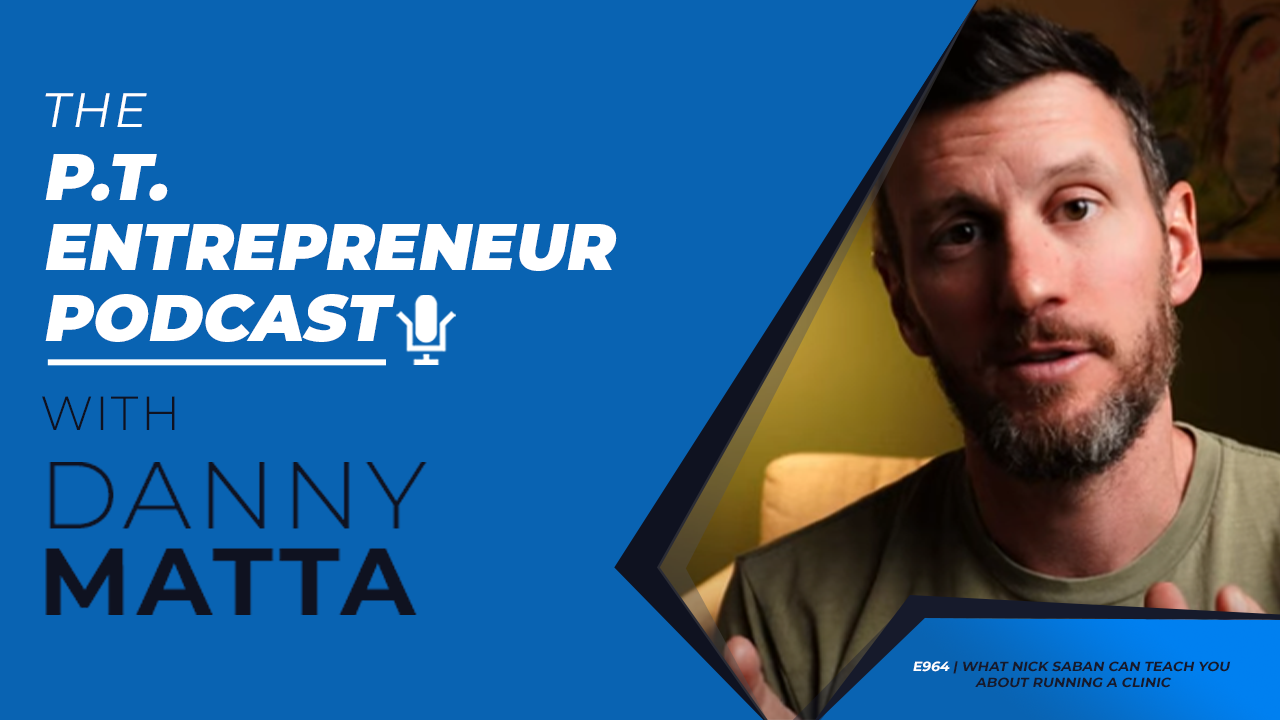
Stop Chasing Revenue Goals: What Nick Saban Can Teach PT Clinic Owners About Growth
Most physical therapy clinic owners have a pretty clear idea of what they want their business to become.
Maybe it's a $1 million cash-based practice.
Maybe it's hiring your first physical therapist, opening a second location, or finally getting yourself out of the treatment schedule.
Whatever the goal is, you probably spend a lot of time thinking about it.
And that's not necessarily a bad thing.
The problem starts when you become so focused on the outcome that you lose sight of the work required to get there.
You check your revenue.
You look at your patient volume.
You compare your clinic to someone else's.
And when you're not where you want to be, you get frustrated.
But what if the best way to reach your business goals was to stop thinking about them so much?
That's one of the biggest lessons I've taken from Nick Saban, one of the most successful coaches in college football history.
And it applies directly to building a cash-based physical therapy practice.
What Nick Saban Learned About Winning
I recently watched the first episode of an ESPN documentary series about Nick Saban.
I'm not an Alabama fan, so it pains me a little to admit how much I enjoyed it.
But there's a lesson in Saban's coaching philosophy that every entrepreneur should understand.
Early in his coaching career, Saban was successful by most standards.
He wasn't a terrible coach.
He won games.
But he wasn't yet producing the kind of results that would eventually define his career.
One of the turning points discussed in the documentary was his relationship with therapist Lionel Rosen.
Rosen challenged the way Saban approached coaching.
Saban was intensely focused on winning.
He watched the scoreboard.
He got frustrated when players made mistakes.
He sometimes responded by publicly criticizing them.
But Rosen helped him recognize that focusing so heavily on the result wasn't necessarily helping his players perform better.
In fact, it could damage their confidence and the trust they had in their coach.
The alternative was surprisingly simple.
Stop obsessing over the scoreboard.
Start focusing on what players could actually control.
The Power of Six Seconds
In football, an individual play lasts only a few seconds.
Saban began emphasizing the importance of executing those individual moments correctly.
Instead of thinking about winning the entire game, players were encouraged to focus on doing their jobs during the next play.
Their assignment.
Their technique.
Their effort.
Their execution.
Then they'd reset and do it again.
Six seconds at a time.
The idea was that consistently executing the right actions would give the team its best opportunity to win.
The scoreboard still mattered.
But it became a measurement of performance rather than the thing everyone was constantly thinking about.
That distinction is enormous.
You can't directly control whether you win a football game.
You can control how you prepare, how you practice, and how you execute your responsibilities.
The same is true in business.
You can't guarantee that your cash-based PT practice will generate a certain amount of revenue next month.
But you can control the activities and systems that make that outcome more likely.
And those are the things that deserve most of your attention.
Your Revenue Goal Is a Scoreboard
Let's say your goal is to build a $1 million physical therapy practice.
That's a perfectly reasonable goal.
It gives you something to work toward.
But writing down that number doesn't tell you what to do tomorrow morning.
Neither does checking your bank account every day.
The revenue number is simply the result of a collection of smaller activities.
Patients have to discover your clinic.
They have to understand why your services are valuable.
They have to schedule an appointment.
They have to commit to a plan of care.
They have to receive an experience that helps them achieve their goals.
And your team needs the systems to deliver that experience consistently.
Those are the things that eventually create revenue.
The problem is that many clinic owners spend more time thinking about the financial outcome than improving the processes responsible for producing it.
They want more patients, but they haven't evaluated how their team handles incoming leads.
They want higher revenue, but their patient conversion rate is poor.
They want to hire another clinician, but they haven't developed a reliable onboarding process.
They want to work fewer hours, but every important decision still runs through them.
The goal isn't necessarily the problem.
The problem is that the work underneath the goal hasn't been clearly identified.
Break Big Goals Into Smaller Commitments
This is where Saban's approach becomes useful.
A football team doesn't improve by staring at the scoreboard.
It improves by practicing and executing the specific skills required to perform.
Your clinic works the same way.
Let's say you want to increase patient volume.
Instead of focusing entirely on how many new evaluations you need this month, look at the process.
Are you consistently generating opportunities for new patients to discover your clinic?
Are you following up with inquiries?
Is your team confident explaining your services and pricing?
Are people scheduling evaluations after their initial conversations?
Are patients committing to appropriate plans of care?
Each of those questions points toward work you can actually do.
And depending on your clinic, one of those areas may be significantly more important than the others.
For example, if you're generating plenty of leads but very few are booking evaluations, increasing your marketing budget might not be the right move.
You may need to improve your sales process first.
That could mean reviewing conversations, training your administrative team, or making your initial consultation more effective.
It's not necessarily exciting work.
But it's the kind of work that moves the business forward.
The objective is to identify the next action that creates the greatest opportunity for progress, then execute it consistently.
Why Visionary Clinic Owners Struggle With This
A lot of entrepreneurs are naturally future-focused.
They enjoy thinking about what's possible.
They can imagine the larger clinic, the additional locations, the team, and the freedom that might come with building a successful company.
I'm wired that way myself.
I enjoy big ideas.
I like thinking about where we're going.
But the details required to get there aren't always as interesting.
And that's a problem.
Because most of the work that creates a successful business is repetitive.
You have to review the numbers.
Improve your processes.
Train your employees.
Have difficult conversations.
Follow up with people.
Make small adjustments.
Then do it again.
It's much more exciting to talk about building a seven-figure clinic than it is to spend an afternoon improving your new patient phone script.
But that phone script might be the thing standing between your current business and the next stage of growth.
Vision matters.
You need to know where you're going.
But vision without consistent execution doesn't produce much.
That's why successful clinic owners need to develop the ability to focus on the details, even when those details aren't particularly exciting.
Stop Letting the Outcome Control Your Emotions
There's another concept from sports psychology that connects to this idea.
It's often described as having no attachment to the outcome.
That doesn't mean you don't care about succeeding.
It means you stop allowing the final result to determine how you approach the work.
Think about Adam Vinatieri, one of the most accomplished kickers in NFL history.
In an interview discussed in the episode, Vinatieri explained that he didn't allow the result of an individual kick to define him.
He could prepare, practice, and put himself in the best possible position to succeed.
But once the ball was kicked, the outcome wasn't entirely within his control.
That mindset helped him perform under pressure.
There's an important lesson here for physical therapy business owners.
You can make a great hire who eventually decides to move away.
You can launch a well-planned marketing campaign that underperforms.
You can open a clinic at an unfortunate time.
You can make a sound business decision and still experience an unexpected setback.
That doesn't automatically mean you made the wrong decision.
Sometimes circumstances don't work in your favor.
The better question is whether you followed a sound process and executed the things you could control.
If the answer is yes, you can learn from the result and keep moving.
If the answer is no, you have something specific to improve.
Either way, you're no longer allowing every short-term result to determine whether you feel successful.
Entrepreneurship Is a Game Without a Final Whistle
One of the reasons this is harder in business than in football is that business doesn't have a clearly defined ending.
Football has rules, a scoreboard, and a clock.
You know when the game starts and when it's over.
Business is different.
Your goals can change.
Your team changes.
The market changes.
Your personal priorities change.
And there's always another problem to solve.
Even when you reach a major milestone, the business keeps going.
You hit your revenue target.
Now you need to improve profitability.
You hire your first clinician.
Now you need to become a better leader.
You open a second location.
Now you need stronger systems.
There's always another stage.
That's part of what makes entrepreneurship interesting.
But it also explains why so many clinic owners feel overwhelmed.
They know there's work to do.
They just aren't always sure which work matters most.
And working hard on the wrong things can be just as frustrating as not making progress at all.
That's where having a clear plan, the right priorities, and outside guidance can make an enormous difference.
Working Hard on the Wrong Things Won't Grow Your PT Practice
One of the biggest mistakes I see physical therapy clinic owners make is assuming that more effort automatically leads to better results.
They're working long hours.
They're treating patients, answering messages, managing employees, and trying to improve their business.
They're exhausted.
But the clinic isn't necessarily moving forward.
The problem usually isn't a lack of effort.
It's that their effort isn't being directed toward the most important problem.
Think about it from a clinical perspective.
If someone comes to see you with persistent back pain, you don't just give them every exercise you know and hope something works.
You evaluate the person.
You identify what needs to improve.
You develop a plan.
Then you progress that plan based on how they respond.
The patient still has to do the work.
You can't do their squats or pushups for them.
But your expertise helps ensure they're working on the right things.
Running a cash-based physical therapy practice is remarkably similar.
You can spend months improving your website when the real problem is your sales process.
You can invest in additional marketing when your current leads aren't being followed up with consistently.
You can hire another clinician when what you actually need is better scheduling and operational efficiency.
All of those activities require work.
But not all of them will solve the problem that's currently limiting your business.
Identify the Biggest Constraint in Your Business
Before deciding what to work on next, you need to understand what's holding your clinic back.
That requires looking beyond your revenue goal.
Start by examining the systems responsible for producing that revenue.
If you aren't getting enough new patient inquiries, your marketing may need attention.
If you're getting plenty of inquiries but not enough scheduled evaluations, your sales process may be the problem.
If patients are scheduling evaluations but aren't following through with care, you may need to improve how your team communicates the plan of care and its value.
If your clinicians are consistently full but you're struggling to grow, hiring and onboarding might become the priority.
And if the business is growing but everything depends on you, the next step may be improving your operations and developing your team.
Each situation requires a different solution.
That's why copying what another successful clinic owner is doing isn't always the right move.
They may be solving a problem that your business doesn't have.
Your job is to identify the constraint that's most important at your current stage.
Then focus your attention there.
Why Business Owners Need Coaching Just Like Athletes
One of the things that stands out about Nick Saban's story is that even an accomplished coach needed someone to challenge his thinking.
He had experience.
He understood football.
He was already successful.
But an outside perspective helped him recognize something he wasn't seeing.
The same principle applies to business ownership.
Consider how professional athletes develop.
A quarterback doesn't simply decide to become better and then practice whatever seems interesting that day.
He has coaches evaluating his performance.
They identify problems with his footwork, throwing mechanics, decision-making, or ability to read defenses.
Then they help him focus on the specific skills that will improve his performance.
The athlete still has to practice.
The coach provides direction.
Physical therapy business owners need that same kind of feedback.
When you're inside your clinic every day, it can be difficult to recognize what's actually causing a problem.
You become accustomed to the way things operate.
You may even convince yourself that something is working simply because you've invested so much time into it.
An experienced coach or mentor can help you see the situation differently.
They can recognize patterns they've encountered in other businesses.
They can help you avoid mistakes.
And they can give you a clearer understanding of what needs to happen next.
That's one of the biggest reasons we emphasize coaching and community inside the PT Biz Mastermind.
The goal isn't simply to give clinic owners more information.
It's to help them determine which information matters right now and how to implement it.
Because knowing more about business doesn't automatically make your business better.
Applying the right knowledge does.
Small Improvements Create Long-Term Momentum
When you think about building a successful cash-based PT practice, it's easy to imagine the major milestones.
Your first full-time month.
Your first employee.
Your first $500,000 year.
Your first million-dollar year.
Those are exciting moments.
But they aren't where most of the progress happens.
Progress happens when you improve how your team handles incoming leads.
It happens when you consistently review your numbers and understand what's changing.
It happens when you train a clinician to communicate more effectively with patients.
It happens when you build a system that prevents important tasks from falling through the cracks.
These improvements might seem small individually.
But over time, they build on one another.
This is the foundation of the Compounding Clinic.
When you consistently improve the systems that attract patients, convert them into care, deliver excellent outcomes, and support long-term relationships, the business becomes stronger.
You aren't relying on one big marketing campaign or a sudden increase in patient volume.
You're building a collection of processes that work together.
And those processes become more valuable as your business grows.
The challenge is being patient enough to keep improving them.
What Should You Actually Work on This Week?
Here's a practical exercise.
Think about the biggest goal you have for your clinic over the next 12 months.
Maybe you want to increase revenue.
Maybe you want to hire another PT.
Maybe you want to reduce your treatment hours.
Write that goal down.
Now ask yourself a different question.
What is the single most important thing I could improve this week that would move me closer to that goal?
Not five things.
Not an entire list of projects.
One thing.
If your biggest issue is converting leads into evaluations, spend the week reviewing that process.
Look at how quickly inquiries receive a response.
Listen to how your team explains your services.
Identify where prospective patients are dropping off.
Make one meaningful improvement.
If hiring is your biggest constraint, focus on that instead.
Clarify the role.
Improve the job posting.
Develop your interview process.
Create a plan for bringing the right person into the business.
If your clinic depends too heavily on you, identify one responsibility that can be documented, delegated, or improved.
Then work on it.
At the end of the week, don't judge your progress solely by whether revenue increased.
Ask whether you completed the work that needed to happen.
Did you make the improvement?
Did you follow through?
Did you move the business in the right direction?
That's how you start building consistent momentum.
Use Your Goals for Direction, Not Daily Motivation
None of this means you should stop setting revenue or growth goals.
Those goals are useful.
They help you define what you're trying to accomplish.
They also give you a way to evaluate whether your strategy is working.
But they shouldn't dominate your attention every day.
Your annual revenue target isn't something you can directly execute.
Your weekly priorities are.
Your five-year vision isn't something you can complete this afternoon.
The systems, conversations, and decisions in front of you are.
When you understand that distinction, business ownership becomes easier to manage.
You stop feeling like every day needs to produce some dramatic result.
Instead, you focus on completing the work that gives you the best chance of making progress.
And when something doesn't work, you adjust.
You learn from the result.
You identify the next priority.
Then you get back to work.
Technology Spotlight
Documentation continues to be one of the biggest frustrations for physical therapists.
Claire is an AI scribe built specifically for PTs that dramatically reduces documentation time, allowing clinicians to focus on patient care instead of paperwork.
👉 Try Claire free for 7 days
https://www.meetclaire.ai/?utm_source=preroll&utm_medium=podcast&utm_campaign=pt_entrepreneurs
More PT Biz Training
Want more content on building a scalable cash practice?
👉 PT Biz Training YouTube
https://www.youtube.com/@ptbiztraining
If you're trying to figure out what your clinic needs next, start with the free Clinic Growth Blueprint Assessment at Physical Therapy Biz.
It's designed to help you identify what's working, where your biggest opportunities are, and what to prioritize over the next 90 days.
And if you're still working toward starting your own full-time cash practice, our free Part-Time to Full-Time 5-Day Challenge can help you create a clear plan for replacing your income.
👉 https://physicaltherapybiz.com/challenge
Final Thoughts
Nick Saban didn't become one of the most successful coaches in college football by ignoring the importance of winning.
He became more effective by changing where he directed his attention.
Instead of obsessing over the scoreboard, he focused on preparation, execution, and the small details that made winning more likely.
That's exactly how you should approach growing your physical therapy practice.
Set your goals.
Know what you're working toward.
But don't spend every day worrying about whether you've reached the outcome yet.
Identify the most important work.
Make sure it's the right work.
Then execute it consistently.
And if you aren't sure what you should be focusing on, get help from someone who can evaluate your business and point you in the right direction.
Because the difference between a clinic that stays stuck and one that continues to grow isn't always how hard the owner works.
Often, it's whether they're working on the right things.
Stop staring at the scoreboard. Focus on winning the next six seconds.