
E878 | From Start Up To Scaling Up A Cash-Based PT Clinic With Kim Manlangit
Dec 25, 2025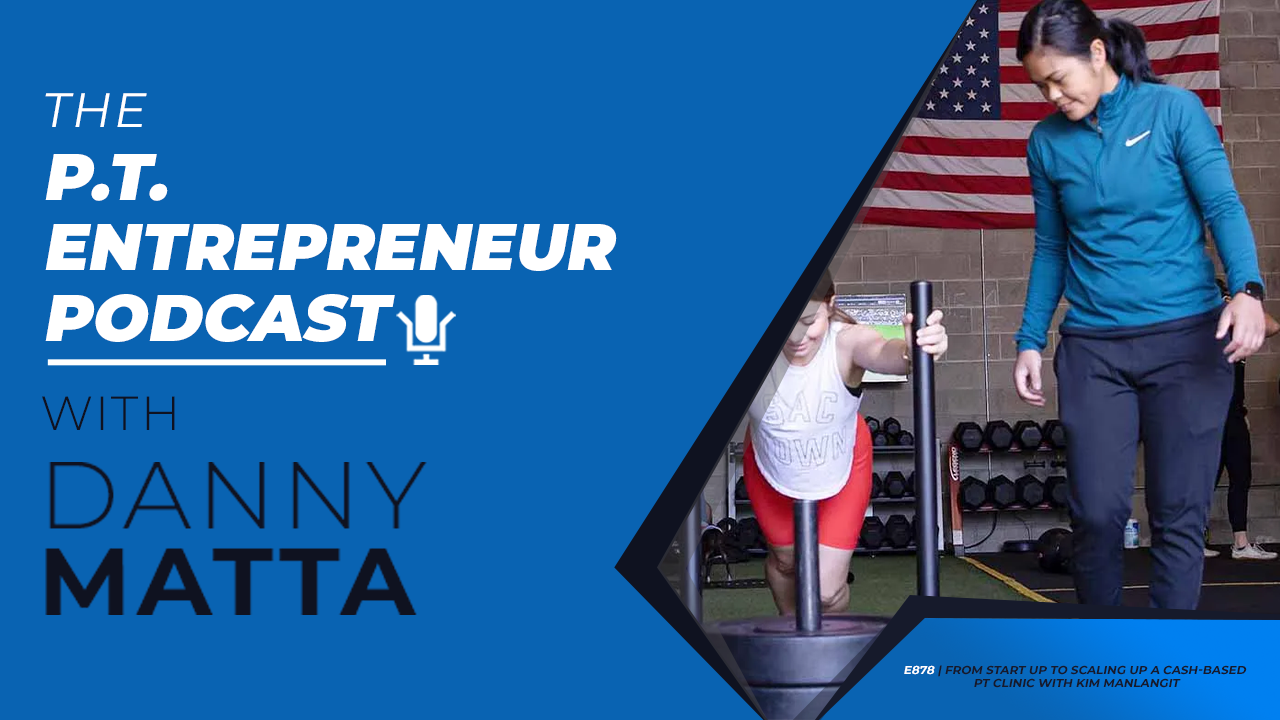
From Self-Doubt to Momentum: How Kim Took Her Practice From Rainmaker to Mastermind
Every cash practice owner remembers the early stage.
You’re excited.
You’re scared.
You’re grinding after work, taking patients on weekends, and trying to convince yourself you’re not crazy for believing this could actually work.
That’s where Kim started.
In this episode, Danny shares a conversation between Coach Michael and Kim inside the Rainmaker program. It’s raw, it’s honest, and it’s exactly what most new clinic owners need to hear.
Kim began just like everyone else—balancing a full-time job, fighting imposter syndrome, and wondering if she could ever get enough volume to go all in. What changed everything for her wasn’t luck or a special niche. It was consistency. Clear steps. A proven framework. And the confidence that comes from watching other clinicians just a little further ahead in the process.
Rainmaker helped her build that first stage of momentum.
Mastermind is where she’s now learning to scale.
What makes her story powerful is how relatable it is. She didn’t start with perfect branding, a big following, or a fancy space. She just decided she wasn’t going to settle, and she followed the plan.
If you’re early in your practice and feel like you're constantly questioning yourself, this episode delivers a dose of perspective. The doubt is normal. The slow start is normal. The fear is normal. But so is the progress when you stick with it and do the right things in the right order.
Kim did it.
So can you.
If you want to see what your own next step might look like, you can chat with a PT Biz senior advisor here:
https://vip.physicaltherapybiz.com/discovery-call
Do you enjoy the podcast? If so, leave us a 5-star review on iTunes and tell a friend to do the same!
Ready to elevate your practice? Book a call at the link below with one of our expert consultants today and start your journey to delivering unparalleled physical therapy.

Podcast Transcript
Danny: [00:00:00] Hey, what's going on that Danny, here at the PTN Store podcast, and today we have a special [00:00:05] podcast for you. This is a conversation in our Rainmaker program with [00:00:10] one of our amazing coaches, Michael and one of our amazing alumni, Kim. Now [00:00:15] Kim came through the Rainmaker program and is now working with us in [00:00:20] the, uh, mastermind, uh, program, scaling her business.
And it's cool to be able to hear, [00:00:25] uh, the journey, right? To, to hear how people got [00:00:30] started, the things that were challenges along the way, and then where they are now. And, and this is [00:00:35] something that, that we do on an ongoing basis within that Rainmaker program. And a lot of it is so people [00:00:40] that are just getting started, which is what that program is for, you know, people that are really just looking to start and get to a point where they can [00:00:45] go all in on their practice.
Um, you know, for a lot of them it's the [00:00:50] hardest stage from a mindset standpoint. You don't know if you're gonna be able to do it. [00:00:55] There's a lot of self-doubt, there's a lot of imposter syndrome. And to be able to, [00:01:00] um, you know, hear somebody describe the things that they went through that are so similar to what you're going through [00:01:05] and recently, so right.
Be able to overcome those and move on to the next [00:01:10] stages of her business. It's just, it's really a, uh, important thing to hear and it's very [00:01:15] motivating. So, um, we wanna share this with the community as well, so you can hear, you know, [00:01:20] Kim's story. You can hear Michael, who, uh, you know, is just a fantastic coach, be able to have a great conversation with her [00:01:25] about what that looks like and what she's doing now.
So I hope you enjoy, uh, I wanna give you a little bit of context for the, for what this is. [00:01:30] And, uh, as always, thanks so much for listening and we'll catch on the next one.
Michael: Hey, thanks so much for doing this. This is [00:01:35] gonna be, this is gonna be fun today.
Kim: No, I'm ex I'm excited. Yeah, this [00:01:40] is, uh, I'm on Pacific time, so it's right at lunch, lunch hour, so it's good for me.[00:01:45]
Michael: Oh, perfect. I, I forgot, which city are you up in? You're in, uh, Pacific Northwest. Right. [00:01:50]
Kim: No, I'm in, uh, in California. I'm in Sacramento.
Michael: Sacramento. Sorry Kim.
Kim: [00:01:55] Yeah, no worries.
Michael: What you do over the weekend? Anything fun? [00:02:00]
Kim: Yeah, actually we had a big party in our clinic 'cause we had the California [00:02:05] International Marathon and it's runs from sa, it's in Sacramento.
Um, [00:02:10] so it's in a town in Folsom. They go down to downtown Sacramento and they passed the [00:02:15] clinic along the way. So we had a big, we had a viewing party.
Michael: Oh, that's cool. [00:02:20]
Kim: Yeah, it was great.
Michael: Yeah. Well, if you're okay, what we'll do [00:02:25] is, um, this is gonna be recorded, so just for the sake of time, [00:02:30] normally we would just kinda like BS and chit chat a little bit.
But if you're Okay, Kim, [00:02:35] I'm just gonna just give you a brief introduction and then I'll let you roll with a few questions. You were able to, [00:02:40] to access those, uh, questions that we had earlier, right? Uh, through that email. Yeah. [00:02:45]
Kim: Yep.
Michael: Cool. Well, um, welcome everybody to [00:02:50] the Tuesday call. Today we're gonna be doing something a little bit different.
So each month we're gonna be [00:02:55] highlighting a Rainmaker alumni who has since gone from the rainmaker and [00:03:00] ascended into our mastermind program. So today I'm joined with Kim, who, as [00:03:05] I erroneously pointed out, she's in Sacramento. Uh, Kim's got a really cool [00:03:10] team of other PTs with her. Um, I'm not gonna seal her thunder too much, but, [00:03:15] um, we'll, welcome Kim.
And then, um, Kim, if you wouldn't mind, just give us a little bit of [00:03:20] some background about yourself, how long you've been a pt, um, maybe any [00:03:25] early jobs you took before starting your own practice. Just give us a little Yeah. Little background of who [00:03:30] you are.
Kim: Yeah. Well, thank you guys for having me. Um, like Mike Michael said, I, [00:03:35] I'm Kim, um, and I own Laco PT and performance.
Um, so I always have to [00:03:40] preface what Lacoss is. LaCosse means strength in Filipino, I'm [00:03:45] Filipino. I chose a word that I, I didn't think anyone would ever take as far as a PT [00:03:50] goes. So from a branding standpoint, I'd say we did, we did great on that. [00:03:55] Um, but before Laco, uh, you know, I start, I graduated PT school in [00:04:00] 2019.
Um, so I started really in 2020, uh, treating. Uh, and [00:04:05] I worked at a sports kind of outpatient, you know, clinic. [00:04:10] I wouldn't call it a meal. It was actually a really sweet gig. Um, so I worked at, [00:04:15] um, like a one-on-one setting our eval, 30 minute follow ups. Um, [00:04:20] worked there for about two years and I really tried to find the best clinic in my area.[00:04:25]
Um. And from an in, in-network practice standpoint, I th I [00:04:30] thought that was the best that I could do, and it, it was for two years. Um, [00:04:35] but I'm very, the reason why I became a PT to begin with is I, I had two torn acls [00:04:40] in high school, so I'm very familiar with ACL rehab, played through college, um, played [00:04:45] college basketball, and, you know, and I just know all the like, [00:04:50] kind of breakthroughs and, and just like the mental mindset too of ACL rehab, [00:04:55] um, going through my injury.
So I felt like with my in-network job [00:05:00] at the time, like, you know, anyone and everyone can walk through the door, but I, [00:05:05] like, I, I couldn't pour into my ACL rehab folks, especially in that like, [00:05:10] return to sport, middle to late phase of rehab. Um, I was definitely pushing that [00:05:15] clinic to like. Get all the tools available, get a a force plate, [00:05:20] get a dynamometer, and it just kinda, again, it's a local clinic, but it was [00:05:25] big enough to where there was more like down the line to be able to make those changes in, in, in, in [00:05:30] house, in the clinic.
So, um, so that was a little bit of frustrating. Um, [00:05:35] but it wasn't really until I actually got COVID, like early [00:05:40] 22 where I couldn't work for a week. 'cause obviously, um, [00:05:45] and I had time to think, and I'm sure that's a, I'm sure that's a common story [00:05:50] with a lot of people is like, okay, during that time, during the pandemic, you have more time to think [00:05:55] what kind of like clinician do you wanna be?
How do you wanna work? How do you wanna work? Who's the [00:06:00] population you wanna work at, uh, with? And that's really where I, the ball started [00:06:05] rolling. I think that's when I took a call with John Lata at PT Bz, um, for the [00:06:10] Rainmaker I think was like. I, I didn't even start the practice. I didn't have a name yet.
[00:06:15] And, and I just kind of was like, Hey, I, I have an idea. I think I can, [00:06:20] and then that spurred this all on. Um, so yeah, it's a little bit of background on [00:06:25] before the practice. That's awesome. Yeah.
Michael: So how, so, uh, two questions. One, how [00:06:30] many years had you been working as a PT then before you decided to open up, [00:06:35] uh, your practice?
How, how, how many years was that? Was that four for you?
Kim: No, it [00:06:40] was like, I was relatively new still, so I was like two years under my belt, so I was like probably Wow. [00:06:45] Heading into my third year. Yeah. So I graduated end of 19, treated [00:06:50] February, 2020 March hit. We all know what happened and then I think it started my [00:06:55] practice March 22, so it was like two years.
Michael: That's crazy. [00:07:00] That's, that's awesome. I mean, it's, it's good. And then tell us a little bit about, um, so when you joined [00:07:05] the Rain, the Rainmaker has program has gone through several iterations and [00:07:10] evolutions. So like, Jackson and I were both rainmakers way back when in like late [00:07:15] 2020, uh, together. Mm-hmm. And back then we didn't have [00:07:20] one-on-one coaching calls.
There were two group calls. There was, uh, somebody [00:07:25] was doing one Monday evening, and then Danny was doing one Thursday afternoon. What was the [00:07:30] rainmaker set up like? Um, at that point did you have one-on-one calls? [00:07:35]
Kim: Yeah. Um, I remember one-on-one calls with Courtney, I, I believe at the [00:07:40] time. Um, okay. And then I had, I had another coach, I think it was, I wanna say Liz, [00:07:45] um, or Elizabeth.
Um, yeah,
Michael: yeah, yeah.
Kim: So I [00:07:50] think that was the extent of it. Yeah. And then we had some, like maybe at some [00:07:55] point we were in a group. I believe, or maybe I'm mixing up Mastermind, but, but we were, I [00:08:00] felt like there was some sort of group as well. Um, but yeah, I, uh, or maybe that was [00:08:05] just me hopping into a call similar to this, uh, it seems like that such a long time [00:08:10] ago, even though it's only been, it's been three years, I guess.
But, but I do remember some one-on-one calls [00:08:15] for sure. Okay,
Michael: perfect. How did you even find out about PT Biz? So like, you have [00:08:20] this idea during COVID that you wanna Yeah. You know, you think about splintering off and doing your own [00:08:25] thing. How did you even come about? Was it podcasts? Was it one of the like Instagram [00:08:30] ads?
Like, how'd you even get hooked up with PT biz?
Kim: Oh, man. So during my, like last [00:08:35] clinical, I remember, um, buying Danny's book, you know, [00:08:40] fucking Jordan's book. Yeah. So that was like probably sitting on my [00:08:45] like. To read or, you know, in my, on my bookshelf for a while,
Michael: you have the paper [00:08:50] copy of the digital one.
Kim: I had the paper copy.
Yeah, I had the paper copy. Um, so I was just [00:08:55] sitting there collecting that. So I, like, I would say, you know, it was always an idea. I was like, [00:09:00] okay, maybe in five years out I'll go start something, or 10 years out. I, I didn't know [00:09:05] it would be as early as two to be honest with you. But it was there. And then I think [00:09:10] as I started to really, and then I, and then I started listening to the podcast, right?
And then [00:09:15] that got the ball rolling even more. Um, so, you know, I, I think [00:09:20] I met Danny that 22 fall like mastermind because I went right in from clinical [00:09:25] Rainmaker into the Mastermind. So I met him that year and I, I was like, fangirling. I was like, I feel like I know [00:09:30] you for a while. But, um, but for the most part it was a slow burn for me.
Like, [00:09:35] I was like, okay, I might read this book, I might listen to this podcast, and then all of a sudden [00:09:40] I was like, okay, I think I'm in the thick of things now, you know?
Michael: Yeah, for sure. [00:09:45] I think, I think a lot of us kinda have this, like, this moment where it's like a tipping point. We're like, all right, [00:09:50] now's the time to make the, like, let's just do it.
Like no more tiptoeing dancing around it. Like, [00:09:55] we're either gonna do this, you know, we're gonna shit or get off the toilet kind of deal. Right. So you finally, [00:10:00] finally hopped in, so that's great. So then, um, you joined the Rainmaker program, [00:10:05] you get hooked up with John and then Courtney and uh, Elizabeth Rudd.
Um, tell us a little [00:10:10] bit like when you started out early in your practice, like what were your initial goals that you [00:10:15] even wanted to accomplish while you were in the Rainmaker? Like, you know, we always go through our one-on-one [00:10:20] calls as what do you wanna accomplish in six months with us? Like what were some of your initial [00:10:25] things that you wanted to do within that kind of startup phase?
Kim: Yeah. [00:10:30] Honestly, it was first to just replace my income, which I think most people [00:10:35] have as a first goal is like, Hey, can I, this is kind of the bar, [00:10:40] can I just meet this bar? Um. I don't even know if I was looking to [00:10:45] hire even the first year, to be honest. Like, I was just like [00:10:50] trying to just float on by make sure that like, you know, um, [00:10:55] it, I think looking back, I wish I had more clarity at starting, [00:11:00] but you don't know what you don't know at the time.
Right? Like, I was just like, let me replace my income, let me see the people I wanna [00:11:05] see. Um, can I get cheap rent somewhere, you know, um, what [00:11:10] workshops do I need to run that weekend? Um, so just putting one foot in front of the other [00:11:15] until momentum builds up. Right? And we can talk about more on that. Um, yeah, [00:11:20] so, so yeah, that was like priority number one is just like, replace my income.
Michael: Yeah. I [00:11:25] think that's a really common goal, right? Because I think people are afraid. You know, they want this proof of concept [00:11:30] and brand awareness, et cetera. Right? But at the end of the day, it comes down to dollars and cents, right? Like, you're not making [00:11:35] money, you can't support your own practice. So just to have the ability to either [00:11:40] replace it or come really close to that.
Um, did you feel like you were pretty well [00:11:45] paid and well taken care of at the job that you'd left prior to starting it? Or do you feel like you were, [00:11:50] you know, we talk about like solopreneur sometimes we don't have health insurance or [00:11:55] 401k and some of those other benefits. Like, how'd that sit with you?
Kim: Yeah, I You like in [00:12:00] that first year of starting?
Michael: Yeah. Yeah, yeah.
Kim: I, so, and [00:12:05] that's where there's some things that helped along the way. Like I was, um, I got [00:12:10] engaged around the month, the same month I started my practice. We got married a month and a half [00:12:15] or a year and a half later. Um, so like. [00:12:20] Yeah, there was a period there where I think my wife and I, like we, you know, we've been married for a couple years, but I [00:12:25] think we were domestic partners at the time to just get into her health insurance.
So there were [00:12:30] things that helped on that end. Um, as far as like, [00:12:35] and I think I still, some, it's still an ongoing, I wouldn't call it struggle, but an [00:12:40] ongoing conversation in my head of like, investing in the business versus investing as far as [00:12:45] investment goes. Right? Like kind of the more like Roth IRA, the more [00:12:50] traditional route versus like, investing into your business of hiring and keeping dollars [00:12:55] in the business.
So, um, I still toggle with that too, but that was definitely like a, oh, [00:13:00] I'm playing, you know, I remember like year one, year two, I was like, oh, I'm playing a different game than like [00:13:05] my, my friends who are nurses and dieticians and get w [00:13:10] twos and salaries. And it's, it's a different way to think about it.
Yeah, [00:13:15] it's,
Michael: it's hard. 'cause if you're used to like, you know, you're probably salaried, right? So you're like, okay, cool. Every [00:13:20] two weeks, twice a month, whatever. Right. I'm gonna get paid X amount of money. Yeah. And it's like, it's, it's a [00:13:25] little bit of a struggle at first to, to say like, Hey, I don't know what my next paycheck [00:13:30] is gonna look like when it comes.
It could be higher, it could be lower, it could be whatever. Right. Yeah. How did [00:13:35] you, um, if you don't mind me asking, Kim, how did you feel like your money mindset [00:13:40] was around all of that? Like with some of the financial undulations that take place in the beginning? [00:13:45]
Kim: For sure. Um. It was tough. Like, you know, I had to [00:13:50] have conversations with my significant other of like, Hey, this is about as much as I can take to help with [00:13:55] rent.
Or this is like minimum and, you know, maybe, or there's a growth cycle [00:14:00] coming up. Like, hey, like as I got to know, I'll, I'll speak more on the first space I was [00:14:05] in. I just knew I couldn't be there longer than a year because there was like no air conditioning. It [00:14:10] was the heat of Sacramento. I was up in a loft somewhere.
It was like dirt cheap rent. But [00:14:15] like there were times where I could, I had to stop trading at 11 o'clock summertime because it was [00:14:20] just way too hot the rest of the day. So knowing that, I was like, okay, I need to find another space and [00:14:25] I know rent's gonna increase. Like I need to save money for that.
Like that sort of stuff. Um, [00:14:30] but yeah, from a personal to like business standpoint, you know, it is the same as it is [00:14:35] now. Like I still have growth phases now where like. Hey, can you toggle back on your [00:14:40] personal to reinvest in the business as, as best as you can? You know, like what's the [00:14:45] minimum amount you can pay yourself, but, but still, like, you know, [00:14:50] hopefully not diminish your lifestyle so much.
Um, maybe for a short window you, you [00:14:55] have to, but like to where, okay, you feel more of a buffer to grow the [00:15:00] business. Um, so I think that's where, you know, people can get [00:15:05] stuck is like, they don't know that balance and it's like they're taking as much [00:15:10] to fund personal, you know, the personal side of things.
And then the business stays [00:15:15] stagnant, in my opinion.
Michael: Opinion. Yeah. I agree with that. I think it, it is a, it's a [00:15:20] tough balance too. I think a lot of people just, they just, it's all about finding that balance and it [00:15:25] takes a hot minute, right? Like your first year in practice, you may not even find that balance [00:15:30] unless, right, you're tracking KPIs.
So we always. You guys for, for doing that. This is [00:15:35] why it's so important to find some of these trends. So tell us a little bit about that space, Kim. 'cause [00:15:40] that space sounds pretty gnarly for, uh, for, you know, Satan's uh, [00:15:45] summer up there. So was this a CrossFit gym, or what kind of gym was this that you got hooked up [00:15:50] with?
Kim: Yeah, it was so funny. It was literally like, it, it was not a CrossFit gym. [00:15:55] It's kind of like a mix of other trainers in this space. So it's almost like [00:16:00] every, there was a trainer and their client trainer and their client. So, um, it wouldn't, [00:16:05] it wasn't CrossFit. It was more, I guess, a studio than anything else I'd call it.
But I was, [00:16:10] it was two stories. I was on a, the loft to be, to be honest with [00:16:15] you. There were stairs to find me upstairs and no ac. Um, like [00:16:20] I said, um, and it was, uh, good for what it was like, it was, I [00:16:25] think I was paying $250 a month, like stupid cheap. Um, I, [00:16:30] I think I found them 'cause I was. Just on Instagram and I was DM DMing, like [00:16:35] gyms at the time, and they're one of the first few that responded and got to meet the guy and he seemed really [00:16:40] cool.
And, you know, and, and that was a good start, but I knew, I'll [00:16:45] tell you one story, like around that winter time, it would start raining in Sacramento and I [00:16:50] would start to see like a one drip of like, I had to have a pale in the middle, [00:16:55] like, like, and I'd have to apologize to patients and like, uh, [00:17:00] yeah, sorry about that.
Like, um, trying to get the roof fixed and it wasn't gonna be fixed [00:17:05] 'cause like, you know, wasn't the owner or anything. So I just knew, I was like, okay, I have a [00:17:10] deadline. Within summer of 23 or I think, yeah, 23 at the time, I have [00:17:15] to find another space. Um, and I, luckily I did, it [00:17:20] was another sublease where I was able to grow a little bit past myself [00:17:25] and I was able to hire like a PT next to me in a sublease space.
Um, [00:17:30] so that helped propel more momentum our way as far as growth goes. [00:17:35]
Michael: Gotcha. Gotcha. That's perfect. I want to touch on that in a minute though, Kim, but, [00:17:40] um, tell us a little bit more. So we got a, we got this kinda loft sublease, [00:17:45] um, and then how did you even come by the first few patients to even get into your practice?
[00:17:50] Like, were they some of the patients that followed you from your former job? Yeah. Tell us a little bit [00:17:55] about like what the first like maybe month or two of new patient acquisition was like for you. [00:18:00]
Kim: Yeah. Yeah. So, um, you know, I wrapped up my last job, you know, [00:18:05] and there were people that found me there that was like, Hey, you know, um, I'd [00:18:10] love to see you.
I'd love to still work with you. Um, so there was a couple, um, I did [00:18:15] Luna, uh, so there, you know, the kind of like concierge kind of that [00:18:20] sort of stuff to help float by. Um, but it really was a lot [00:18:25] of, there's a few clients that really spread the word of mouth for [00:18:30] me, like generate leads for me. So one was like a director of, [00:18:35] um, a would say director of training for Fleet Feet Sacramento and Fleet Feet [00:18:40] is all over the country, but the first Fleet feet started in Sacramento.
So we have a [00:18:45] huge following in that store and like run clubs and training programs through that [00:18:50] store. Um, and. He was, he was my patient. He was just like, love what you [00:18:55] do. Like, I'd love to get you to do, like, come do a warmup with one of [00:19:00] our training programs. Um, so, and I did like webinars leading up to like, [00:19:05] uh, a marathon or a half marathon.
You know, we do like virtual workshops [00:19:10] if you will. Um, 'cause it was still kind of in the height of, you know, the panda or COVID I [00:19:15] guess like towards the tail end. And, um, and yeah, that was just awesome momentum. [00:19:20] So I, I would say I was deep in ACL rehab. Knew, knew that I wanted to work with that [00:19:25] runners. It was like, I've done a couple half marathons, but I wouldn't say I was like an [00:19:30] avid runner, but with those population I had to like, oh gosh, I gotta up my [00:19:35] game to be able to serve this population.
There's like the ultra marathon, the marathoners, you know, a [00:19:40] hundred K club. Like yeah. So to be able to get talk their language [00:19:45] was, uh, an adjustment for me. But that all honestly like helped. Open the floodgates a [00:19:50] little bit with a new niche that I didn't see coming, to be honest.
Michael: That's cool. [00:19:55] 'cause sometimes it just takes the right patient, the right person, and then all of a sudden it's like they become this [00:20:00] catalyst and before you know it, you're like, oh, cool, I thought I was gonna be ACL.
And then now [00:20:05] all now I'm like, you know, knee deep in, in running and talking about how to modify your [00:20:10] training for an ultra marathon. Like who would've thought, right. So, and I think too, you [00:20:15] know, as the business matures, the more people that you get through word of mouth, the better your business is [00:20:20] doing.
Right. Because then it doesn't feel like you have to like. Do as much gorilla grassroots [00:20:25] marketing and at that point just kind of now you, you have a good product, you have a good [00:20:30] service and people know about you. And that I think is a testament to kind of like that, [00:20:35] that sophomore stage of your business.
So That's great. How, um, so [00:20:40] you were doing these webinars. Did you get a lot of traction from, from the webinars during that [00:20:45] time? Was that kind of like the only option or was that just the option that you went with? Tell us a little bit [00:20:50] about that.
Kim: I mean, I, you know, it was, it was some in-person workshops.
I wouldn't say it was all [00:20:55] webinars. There was a couple webinars, some, uh, in-person workshops I did, I did the [00:21:00] injury screens as well, I think, um, maybe more in the sophomore year of [00:21:05] business, um, in store. So, um, and then, you know, [00:21:10] outside of the running community, like I would talk to, um, like soccer [00:21:15] clubs, um, I still was trying to like find the ACL niche within my, [00:21:20] my new practice.
Um, and that kind of, that came naturally as [00:21:25] well where like, okay, it took 1, 2, 3, couple soccer, uh, patients [00:21:30] and, you know, the soccer community is huge and, uh, you know, [00:21:35] sadly the ACL, the recurrence rate is just so high with those athletes that, um, [00:21:40] they would refer like a teammate or they know somebody that knows somebody.
Um, so that kind of [00:21:45] came in as a secondary, uh, niche for me.
Michael: Cool. That's awesome. [00:21:50] Yeah.
Kim: Yeah.
Michael: What do, well, now that we talked a little bit about like, some successes, what do you [00:21:55] feel like in the beginning, um, you know, we'll say like the first three to four months of your practice, [00:22:00] Kim, what do you feel like were, were the biggest challenges to really kind of get the ball rolling, to [00:22:05] really gain some of that traction?
Like, what do you feel like was, were some, a couple snag or sticking [00:22:10] points?
Kim: Yeah, for sure. Um, you know, I, I think as I, like, [00:22:15] started to figure out, okay, like I'm, I'm seeing people, which is great. Um, but [00:22:20] I started to think about a team, right? Like, okay, what would that look like? What, like, what is an admin?[00:22:25]
Like, what, how are they gonna help me here? Or, um, you know, [00:22:30] so I, I did, one of my very first hires was like a, like a friend. [00:22:35] He was actually like an aide at my last job. Um, but. And we [00:22:40] ended up becoming like he, when I say an aide, even though he's an aide, he was like close in age as me. [00:22:45] So, um, you know, I, we got lunch one day and I was just like, look, this is about how much [00:22:50] I can pay for an, for an admin.
Can you help me in this aspect? Um, and I [00:22:55] just remember margins were still thin, right? Like, um, even though I had cheap [00:23:00] rent and I was paying myself minimally, like even just creating a job description for [00:23:05] somebody and the word systems was not in my vocabulary yet. So [00:23:10] like, leading somebody trying to lead somebody or create a culture [00:23:15] when you are also just like threading water as a business owner [00:23:20] was, um, one of the challenges was like, you know, and luck.
You know, luckily, [00:23:25] luckily for me and him, we're still friends and you know. He, he sends people our [00:23:30] way, but I, uh, I, I'm almost like, I don't even know the last six months of, or [00:23:35] the first six months of working with him, like what I told him to do. I think we filmed a YouTube exercise [00:23:40] library and maybe he helped, um, you know, some social media [00:23:45] stuff, but it's like, I didn't know what, I didn't know on as far as like bringing on a [00:23:50] staff member and what that, that entailed.
Michael: When did you hire him? Was because he was your first [00:23:55] hire, right?
Kim: Yeah. Yeah. I would say probably the tail end of 22. [00:24:00] Like maybe I was like maybe four or five, maybe closer to six months [00:24:05] into the practice where I like just additional help kind of deal.
Michael: [00:24:10] Sure. What was, so obviously it was a little bit of a.
We'll call it a [00:24:15] lean contract. Like what did you end up like, what, what was that setup like? Because we get some questions from [00:24:20] time to time and, and even in the rainmaker about like, Hey, I know that my first hire is typically an [00:24:25] admin. Do I pay them minimum wage? Like what do I have them do? Like, can you tell us a little [00:24:30] bit about what that was like from, uh, and then we'll get into the leadership side?
Kim: [00:24:35] Yeah. Um, yeah, I, if it wasn't minimum wage, it was slightly above, I think is what [00:24:40] I was paying him. You know, like, it wasn't like, uh, a lot of money. [00:24:45] Um, I think I tried to, he also was interested in like personal training. [00:24:50] So we tried to do like, okay, I'm a pt, you know, and like if there's no one [00:24:55] that's, if someone that comes through our funnel of like leads, I guess, and who's maybe looking [00:25:00] for just some sort of personal training where they're not really injured.
We tried that [00:25:05] aspect. And I try to pay him maybe slightly more than that, you know, and, but. You know, [00:25:10] I, in my practice right now, that's not our model. We don't have personal trainers, you know, so it was [00:25:15] a lot of doing and trying and I'm like, yeah, that, that didn't stick with [00:25:20] me. 'cause it was confusing from a marketing and also messaging standpoint, like, what's PT versus [00:25:25] personal training?
Who do I see? Um, so I kind of like stretched that [00:25:30] quite early. Um, but yeah, he kind of just helped me on the backend side of things. Mostly [00:25:35] social media. Like we have, we still have the same videos. He's on 'em on, if you look up our, [00:25:40] our exercise library, you guys will see the trajectory of our clinics is like our [00:25:45] very first one.
It's like dark and gloomy. Our second one's like bright and there's like red, which is not our [00:25:50] color. And now you'll see like our clinic right now with our brand colors. So [00:25:55] it's, it's quite interesting.
Michael: Oh, God. It's so funny when you look back at like [00:26:00] early social media, early YouTube, like obviously you want it to look better and [00:26:05] different, but sometimes you get like, like Instagram will send you one of those like, Hey, you remember this, uh, really [00:26:10] lame reel that you put out?
I'm like, oh my God. Like no beard skinny. [00:26:15] Like dude wasn't doing anything. And it's just like you just talking and it's like, what are you [00:26:20] even saying? It's so bad. Like it's terrible.
Kim: Oh my God, how many, like, I [00:26:25] feel like I've renamed Art LaCosse PT into different things. Like, this was a [00:26:30] Instagram that I had as a student, so it was renamed something else.
And I've archived so [00:26:35] many, you know, posts that no one will ever see again, but. You know, it, it's all the [00:26:40] breadcrumbs though, leading to where we are now, so. Exactly.
Michael: So I take it, are you, are you [00:26:45] a big social, like obviously we have to do it social media for our practice? Yeah. Before, [00:26:50] you know, Rainmaker and starting your practice, were you big into social media yourself?
Or [00:26:55] how do you feel about social media? Because it's always such a, it's kind of polarizing, you know? [00:27:00]
Kim: Yeah. You know, as a consumer of it, I mean, I like it to be honest with [00:27:05] you. Like I, if you, if I'm tired from a workday, I could, I could [00:27:10] scroll and, you know, I'm not, I'm not bad at scrolling. I'm pretty decent at [00:27:15] it, so I like it from that aspect.
But when you, when you think about it from a business [00:27:20] lens, it's like, oh, I have to do it. And that's where I didn't like it as much. It's like. [00:27:25] Yes, I will. I, you know, uh, I'll have some sort of momentum or I'll have some [00:27:30] sort of, um, idea and I wanna like act on it. But then there's no like [00:27:35] system in place to be like, okay, I'm posting Monday, Wednesday, Friday, [00:27:40] so and so, and so the minute that became more of like a task in like, because of the [00:27:45] business that that's where it was like, oh God, I need to hire somebody to help me with this, to just [00:27:50] get me concentrated.
Michael: Oh yeah. Well it's like you take [00:27:55] something that's kind of fun and you're kind of interested in it and then now you have to like systematize it, make it [00:28:00] look pretty catchy. 'cause God forbid it's longer than. 80 seconds and a [00:28:05] DD people scroll away. Right. It's just, it's a whole to do. It's so, you know, you [00:28:10] talk to like Brooke Miller, who's one of our coaches in our mastermind program, you know, she hates social [00:28:15] media and she's like, I don't think that PT should be doing social media.
They should be treating patients. Right. And [00:28:20] I mean, I get her point, but at the same time it's like, I don't know, it's such a necessary evil. Yeah. [00:28:25] Because we do not have a, like, not have a social media page. Somebody's gonna look you up, be like, that's [00:28:30] weird. They have like three posts and one of them is gritty and gloomy.
It's like it, I [00:28:35] don't know, like we just have to do it. But
Kim: yeah.
Michael: Um. Tell us a little. [00:28:40] Okay. Yeah.
Kim: One last thing on the social media side, like that, it took a while for me to [00:28:45] even, like, currently with our practice now to, to offload that to someone else, to help [00:28:50] someone like spearhead that. I think I was holding onto that even too long 'cause I felt [00:28:55] like, oh, I needed the right messaging there and, you know, and it needs to look our brand and [00:29:00] it, it needs, if it's ACL stuff, it needs to be evidence-based, you know, that sort of [00:29:05] stuff.
So it took a while for me to like, to peel that out of off my hands. [00:29:10] 'cause I do like it, but not enough to be like consistent with it, I guess.
Michael: So how [00:29:15] do you set it up now? So you, you offload it to your current admin, right? [00:29:20]
Kim: So we have a third party vendor who's like, um, like she does mar [00:29:25] marketing for businesses local to Sacramento.
So she's awesome. She, we do like a [00:29:30] once a month like kind of, um, film session with our PTs and we [00:29:35] get it done in like an hour, two hours, and it's good for two months where she's just like, [00:29:40] you know, able to like, give us a, not a script, but kind of like ideas of [00:29:45] what to talk about. And then, you know, we're just talking in front of the camera or doing some sort of [00:29:50] exercise, um, de demo.
And, uh, it, it's worked out really well. We've had her for [00:29:55] only a few months and I love it.
Michael: Yeah. Oh wow. This is a recent thing then. Cool.
Kim: Oh yeah, [00:30:00] for sure.
Michael: Do you mind telling us, uh, cost-wise, because obviously [00:30:05] everybody probably perked up and they're like, oh, cool, I can just outsource it to somebody and pay them.
Yeah. What's that? [00:30:10] What's the investment look like from a business perspective?
Kim: Yeah, I, so I wanna [00:30:15] say it's like. 2, 200, 2 20 a a week. [00:30:20] So it's like if you do a four times four, it's like around 800. And if it's a five week, [00:30:25] um, you know, five week, month if you will, it, it's closer to like [00:30:30] 1100. So 800 to 1100 is what I pay.
It's not bad. Yeah. Yeah. It's
Michael: really [00:30:35] not terrible for some of the companies that I looked into in the past. So one guy wanted like [00:30:40] $2,500 a month and like a retainer, uh, upfront as well. It was ridiculous. [00:30:45] So, but that's, that's a good deal. Um, cool. So [00:30:50] Kim, tell us a little bit, um, let's go, let's circle back to baby Rainmaker [00:30:55] stage.
Like how, um, how do you feel? Like what was what. [00:31:00] Big leap in success for, so like when you really started to [00:31:05] hit your stride, was it the fleet feet? Was it something else? Like when do you really feel like [00:31:10] you're like, okay, cool, now I can, I can make it, I feel like I can [00:31:15] really pull this thing off and I can really make this my full-time gig.
Give up Luna [00:31:20] and just really invest in this. What was that turning point like for you?
Kim: Uh, [00:31:25] that's a good, good question. Um, I think it was, I, I [00:31:30] went all in pretty quickly, to be honest with you. Like I said, from a personal standpoint, I was [00:31:35] able to offload the, um, like my wife was, was able to help [00:31:40] on the, carry us a little bit on the personal side in the first few months.
[00:31:45] Um, but as far as like momentum and how [00:31:50] long it took, it WI would say within four or five months, I was like, [00:31:55] okay, I think this can be my full-time thing. Um. Completely without Luna [00:32:00] and everything else. Um, and yeah, I think the biggest thing is like knowing [00:32:05] your avatar and I, I had two of 'em, right? Like I said, one fell on my lap.
[00:32:10] One, I was actively seeking out and wanting to treat acls. But like even [00:32:15] in those earth, early social media posts, like I was talking to ACL [00:32:20] clients, I was talking to runners and I put the messaging to where, okay, it's [00:32:25] gotta be one of those two people that are seeing this. Um, and that [00:32:30] helped a lot. 'cause there's so much noise as you guys know, on like the internet and even in your [00:32:35] local town or local cities, like how many PT clinics are there.
But how can you [00:32:40] differentiate your messaging, you know, to, to that. Person that want you wanna [00:32:45] treat, right? Um, and then you gotta deliver on a great product for sure. So that's the [00:32:50] word of mouth. Um, continuity of things is like, okay, you help so [00:32:55] and so and they're gonna bring their friend and that person's gonna bring their other friend.
And, um, [00:33:00] and, and like knowing that people are gonna talk and they're gonna be within their [00:33:05] same group, kind of throughout the community, like how many run clubs are there at breweries? [00:33:10] Um, you know, or coffee shops. So I think just doing a [00:33:15] stellar job in your day-to-day work as a PT is part of marketing. [00:33:20]
Michael: Oh yeah.
Like the patient, you know how we always talk about the patient experience and the mastermind, [00:33:25] right? It's like now everything revolves around that. That's really, uh, yeah, that, that's a [00:33:30] really good point though, Kim. 'cause you just have to, it's like with that word of mouth, I feel like [00:33:35] once you start to really get that and you don't feel like you have to.
I don't wanna say market [00:33:40] as hard, but you don't have to spend so much time and energy being almost obsessive about [00:33:45] it. You know, you can actually start to feel like, okay, I can kind of actually treat as a [00:33:50] clinician and then take discovery calls and kind of focus a little bit more on [00:33:55] the internal dynamics of the clinic rather than all of these other external forces [00:34:00] of nature that you have to go out and, and kind of, you know, fight against.
Kim: For [00:34:05] sure. Yeah. And, and like, it also doesn't divert your attention so much, right? [00:34:10] Like, I wasn't at CrossFit gyms, like I knew I like, you know, CrossFit [00:34:15] once in a blue moon, but I just wasn't my thing. Um, you know, and I [00:34:20] wasn't at like assisted living facilities or anything like that. Like I wasn't [00:34:25] marketing to everyone and everybody I like knew my okay.
Avatar [00:34:30] of like, it's probably someone in their thirties to fifties. Um, and they're [00:34:35] probably hanging out here. So I think that's the biggest thing when you're a new [00:34:40] business owner is like, your time is already limited. You're the only person, you don't [00:34:45] quite have an admin. How can I really target my messaging, [00:34:50] um, to, to the person I wanna be be in front of?
Michael: Did you [00:34:55] find that, um, when you did market and you started to kind of, especially in the running world, it sounds like you did a lot [00:35:00] more like in-person marketing. Did you find that you were leaning more towards [00:35:05] workshops, towards entry screens? You find yourself doing a pretty even mix of both. Um, [00:35:10] 'cause we have a lot of people that ask us in the rainmaker, like, which marketing avenue is, is best for me?
Right. Yeah. [00:35:15] So what did you find was most successful for your personality and your avatar? [00:35:20]
Kim: Yeah. Um, definitely the workshops, I mean, the injury screens are great, [00:35:25] but, um, I think I, that was more in the later half of things. Um, maybe when I was already in my [00:35:30] second location, I was thinking about in injury screens, but when are we, if we're talking [00:35:35] about the first year, it was definitely like workshops.
I loved educating, I, you know, I was a former, [00:35:40] uh, varsity basketball coach, so just being able to like, I [00:35:45] think that's important too, is like, how can you command a room? How can you like, um, be the [00:35:50] subject matter expert? I would get nervous for sure, but I always try in the back of my head, be like, [00:35:55] okay, I still know this X topic better than anybody else in this room.
How can [00:36:00] I exude confidence? Um, and I think that's the biggest thing about workshops is like, [00:36:05] you know, can you simplify it for the layman person, but also kind of [00:36:10] show your skillset and show your knowledge base on like whatever topic you wanna [00:36:15] talk about. And then giving, giving them a call to action at the end.
Michael: Yeah. [00:36:20] Yeah, that's solid. Um, so let's, let's transition now. So you, you [00:36:25] wrap up the Rainmaker program, um mm-hmm. At that point it was, was it a six month [00:36:30] program? Was there a hard stop at six months or was it three, there was a time that it [00:36:35] were you, were you part of the three month? There was a short phase where it was three months and then they [00:36:40] found that that was short and then we expanded it to six months.
So
Kim: [00:36:45] I wanna say I was just at three. 'cause I started like March, April, may, [00:36:50] June, maybe by July. It was already at Mastermind to be honest. Okay.
Michael: So [00:36:55] what prompted you to then like, uh, go from the rainmaker up to [00:37:00] the Mastermind? Like, how'd you decide that you, it was time to ascend? What made you want to stay within [00:37:05] the pt biz ecosystem in general?
Like, tell us a little bit about what that transition was like. [00:37:10]
Kim: Yeah, I, I, I think the bug of like. You know, as I, [00:37:15] while I was still on, uh, clinical Rainmaker, it wasn't like I stopped listening to Danny's podcast. [00:37:20] You know, I probably, Danny was still in my ear and, uh, was listening to the podcast and [00:37:25] he talk about the hit by the bus test, right?
Of like, if something happened to [00:37:30] you, what would be, what have, what would happen to your business? You know, would it crumble [00:37:35] or like, did you just create a job for yourself versus building a true business? So that [00:37:40] messaging, I think, kind of started coming along and, you know, I had a call or [00:37:45] talk with, maybe it was John again, um, of like, Hey, [00:37:50] think you could be a good fit for the Mastermind.
Um, you know, here's X, Y and ZY [00:37:55] and, you know, I just had this forward momentum. Like, even, [00:38:00] even before signing up for anything with PT Bz, I was thinking to myself like, if I [00:38:05] can have a way where. I can learn from other people's mistakes, I'll do it. [00:38:10] Like I think I'm a great co uh, not coach, but I was a great athlete in that sense, where [00:38:15] like if I had a coach, they'd tell me what's wrong or what not to do.
I'll do it or what to do, I'll do it. [00:38:20] So I, I just took that same mentality. It was like, I'd rather make these mistakes early or not at [00:38:25] all. And if I can learn from other people that can, like, there's no shortcut. It's [00:38:30] still hard for sure, but like the mental, the mental [00:38:35] overload of like the indecisions and whatnot, I wanted to kind of like [00:38:40] not worry about so much.
So I think, so I think the messaging from Danny, but also just the [00:38:45] momentum where I was in business, where I knew I wanted to get out of, you know, my old space into [00:38:50] a new one and eventually hire was definitely something in my radar already.
Michael: Were you, [00:38:55] where were you at revenue per month at that point, if you don't mind me asking?
So were you close to like 10 [00:39:00] K at that, at that, uh, point in time? Yeah.
Kim: I think I hit that 10 K mark [00:39:05] where I'm like, I probably hit like, um, 10 K within the last month, I [00:39:10] would say, of like rainmaker.
Michael: Okay, perfect. That's a, that's a perfect time then [00:39:15] to continue that, that momentum swing. Mm-hmm. Um, so you joined, [00:39:20] you know, you joined the Rainmaker then, um, you hire your first [00:39:25] admin.
Um, how long did they stay with you and did you overlap that with the PT as [00:39:30] well? Um, the tech that you had mentioned earlier?
Kim: Yeah, I, I wanna say [00:39:35] he was probably there for about six months, but no, they did not overlap. [00:39:40] Um, you know, I hired a PT by [00:39:45] July of, I wanna say, or maybe August of 23. Okay. [00:39:50] So I had moved into a new space that my second sublease in May of [00:39:55] 23, and I think I was looking to hire by like that fall.
Michael: [00:40:00] Okay, perfect. How did you, how'd you find your first pt? Did you find them on LinkedIn [00:40:05] or Indeed, or,
Kim: uh, no, she was referred to me by a [00:40:10] PTA that I actually treated as a patient. Oh, that's cool. And she's, um, [00:40:15] I think she was like looking to trans, not transfer, but, um, moved from, [00:40:20] you know, a smaller town to Sacramento, not, not too far away.
Um, and she was [00:40:25] doing a, a long commute at the time, so she's moving to Sacramento and gonna be more local and yeah, [00:40:30] just looking for another, another gig. Yeah.
Michael: That's cool. Yeah. So what's your, [00:40:35] um, before we open it up to, to questions, tell us your two things. [00:40:40] One, tell us your current setup. So what does, what does your practice look like [00:40:45] now in terms of standalone space, uh, team, all of that?[00:40:50]
Mm-hmm.
Kim: So currently we're at about a 1500 square foot. [00:40:55] Gym. Um, so the current setup is I, I still treat, um, I [00:41:00] have two clinicians. I have a full-time PT and I have a part-time pt. [00:41:05] Um, as far as niche goes, like, um, we're still seeing a lot of like [00:41:10] ACL rehab. We're still seeing a lot of runners. Um, one of our, our part-time PT is [00:41:15] really into like the barbell like space, so she does more and she loves working with the, like [00:41:20] chronic low back pain patients.
So she sees more of that. And then our, [00:41:25] um, full-time PT who's more my recent hire actually, um, he, [00:41:30] he sees like more general ortho. Um, he came from, he, he's been a [00:41:35] clinician for about four years before he jumped on our, into it, into the practice. Um, so [00:41:40] he sees more of your general like, um, you know, weekend warrior if you will, [00:41:45] but, um, they're both kind of dabbling into the ACL rehab and we, we all see runners.[00:41:50]
So that's kind of where we're at right now.
Michael: That's awesome, Kim. That's a good team. Yeah, that's a, [00:41:55] I think that's a great size. 'cause you're, are you green or are you black at that point then?
Kim: Um, I'm [00:42:00] green pushing, hopefully black next year. Yeah,
Michael: it sounds like you'd be like upper [00:42:05] tier green and that's probably pretty, pretty solid.
So yeah, for those that aren't [00:42:10] familiar, we have a colored name tags for those of us in the rainmaker. So a green name [00:42:15] tag that, uh, basically it designates your, um, past 12 months worth of [00:42:20] revenue. So green is two 50 to 500 KA year, and then black is 500 to [00:42:25] seven 50. So the setup you have Kim, I That's awesome.
That's a [00:42:30] nice, it's not too many team members to manage either. It's probably very, uh, little bit [00:42:35] simple leadership wise. You're not running around feeling like a chicken with your [00:42:40] head cut off. The last question that I'll ask before I open it up to the group is, [00:42:45] what advice would you like to give the current rainmakers who are listening to this call [00:42:50] now or in the future?
Like what, what advice would you like to leave, leave them with?
Kim: [00:42:55] Ooh, that's a good one. Um, you know, and I, I'm not sure [00:43:00] if this is, was if you guys heard this before, but one of Danny's talks was like, know [00:43:05] what race you're running, right? Like, I think that if even in this [00:43:10] earlier business, if I listened to that talk, we, and this was at a mastermind event, a couple, a [00:43:15] couple more sessions back now.
Um, he talked about like knowing what race you're in, and [00:43:20] we've been talking a lot about runners, right? Which is good segue. Um, so [00:43:25] like, meaning do you wanna just be a solopreneur? Do you want, do you want a [00:43:30] team of, you know, two to three kind of mid, um, small size where I'm at? Or do you wanna grow [00:43:35] this to.
Multiple locations, several clinicians. Um, [00:43:40] I think knowing that in the, like, as best as you can, [00:43:45] um, where you are now helps, helps propel you into whatever action [00:43:50] you're gonna have next month, next quarter, next year. 'cause [00:43:55] you know, if, if I knew that, I just, I would maybe [00:44:00] be more risky if I wanted to do something.
But a lot of that comes to finances as [00:44:05] well. So I think knowing your numbers is super important. And then knowing what race you wanna run, [00:44:10] like it's solely okay to be a solopreneur and just kind of do your thing and have time [00:44:15] flexibility. Um, you know, that first hire is not always the most profitable either.
There's [00:44:20] more work that happens after that first hire. So there's so much like [00:44:25] undulations along the way, but it's, you can get through it if you kind of know what the end goal is. There's [00:44:30] ups and down with, with the business. Yeah.
Michael: Yeah, that's a really good point, Kim. [00:44:35] Yeah. And I think it does. It's like, 'cause then it gives you a, a guide, a path, right?
You don't feel like you're [00:44:40] like, I don't know. 'cause you join the mastermind or even in the rainmaker sometimes you see everybody at these different [00:44:45] levels and different stages, right? And you're like, oh man, am I behind? Am I ahead? Am [00:44:50] I never gonna get this thing off the ground? Right? And it becomes like that thief of [00:44:55] joy from comparison, right?
So, yeah. Cool. Well, Kim, what we're gonna do [00:45:00] next, and for those of you that are, are on the call, we're gonna open it up to any questions that you [00:45:05] all have for Kim. Um, so if you do have a question, just drop question in the [00:45:10] chat. Um, Kim, there was a question from Jeff, uh, uh, a little bit [00:45:15] ago. Um, and he said, he said, you mentioned some key clients that helped spread your business [00:45:20] through word of mouth.
Other than the help you received from those referrals, what [00:45:25] avenue of marketing produced a greatest growth in your, in your sales and for the business? [00:45:30]
Kim: Yeah. Um, a lot of it was like, to be honest, like [00:45:35] gorilla marketing in the first early stages. Like, I don't think I ran ads [00:45:40] until I wa I had a pt, right?
Like, I didn't mess, I didn't miss mess with paid [00:45:45] ads at all. Um, it was a lot of like social media marketing. [00:45:50] Um, it was a lot of local workshops, those injury screens. [00:45:55] Um, you could boost ads if you will. Like, if you don't wanna, like maybe, [00:46:00] um, or I'm sorry, boost Instagram posts, not ads. But if you don't want to dive into like the [00:46:05] meta and the Googles of the world, um, then maybe trying to boost a, a post [00:46:10] that's doing really well, that's another avenue to do.
Um, but, but [00:46:15] honestly, it's, it the, you have to create brand awareness and people have to know who [00:46:20] you are. Like it's hard to do that when. You're just in, in [00:46:25] a clinic by yourself, and maybe you're not going out to, um, A [00:46:30] BNI group, or you're not meeting at a chamber event, or you're not meeting other [00:46:35] business owners, right?
Like people have to kind of know who you are to know who to send you to. [00:46:40] And unless it's changed, Michael, you can tell me, but like, I [00:46:45] feel like in the early stages you have to do that hard work of just getting out there, being in front of [00:46:50] people, um, versus relying on some ad or some, [00:46:55] some vendor that's gonna get you leads, you know?
Oh, a hundred percent.
Michael: Yeah. I, I agree [00:47:00] with that. And, you know, we talk a lot in the rainmaker. We wanna market to where our [00:47:05] avatar congregates like market to that watering hole and Yeah. And nobody knows who you are when you [00:47:10] first start out and you're sitting in the four walls of your office, like you're an unknown entity.
I mean, yeah, you may [00:47:15] have a few people that knew you from the previous job, but not, not enough to really [00:47:20] stand on. So that's a really good point. Um, if you guys have any other [00:47:25] questions, um, just type question in the chat, um, or you can raise [00:47:30] your hand and if you wanna ask Kim in person. [00:47:35] So I wanna, I wanna make sure we have enough time for any questions from the peanut gallery.[00:47:40]
Thank you, Kim, for plugging KPIs. [00:47:45] 'cause I think that's something that we see a lot. Rain the folks in the rainmaker and [00:47:50] even in the Mastermind. It's, it's becoming like out of vogue to track [00:47:55] KPIs. I remember like when I was a rainmaker, it was, it was like, man, you either do this or [00:48:00] you're gonna really, otherwise you're just like, I don't know, what am I doing right?
Like, how many evals? I dunno. [00:48:05]
Kim: Yeah, I mean, it helps so much with decision making and [00:48:10] trends, right? Of like, hey, like, you know. We, we [00:48:15] got, um, number of like evals or, or leads from this person or from [00:48:20] this gym owner. This worked out really well. How can we replicate that? How can we replicate [00:48:25] that? Because it's not just, you know, there's seasonality in some things, but like, how, how much can [00:48:30] you replicate success?
Right? Um, and, and how do you know that when you do have it? [00:48:35] So,
Michael: yeah, for me, I'll, I'll say for me it was, it took the [00:48:40] emotion out of it. 'cause I mean, I'm Italian, so I'm like, oh yeah, cool. Like, we're crushing it [00:48:45] this month. And it's like, are you though, or sometimes it's like you sing the blues, you're like, oh [00:48:50] man, I don't know.
Does it count, seem down? Is this normal for what it's supposed to be like [00:48:55] in December? What was December like last year? Right? Like, it kind of, it kind of [00:49:00] tampers your emotional amplitude a little bit, you know?
Kim: For sure. And the more [00:49:05] sample size, the bigger the sample size is, the better. Right? Like if you're, uh, [00:49:10] comparing week one to week eight and you've only been in business for two months, there's so much like [00:49:15] up and down in that process versus now we're looking at quarterly trends of like, Hey, [00:49:20] we're year three, end of year three, Q4 versus like year one.
[00:49:25] You know, what, what big uh, rocks did, did I move to be able to get to this point? Right. [00:49:30] Um, I think that's important.
Michael: I know you mentioned that systems [00:49:35] were, uh, I think a lot of us were, are not used to developing systems 'cause we're used to being [00:49:40] staff clinicians. Um, what do you feel like really helped?
Like what, um, what [00:49:45] system in your business do you feel like really helped you to just kind of hit your stride and kind of [00:49:50] take out the chaos a little bit and feel like you were able to just aim the cannon a little [00:49:55] bit better?
Kim: Hmm. Um, you know, I'd say [00:50:00] I hired a bookkeeper quickly. So do that if you [00:50:05] can, if you can afford one.
Um, and then being able to see that like profit and [00:50:10] loss sheet, you know, and, and, and start to learn how to read that. Um. [00:50:15] Then you can kind of figure out like from a whole, not just on a clinical [00:50:20] side, like from a business side of things, like how much am I like saving? [00:50:25] You know, how much can I put into business savings?
Or how much am I, um, am I spending on, [00:50:30] you know, discretionary things That's really slightly personal, right. That we could maybe dial back [00:50:35] on. Um, 'cause again, that drives decision making in a business. It's like, if you can be [00:50:40] profitable and not just net zero, then you can start to think about hiring that first [00:50:45] hire, which is like an admin I can allocate, you know, 10 hours at minimum [00:50:50] wage or slightly above to this person and, and knowing those numbers.
So [00:50:55] yeah, that it was probably maybe at the time, too expensive for me, but it, I [00:51:00] just kept at it. And, and then eventually your, your, um, gross revenue grows to where [00:51:05] that's just an expense you're willing to take, uh, on a monthly basis.
Michael: [00:51:10] Exactly.
Kim: Yeah.
Michael: Guys, if you have any questions, yeah, feel free to either drop [00:51:15] question, type question in the chat or raise your hand.
Oh, Joe asked a question. Um, [00:51:20] Joe asked, I keep seeing ads on social media along the lines of if you're not involved [00:51:25] in the AI movement helping you run your business, then you are falling behind. [00:51:30] Um, so he was asking, uh, Kim, if either of us use AI to help our [00:51:35] business, just aside from like simple chat GPT questions.
I knew Danny had that mastermind, [00:51:40] uh, presentation. Was that two cycles ago or somewhat recently about [00:51:45] ai? What, how do you use AI in your practice?
Kim: I wish I knew how to answer [00:51:50] this to be honest. Maybe I'm not using it enough.
Michael: Yeah.
Kim: You know, [00:51:55] we. Again, it's maybe the size of business that we're in [00:52:00] now where I, I, I'm lucky enough to be able to have like a vendor like Patch, um, [00:52:05] someone, a plug patch a bit.
They help on the search engine operation, uh, [00:52:10] optimization, sorry, side of things. So I think that bleeds into ai, right? Because [00:52:15] ai, all it does is be able to populate the internet and grab as many things about what it is on [00:52:20] that question that you're asking it. Um, so I've tested it myself, like I've written down like, [00:52:25] you know.
Go to ACL rehab in Sacramento and like, where do we [00:52:30] rank in that? So, um, I, I think from, like, I can't answer on the [00:52:35] AI side, but I can answer just at least on like what can you do, uh, as a business owner, [00:52:40] you can write blogs, right? You can, um, make sure you can scan the, [00:52:45] um, the language on your website to reflect back the message that you wanna hear about [00:52:50] ACL rehab or whatever it is, whatever niche you wanna, you wanna speak to.
Um, [00:52:55] and then I think that's gonna help. And then also your social media and that should also [00:53:00] interact with your website. Um, as you gain more followers and as you get [00:53:05] more, uh, clicks along the way, I think that's only gonna help spit out on, on ai. So, [00:53:10] yeah, I haven't seen these ads on getting behind, but maybe now I'm gonna get [00:53:15] targeted now that I've read this question.
Michael: I was about to say, I think we're all gonna get targeted now. I think [00:53:20] it's, there's, there's like a few of those companies that offer like AI business solutions, [00:53:25] right? And they, 'cause you know, uh, so for those who don't know, patch is one of [00:53:30] our, um, former mastermind members, Jeremy DuPont, well I guess he's still a current mastermind member.[00:53:35]
Jeremy DuPont. He sold his practice in Boston and he created basically, [00:53:40] uh, we'll call it what a marketing SEO company that patches and he, [00:53:45] um, he will take on businesses and help them, uh. [00:53:50] Run, he'll run Google ads for you. He'll run, uh, email campaigns, [00:53:55] set everything up through HubSpot. Right. Um, what else does he do?
Write blogs for [00:54:00] you? And a lot of that is AI based that he uses. So Kim's essentially just [00:54:05] outsourcing a lot of the AI usage, um, from her practice to Jeremy. [00:54:10] Um, so Joe, for example, who asked the question, he's in the golf niche. So [00:54:15] if I was in the golf niche and wanted to really target golfers, I would probably use AI to start looking [00:54:20] to see kind of what you alluded to.
Like how can my message be best branded? Like, what [00:54:25] do, what do golfers wanna know about? What are some common injuries? What are some common things? Right [00:54:30] now I'm, I'm using AI as almost like a really, really robust search [00:54:35] engine to allow me to help for that. Um. I use, I personally, I [00:54:40] use AI actually as a second business consultant.
So I take my, I [00:54:45] download my KPI spreadsheet every month and I upload it to a separate chat and chat [00:54:50] GBT, and all it does is remember and give me feedback month over month. And it's like, [00:54:55] oh, great, your continuity percentage started a little bit lower in Q2 of [00:55:00] 2025. It's getting higher. It will read the little notes section that I have at the end [00:55:05] of the row for that month.
And it's like, oh, I can see that, you know, one of, [00:55:10] you know, Jamie, one of our PTs took, um, a few, a few days off or took a week off, [00:55:15] so we'd expect revenue to dip a little bit. And so I kind of almost use it as sort of like a [00:55:20] small business consultant or just to like kind of bounce ideas off of. [00:55:25] Um, I'll use it from time to time, um, for contracts.
So I'm the Director of [00:55:30] Sports Medicine for Sarasota Professional Soccer Team. Um, I'll take the contract that I [00:55:35] get as a, as an employee for the team and upload it to make sure that it's fair. Our [00:55:40] lease renewal contract, I uploaded that. I kind of use it just as a, [00:55:45] um, it's sort of like an accelerant, um, to the things that I'm already doing.
[00:55:50] What I don't use it for is I don't replace anything, so I don't, [00:55:55] um. I definitely don't use it for anything clinical 'cause it's pretty garbage for medical and [00:56:00] for, uh, I guess legal advice as well is what I'm hearing. Um, it'll just make up [00:56:05] facts and figures and references. So I wouldn't use it for anything clinically, but I would use it [00:56:10] for just like, I definitely think marketing.
Um, you can link it to [00:56:15] Canva and like, I'll even take a, like let's say we're doing, we're doing a run workshop, um, [00:56:20] in mid-December or mid-January. Once I finish making that Canva [00:56:25] flyer for it, I'll download it and upload it to chat GBT and say, I want you to act as a, you know, [00:56:30] digital marketing expert in the field of, uh, healthcare.
Can you [00:56:35] please give me as much robust critique on this flyer that we're doing? And I'll describe [00:56:40] the event that we're doing and it will tell me like. How to change the font, where to add a shadow. [00:56:45] If I don't know how to do something in Canva, I say, can you provide a step-by-step instruction on how [00:56:50] to, um, make that text more 3D or can you explain what you mean by [00:56:55] improving your title text for X, Y, Z?
Right. So kind of use it [00:57:00] as, um, sort of like an adjacent but not a replacement. And I think that's where [00:57:05] people can get a little stuck in. But um, yeah,
Kim: I, I will say I, [00:57:10] yeah, I think when I read this question, sorry, I, I thought it was more like how do I, how does the [00:57:15] clinic, or how do I show up on ai? I, yeah.
I'm with you, Michael. I totally sh I totally [00:57:20] use, um, chat GBT, like I think for job descriptions it's super helpful, right? Oh yeah. [00:57:25] Just to like, hey, create a job description of like an admin or a [00:57:30] pt. Um, even if when I wanna run numbers by it, like we just did a price or we are [00:57:35] gonna do a price rate increase in, um, 2026 and I ran our [00:57:40] old rates to our new rates and like, what's the percentage increase and where, where are we on the market of [00:57:45] side of things.
And um, you know, just to get it is not, it's, I'm not gonna go my [00:57:50] decision making, decision making on that, but it is good to see like, okay, that's a [00:57:55] job of like 10 to 15% kind of where I wanna land, like do some hard math for me. [00:58:00] So yeah, I totally use AI on that sense. I don't know how to manipulate it for, for me to [00:58:05] show up in or for our clinic to show up on AI as frequently is, is I think [00:58:10] how I read it the first time.
So, yeah.
Michael: Would you mind, Kim, um, tell us a little bit about what [00:58:15] your current prices are for 2025 and then where you going in 2026? Just 'cause [00:58:20] everybody seems to undercharge themselves even in the Mastermind too, but especially in the Rainmaker program. [00:58:25]
Kim: And I will say when you hear these numbers, you'll, you probably think I'm undercharging to be [00:58:30] honest, in Sacramento, California.
Um, so currently we're at 2 [00:58:35] 39 in eval at, and then our 10, we do a 10 20 and a 40. [00:58:40] Really a 40 is kind of pie in the sky, like early post-op ACL. So we don't really sell [00:58:45] a lot of those, but that's at 1 59. That's our lowest. But our 10 and our [00:58:50] 10 visit is at 1 99 a session and our 20 is at 1 [00:58:55] 79. And then primarily, and that's [00:59:00] primarily what we sell is like a 10 pack or a 20 session package.
Um, now [00:59:05] though, in Jan one we're gonna implement the time-based offer. So I'm kind of saying this out to [00:59:10] everybody in the world, which is great. Um. Yeah, I, you know, I ran through the, [00:59:15] you know, we have a whole like, webinar, or not webinar, but like module on it, on, on PT [00:59:20] biz, and it just makes a lot of sense for our population.
Um, so we've [00:59:25] alluded and we've told, you know, everybody, and you know, we have email drips about this [00:59:30] like price raise, but instead of going the traditional route of, Hey, we're just gonna slightly [00:59:35] increase our 10 pack, slightly increase our 20, it's still a slight increase, but it is just flipped our [00:59:40] messaging into more of like, Hey, we're gonna sell more programs, um, starting of 2026, [00:59:45] like if you fall into the 10, it really is a three month program, 20 is a six [00:59:50] month program, and so on.
Michael: Can you just in like one or two sentences [00:59:55] explain the time-based offer just so that we didn't lose everybody real quick?
Kim: Sure. [01:00:00] Yeah. So I think, um, historically PT Biz has kind of taught to sell [01:00:05] packages, right? Like, um, six. 10, 12 or 10, 20, 40, however you [01:00:10] slice it. But now the time-based offer is more, it's really very [01:00:15] similar.
It's just flipping it on its head in. Instead of saying to the patient that you're [01:00:20] selling a number of sessions, you're saying, Hey, your whatever, let's call it like [01:00:25] knee sprain. Your, your knee injury here will take you about three months of working [01:00:30] together. Um, and then there's like a monthly payment program for three [01:00:35] months.
So whatever that number is. And, um, just off the top of my head, like 650 or [01:00:40] $700, they're paying that amount for the next three months. And then [01:00:45] you are kind of essentially capping that. To a number of sessions, [01:00:50] but it's clinically relevant to that tissue healing or it's, it's at [01:00:55] your determination how many sessions that might take.
So it's not unlimited visits, [01:01:00] but it is kind of, maybe I'm seeing you from a weekly standpoint down to a, um, [01:01:05] you know, biweekly standpoint.
Michael: Well, and if you charged,
Kim: I dunno, that was, that was [01:01:10] pretty wordy. No,
Michael: that, that was No, that was perfect. The, and I think to your point, if you, if you were [01:01:15] to do 700 a month for a three month program, that's probably gonna replace your 10 visit [01:01:20] package, and that would be 2100 total.
So you basically went from 1 [01:01:25] 99 to two 10 per visit, right. Or per plan, I guess would probably be the [01:01:30] better way to describe it now. Yeah. So that's not, is that kind of what you were thinking about? That would be, what [01:01:35] about a, oh shoot, I can't do the math that fast. Like five to 10% increase? Or did you do more?
We're,
Kim: [01:01:40] we're actually gonna be a little bit more, we're probably gonna land closer to seven 50, which is gonna be like. [01:01:45] Again, based on chat gpz, it's like a 15% increase. 15 to 18 [01:01:50] is kind of where we're landing.
Michael: That's still pretty solid. Yeah, I mean that's a, I think [01:01:55] that's, I think the new price, I think. Yes.
You were undercharging a little bit at 2 [01:02:00] 39. Yeah. There for especially, you know, you, well you have a part-time pt, so I [01:02:05] feel like that helps a little bit because are they, is your part-time PT 10 99 or W2? [01:02:10]
Kim: So in California, uh, if you're a PT you gotta be a W2 if they're within the same [01:02:15] kind of work. So they're all my PTs are W2.
Michael: Okay. And are they paid hour, [01:02:20] hourly or salary?
Kim: Hourly.
Michael: Okay. Gotcha.
Kim: [01:02:25] Mm-hmm.
Michael: Very cool.
Kim: Yeah.
Michael: Cool. Well, does anybody else have any [01:02:30] burning questions that they'd like to ask before we send Kim back to Sacramento? [01:02:35] I. No. Well, Kim, thank you [01:02:40] for your transparency for just opening up a little bit about your story, your [01:02:45] history, everything like that.
Really.
OC: I had one question.
Michael: Okay. Yeah. A question.
OC: Yeah. I [01:02:50] was just wondering, so yourself, you were saying that you felt like the workshops were kind of, [01:02:55] um, just kind of a better way to kind of attract more clients versus the injury screens. [01:03:00] Um, anything else other than just kind of, you felt like just you were good at like talking and explaining things.
Was [01:03:05] there anything else that you kind of felt that made you feel that way at all? [01:03:10]
Kim: Yeah, I, I think from a brand awareness standpoint, I would lean in workshops, [01:03:15] right? I'm not saying one's better than the other, but I think in the early phase, it's like [01:03:20] you have to set yourself up to be the subject matter expert on something.
And [01:03:25] I think you can capture a bigger audience with a workshop and then, you know, [01:03:30] maybe subsequently you, you set up an injury screen later on where it can be more [01:03:35] one-on-one. Um, I, I, to be honest with you, I think at the time when I was kind [01:03:40] of newer to my own practice that I wasn't just a, I just wasn't aware of injury [01:03:45] screens.
Maybe it was just a newer concept that kind of was introduced. So that's, [01:03:50] that's, I say that in saying like, this is why I, I leaned with [01:03:55] workshops more because I was trying to establish a brand, establish like, you know, [01:04:00] some. Notoriety, I guess in, in my local, um, community. [01:04:05] Um, but I'm not saying workshops, I'm sorry, or injury screens are not helpful.
I think [01:04:10] once you've established that, then you can kind of niche into, Hey, let, let me go back to that gym [01:04:15] again and let, let's see if we can do an injury screen and I can be more one-on-one with, with clients. [01:04:20]
OC: Yeah. And I definitely could see in terms of just like bigger reach in terms of [01:04:25] like that allotted time, how it's, uh, it can be useful for sure.
So
Kim: Cool. [01:04:30] Yeah. It's like turning on a faucet. Yeah. In marketing it's like you kind of have to [01:04:35] have to, it's like fishing. You gonna have different rods out there and try everything, to be honest with [01:04:40] you.
OC: Yep. No, for sure. Definitely. Definitely.
Michael: Sweet. Well, Kim, [01:04:45] thank you so much for hopping on, on here. I don't wanna keep you longer than an hour, but [01:04:50] appreciate everything and, um, thank you again for, for [01:04:55] everything.
If you guys want to reach out to Kim, um, Kim, where can people find [01:05:00] you on Instagram and your website? You wanna plug those real quick?
Kim: [01:05:05] Yeah. Um, so just follow us at Lakos, [01:05:10] L-A-K-A-S-P-T-P on Instagram. Um, and then our website is the same lakos, [01:05:15] P-T-L-A-K-A-S pt.com. Um, and then my personal is, is [01:05:20] somewhere in there, uh, it's, I have a long last name.
It, it, most people won't remember my [01:05:25] last name, but find me on there. Um, give me a follow and yeah, I'm really excited to see where [01:05:30] this group goes. Best of luck to everybody.
Michael: Sweet. Thanks Kim. I [01:05:35] appreciate it. Well, hey, have a great rest of your Tuesday, Kim, and then, uh, I'll see you in [01:05:40] Charleston in March.
Kim: Yep, I'll see you then. Take care, Michael. Thank you for the interview. Appreciate it. Thanks [01:05:45] guys.
Michael: You're welcome. Bye [01:05:50] guys.