
E877 | The Best Book I've Read This Year
Dec 23, 2025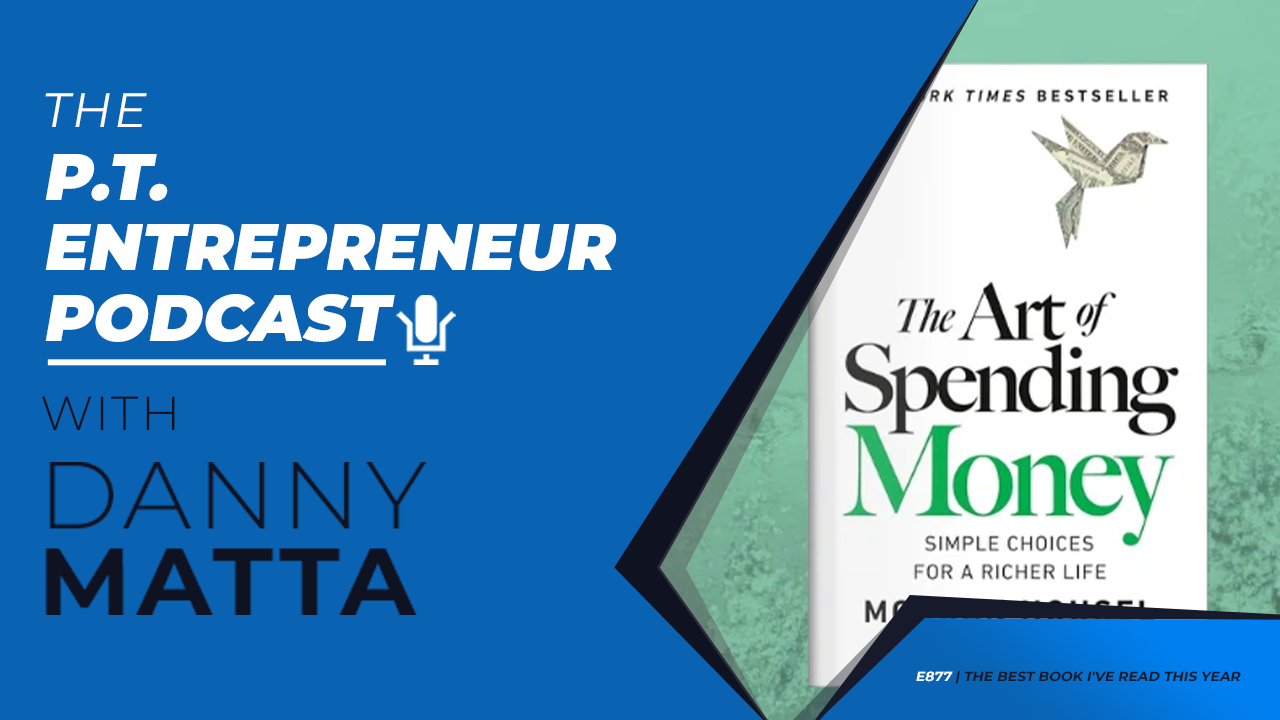
Money, Happiness, and the Race You’re Actually Running as a Clinic Owner
Every clinic owner has to deal with money.
You use it to pay your team, keep the doors open, take care of your family, and fund the future you’re trying to build. But the way you think about money and what you chase with it has a massive impact on how happy you actually are.
That’s why Danny’s favorite book he read this year was The Art of Spending Money by Morgan Housel.
On paper, it sounds like a finance book. In reality, it’s more about decisions, attention, and whether you end up fulfilled or miserable.
Here’s how it applies to cash-based PTs.
Why This Book Hit Home
Danny already recommends Morgan Housel’s earlier book, The Psychology of Money, to a ton of PT Biz clients who struggle with money mindset and self-worth.
The Art of Spending Money goes a step further. It’s less about building money and more about how you use it and what you expect it to do for your life.
Danny’s wife said it probably should have been called “The Art of Not Being Miserable.”
That’s about right.
Because if you:
-
Build a good clinic
-
Make solid income
-
But constantly feel behind or stuck
…it’s not a revenue problem. It’s a perspective problem.
Where You Aim Your Attention
One section that really stood out to Danny was titled “May I Have Your Attention Please?”
The point is simple:
Where you put your attention shapes how you feel about your life.
Let’s say:
-
Your clinic does around $500k a year.
-
You’re profitable.
-
You like your team and your culture.
-
You enjoy your niche and your day-to-day work.
Now you meet another owner doing $2M a year.
Most people immediately shift their attention to comparison:
-
“I’m so far behind.”
-
“What am I doing wrong?”
-
“I should be at that level by now.”
You forget:
-
You don’t know their backstory.
-
You don’t know what they had to sacrifice.
-
You don’t know what risk they were able to take that you couldn’t.
They might have investors, family money, a spouse who covers everything, or a totally different risk tolerance.
They might also have:
-
Poor health
-
No time with their kids
-
A marriage that’s hanging by a thread
You’re at $500k, healthy, and present with your family. They’re at $2M, stressed and falling apart.
Who’s winning? Depends on what you value.
If you want to stay unhappy, stay focused on who has more.
Business as Vehicle vs. Business as Your Whole Life
Another section Danny talks about from the book is “The Happiest People I Know.”
The theme is this:
A business is supposed to be a vehicle that supports the life you want.
Most owners accidentally let the business become their whole life.
Here’s the trade-off in simple terms:
-
Owner A works 60 hours a week and takes home $300k.
-
Owner B works 30 hours a week and takes home $200k.
There’s no universal right answer. It comes down to:
-
Do you want more money?
-
Or more time?
If that extra $100k actually changes your life and you enjoy the grind, fine.
If that extra $100k costs you:
-
Time with your kids
-
Coaching their teams
-
Taking care of your own health
…you might be overpaying for it.
The happiest owners are intentional. They know what they want, then build the business to match that, not the other way around.
Lifestyle Creep and Moving the Goalposts
The book also talks about two traps that crush a lot of people who start winning financially:
-
Lifestyle creep
-
Moving the goalposts
You start making more money, and without really thinking about it, you grow into that income:
-
Bigger house
-
Nicer cars
-
Private schools
-
More expensive trips
Now your monthly burn rate is much higher. You feel like you have to keep saying yes to every growth opportunity just to maintain what you built.
At the same time, every time you hit a goal, you instantly move the bar:
-
“Once we get to $500k, we’ll be set.”
-
Hit $500k. Now it’s “We need $1M.”
-
Hit $1M. Now it’s “We need $2M.”
There’s never a finish line. Just a moving target.
The alternative is boring on paper and powerful in real life:
-
Decide what you actually want your life to look like.
-
Decide how much income you need to support that.
-
Grow your business to that level.
-
Then keep your lifestyle below it, even as income climbs.
That gap becomes “no thank you” money.
It lets you say no to things that don’t fit, instead of constantly saying yes because you’re trapped by your own expenses.
What Race Are You Really Running?
Danny uses a running analogy a lot with PT Biz clients.
If you’re running a 10K and someone else is training for a marathon, everything is different:
-
Pacing
-
Training volume
-
Strategy
-
What success even looks like
The only thing in common is that you’re both running.
In business:
-
Some owners want one great clinic they keep for decades.
-
Some want a multi-location group they sell for a big check.
If you’re aiming for a small, profitable, stable clinic that lets you be present with your family, that’s one race.
If you’re aiming for a multi-clinic platform and a big exit, that’s a different race.
The problem is when you don’t know which one you’re in.
That’s when you:
-
Say yes to opportunities that don’t match your real priorities.
-
Chase other people’s goals.
-
Wake up feeling trapped in a life you never actually chose on purpose.
Clarity about your race makes decisions easier. You’re not chasing every shiny thing. You know what you’re building and why.
Saying Yes, Saying No, and Not Waking Up Miserable
Every time you say yes to something in your business, you’re saying no to something else:
-
Yes to an extra 30 hours of work a week might be no to pickup and drop-off with your kids.
-
Yes to another location might be no to staying deeply involved in patient care.
-
Yes to a big growth push might be no to your own training and health for a while.
There’s no escaping trade-offs. The question is whether you’re making them on purpose.
The owners who are the most content:
-
Know what they want their life to look like.
-
Use their business to support that life.
-
Resist the urge to constantly move the goalposts.
-
Don’t let comparison dictate their decisions.
The owners who feel trapped:
-
Chase bigger numbers without knowing why.
-
Let lifestyle creep eat up every raise.
-
Take on more risk for changes that don’t improve their life in a meaningful way.
-
Compare themselves to everyone else and always feel behind.
How to Use This in Your Own Clinic
Here’s how you can put this into practice:
-
Define your race.
Are you building one great clinic you keep? Or a multi-location group you might sell? -
Decide your “enough” number.
What income and schedule would give you the life you actually want? -
Watch your lifestyle creep.
As your income rises, don’t automatically let expenses match it. -
Treat comparison as noise.
Use other owners as proof of what’s possible, not a stick to beat yourself with. -
Protect your time like money.
Remember that every yes is also a no somewhere else.
If this stuff hits a nerve, that’s good. It means you’re starting to think about what kind of life you want your clinic to fund, not just how big you can make the clinic.
Want Help Defining Your Race and Numbers?
If you’re trying to figure out what you should build and how to get there:
-
PT Biz Part-Time to Full-Time 5-Day Challenge
Get clear on how much income you really need, how many patients that takes, and what to charge so you can leave your job for your practice.
physicaltherapybiz.com/challenge -
Free Discovery Call with PT Biz
Talk through your clinic, your goals, and what race actually makes sense for you with a PT Biz advisor.
vip.physicaltherapybiz.com/discovery-call
Be intentional with what you’re building, so you don’t end up living a life you never meant to choose.
Do you enjoy the podcast? If so, leave us a 5-star review on iTunes and tell a friend to do the same!
Ready to elevate your practice? Book a call at the link below with one of our expert consultants today and start your journey to delivering unparalleled physical therapy.

Podcast Transcript
Danny:
[00:00:00] Hey, what's going on, doc Danny here with the PT Entrepreneur podcast, and today I wanna [00:00:05] share a book with you that I read that it's my favorite book I [00:00:10] read this year. And now, you know, book recommendations [00:00:15] can be very subjective because. Oftentimes, [00:00:20] it depends on your own context, where you're at in your life, the things you're [00:00:25] dealing with, the things you're trying to learn, um, the things that resonate with you.
Could be fiction, it could be [00:00:30] nonfiction, whatever it might be. Um, you know, I and I used to read a lot more than I, than I do [00:00:35] now, which fortunately my reading habits have died off [00:00:40] some, but I still, I still try to get through. A book a month is my [00:00:45] goal. I used to try to do a book a week, which was a lot. Um, but I'll try to get through one a month [00:00:50] and sometimes I get through half and I just stop, which is [00:00:55] actually more common than me finishing one.
But the book that I recently read, that [00:01:00] has been my favorite book this year. It's called The Art of Spending Money by Morgan Howell. [00:01:05] Now, Morgan Howell's written a few books. I like all of his books. In fact, I recommend The [00:01:10] Psychology of Money, which is his first book to almost everybody that [00:01:15] we, uh, that we work with.
They ask me a finance question. So I run a finance call for [00:01:20] PT Biz. I do this every single month, and we dive into finance topics. We'll look at p and ls, we'll talk through [00:01:25] different finance variations of leveraging loans and financing and [00:01:30] expansion, uh, payroll things. All everything has to do with the finance in your business.
And, [00:01:35] uh, so I get a lot of questions about this stuff and I always recommend for a lot of people, they struggle with [00:01:40] money mindset, right? And like the way they view their own value, it's, it's a huge problem within our profession [00:01:45] and the psychology of money. Written by Morgan Hausel a few years ago is a book [00:01:50] that I usually recommend.
Now this is a new book for him. It came out very recently [00:01:55] and the artist Spending Money is a, I think it's a deceiving title, [00:02:00] so I, I. I like this book so much. I was talking about it and my wife decided she would read it as [00:02:05] well, and we were talking about it this morning. She's almost done with it and she goes, I don't think it should be titled [00:02:10] The Art of Spending Money.
I think it should be titled How to Be, how to Not Be Miserable. [00:02:15] Basically like the Art of Not Being Miserable. And it's [00:02:20] because it really, it has some, something to do with money, but more to do about the [00:02:25] decisions we make around it and how we perceive. That and being self-aware [00:02:30] enough of the decisions that we're making so that we can end up, you know, being content, [00:02:35] being happy, being fulfilled, um, and whether we like it or not, we have to deal with money in the world.
It's, [00:02:40] it's how we pay for things. It's how we, uh, get reimbursed for the value we pride provide to other [00:02:45] people. Uh, and, and if you don't have any money, you're terrible with money. [00:02:50] It can create a lot of stress in your life. So especially with [00:02:55] entrepreneurs, as we are charging for what we do, we're building businesses, we're [00:03:00] hiring people, we're paying their salaries.
Like we have to get really comfortable with our own perception [00:03:05] of money and um, and also the usage of it as a tool. But there are two sections [00:03:10] in it in particular that I thought were like really applicable to physical therapists that we [00:03:15] work with. You know, and if you're listening to this, I think that this will be beneficial for you.
You can go read the book if you would like, [00:03:20] but these are two sections that I think, you know, I, I read and I was like, man, these really, [00:03:25] these really resonate. So one is a section called May I Have Your [00:03:30] Attention Please. Okay. And the whole point of this is, uh, about where [00:03:35] you direct your attention. So where you direct your attention shapes the [00:03:40] happiness that you have associated with your life.
So think of it this [00:03:45] way, imagine. That you have a clinic that [00:03:50] is doing half a million dollars in revenue [00:03:55] annually, you know, you're, you're showing good growth. You're, you're [00:04:00] profitable. You like the team that you have, you have a cool culture. You, you have [00:04:05] a unique niche that you're working with, and you get a lot of enjoyment out of your business.[00:04:10]
Then all of a sudden you meet another clinic owner and they're [00:04:15] doing. $2 million a year. [00:04:20] Now, what do most people do? Well, [00:04:25] they start to direct their attention to, oh, dang, I'm not doing $2 million a year. I'm gonna suck at this. [00:04:30] Like, what is going on? Like, it's, it's, it's deflating for you to meet [00:04:35] somebody who's ahead of you in business in these objective [00:04:40] numbers of revenue.
And then we start to compare. [00:04:45] Where we're at to where they're at, and let's just say there are $2 million and they started [00:04:50] at the exact same time as you. Ugh. It's like [00:04:55] salt in a wound. It's the worst. You know, you're just like, ah, dang it. What the heck did I do [00:05:00] wrong? Here's the thing, you don't know the first thing about their [00:05:05] backstory, the context of how they got started.
Uh, [00:05:10] you know, what did they do before that? Did they have any? [00:05:15] Support from investors, family, friends, [00:05:20] you know, do they have some advantages that you don't have? Do they have a difference? Family [00:05:25] dynamic and lifestyle, or do they have the ability to take bigger risks? Do they have, uh, [00:05:30] safety nets that you may not have?
You know, do they just have more ambition and valued things differently than you do? [00:05:35] They may be at $2 million a year, but their physical health has suffered [00:05:40] dramatically and they have terrible relationships, everybody around them. And you're at half a million dollars a year [00:05:45] and you're in great health, and you have people around you that you spend a lot of time with, and you really enjoy [00:05:50] who's, who's winning.
It depends. How do you, [00:05:55] how do you gauge that? You know what's important to you? But if you want to be miserable, [00:06:00] keep comparing yourself to everybody around you [00:06:05] and wait. Focus your attention on what you haven't done yet, and you'll feel [00:06:10] pretty damn bad because of that. Alright. In order [00:06:15] to, you know, be happy.
In order to feel like you're [00:06:20] grateful for where you're at, you have to really just understand that you're running your own race and [00:06:25] your goals are your goals, and your life is unique to you, and what you're doing is unique to what. [00:06:30] You want to do as well. It's great to have people around you. You can view as examples of what's possible.
In fact, this is a [00:06:35] huge part of what makes our Mastermind group so, so powerful when they get together, who'll get a chance to see [00:06:40] what's possible with other people. And it's very motivating in a lot of ways. [00:06:45] It can also be somewhat defeating for people if, depending on the lens, they look through it. [00:06:50] So the second section was titled The [00:06:55] Happiest People I Know.
Okay, so [00:07:00] this is the difference between things that bring [00:07:05] fulfillment and what we think will, and this is where [00:07:10] you have to really understand what your goals [00:07:15] are for your life, and understand that your business is there to [00:07:20] support the life that you want. Like it's, it's the vehicle to then get the life that [00:07:25] you want.
More often than not, the business [00:07:30] becomes the business owner's life. Lemme say that one more time, because this is [00:07:35] incredibly important for you to understand the difference. Businesses should be the [00:07:40] vehicle to get the life that you want, the creation of time, financial freedom, whatever that looks like to you.[00:07:45]
The normal path for business owners is their business becomes [00:07:50] their life. They're obsessed with it. They spend all their time thinking about it, all their time working on it, [00:07:55] and it's because it is their new fixation, their new, [00:08:00] uh, you know, thing that they can compete in. It's also, uh, [00:08:05] tied to monetary, you know, income and reimbursement.
It's [00:08:10] like the more successful your business is, the more money you have. But would you rather be. [00:08:15] A clinic owner that's working 60 hours a week and you're making [00:08:20] $300,000 in income, or would you rather be a clinic owner that's [00:08:25] working 30 hours a week and is making $200,000 in income? [00:08:30] It's up to you.
There's no right answer. [00:08:35] It just depends on what you want your life to look like. You might say. I'll take the [00:08:40] extra a hundred grand. Like, I, I don't mind dropping the extra 30 hours [00:08:45] a week into the business and, and working hard. That sounds like an ideal fit for me. [00:08:50] Someone else who has three kids and he wants to coach their, [00:08:55] you know, their teams and wants to be involved in their community, they [00:09:00] want that extra 30 hours back and they wanna pour it into other things that are value to them, and it's not worth [00:09:05] the exchange.
Of the extra a hundred thousand dollars or, here's a good example. We see [00:09:10] people scale and grow and have success, [00:09:15] and they keep saying yes to things that grow their business. Even though [00:09:20] it's taking away more of their time and attention, it's adding more risk [00:09:25] to what, you know, they, they've already, um, created [00:09:30] and for what?
To be for something that doesn't meaningfully [00:09:35] change their life. And for other people, it's the right decision to [00:09:40] make. Because their goal might be to have a platform business of clinics that they can sell [00:09:45] 'cause they want to have this big financial exit for [00:09:50] whatever reason. And I'm not saying one decision is right or wrong, but more often than not.
[00:09:55] What I see is people don't know why they're doing what they're doing. They're just doing it [00:10:00] because it's hard for them to say no to opportunity. It's harder for them to say no [00:10:05] to staff that are telling 'em like, Hey, I [00:10:10] wanna run this other, I wanna run a new clinic. Let's build another one. Well, that might actually line up with [00:10:15] what you want and maybe you lose that person because of that, but you have to understand [00:10:20] what your goals are.
And what you're saying yes to, because when you say yes to [00:10:25] anything, you're saying no to other things. If you're saying, yes, I wanna work 30 more [00:10:30] hours a week and make another a hundred thousand dollars in the year, I'm saying no [00:10:35] to dropping my kids off at school every day. I'm saying no to coaching my kids' basketball [00:10:40] teams.
I'm saying no to training five days a week and staying [00:10:45] physically healthy. You have to realize there's a [00:10:50] finite amount of time. And the, the people that are the happiest, the people that are the most [00:10:55] content are the people that make decisions based on alignment with where they're [00:11:00] trying to go. The people that feel frustrated and almost like they're trapped are [00:11:05] people that have made decisions based on, in many cases, [00:11:10] monetary.
Small improvements in, in their [00:11:15] life for things that they, that, that don't make a meaningful change in, in their [00:11:20] lifestyle. And the, the biggest thing, and this is from the first book by the way, [00:11:25] and they touch on this again in this one, the biggest thing that happens for most people [00:11:30] when they start to have success, and you may be guilty of this as well, I definitely, I definitely have done this [00:11:35] myself, is that you end up moving the goalpost.
Your [00:11:40] lifestyle creep happens, meaning as you start to make more income, you start to [00:11:45] grow into a lifestyle that absorbs that income. [00:11:50] So in many ways, you don't have a choice but to say yes to these things that will [00:11:55] add additional revenue to your, your take home to income, to your to your life, [00:12:00] because you've now absorbed.
Uh, more income on a monthly [00:12:05] basis in these other things. This bigger house, this nicer car, this private school, these, these more [00:12:10] elaborate vacations, these uh, these, these things that you spend money on [00:12:15] that maybe you find a lot of value in. Maybe you don't. Maybe you just do them because it's what people around you are doing, [00:12:20] and that's what we call moving the goalpost.
So if you're constantly moving [00:12:25] the goalpost, you're gonna constantly have to make more. And you're constantly [00:12:30] gonna have to trade more time or take more risk in order to get there. So [00:12:35] if, if you have this goal of, you know, wanting to be able to do something, like, for instance, [00:12:40] make half a million dollars in income and be able to live in a certain type of [00:12:45] home and your kids go to a certain type of school and like, be intentional about that, that is, that is your goal, that's [00:12:50] personal to you.
And no one else can tell you what your life should look like. Nobody. [00:12:55] But what if you could make the same amount of money? But live a lifestyle [00:13:00] well below that and put yourself in a position where you never have to work again, whether your business sells or not within a few [00:13:05] years, that in many ways is [00:13:10] wealth.
The ability to say no to things, the ability to get out of the trap of [00:13:15] having to continue to grind and and trade time for money, [00:13:20] or just the ability to say, I'm good. I like what I've built. [00:13:25] I like this clinic at the size that it's at. I enjoy the team size that I have. [00:13:30] This is something that's sustainable for me, something that, that I really enjoy.
The culture is what I [00:13:35] want. I want to keep it this way on purpose. We've all been to places like even like restaurants, right? Like [00:13:40] some restaurants have been around forever. Like there's a restaurant here in Atlanta my friend used to work at [00:13:45] to celebrate his 45th year in business. That's a hard thing to do for a restaurant and it [00:13:50] hasn't changed.
The size of it hasn't changed. The branding hasn't changed. [00:13:55] I'm sure the menu has changed to some degree, but like, probably not by much. And for 45 years they've just been [00:14:00] consistent. They've been doing the same thing. The owner's happy, you know, like it's, it's a, it's a [00:14:05] staple in the area. You could decide that that's what you wanna do, right?[00:14:10]
You wanna have a clinic that's gonna be, you know, constantly trying to be excellent with the people that [00:14:15] you work with, and progressing clinically, progressing with your knowledge base, progressing with how you're helping people [00:14:20] get outcomes and staying up to date on the newest research and, and, and trends within the space.
But [00:14:25] maybe you don't grow past where you're at. Maybe you're totally fine with that. That's okay. There's nothing [00:14:30] wrong with that because it's your personal choice if you decide to do that versus for somebody else, that [00:14:35] might sound like a trap to them. And they're miserable because they have these big growth goals.
They want to [00:14:40] test themself on a higher level on the business side. So, okay, but what is it to you? [00:14:45] What's gonna make you happy? That is an intentional decision that you have to make. And you can't make it [00:14:50] based off of what other people around you are doing. And you can't look at other people and be miserable 'cause you're not quite where they're at.[00:14:55]
Because comparison is a thief of joy, period. And you know, if you keep doing that, [00:15:00] you're gonna feel pretty crappy about where you're at forever. 'cause you're always gonna be able to find somebody. That's [00:15:05] bigger than you. You know, oh, this person has a $2 million clinic. I need to get to a $2 million clinic.
Next thing you know, you see [00:15:10] somebody who has a $5 million clinic. Well, shit, I'm not at five, I'm at two. Why better get to five? Then you get to five. Then you [00:15:15] meet somebody who has a $10 million clinic. Well, damn, I still suck. I need to get to 10. You get to 10, you meet somebody who has a hundred million [00:15:20] dollars clinic, a billion dollar group of clinics, like there's no end to it.
There's no end. [00:15:25] It doesn't matter. Like you gotta realize what you're trying to do, and then you have to reverse engineer [00:15:30] that. Period. Right. And if you can not change your lifestyle a ton along the [00:15:35] way, you are gonna create financial stability to yourself or for yourself. [00:15:40] Where you have what we call no thank you money, and you can say no to doing things and you can prioritize [00:15:45] doing the things that you really value the most, whether they are ROI, positive to you on paper or not.[00:15:50]
So I hope that this, this message resonates with you. This was a very, very, uh, [00:15:55] helpful book for me. Like, I just like this stuff a lot. Um, maybe you find this boring. You're not at that [00:16:00] sort of stage where you can even think about this stuff, but the earlier you start thinking about where you're trying to go.
What [00:16:05] race you're running. This is a big part of what we talk about at PT Biz. People understanding what race that they're running, [00:16:10] you know, and not comparing themselves to other people. Like if you're running a 10 K and someone elses are running a [00:16:15] marathon, you can't compare your pacing to them. You can't compare your training to them.
You can't compare anything really, [00:16:20] right? And aside the fact you're both running, but you may have completely different goals. Somebody might just be trying to [00:16:25] complete a 10 K. Somebody might just be trying to, somebody might be trying to pr a [00:16:30] marathon, right? Like the different paces and speeds and lots of things.
You gotta know what race you're running. [00:16:35] Why you're doing it. And once you understand that, man, your decisions become a lot easier with what you're gonna say [00:16:40] yes and no to. And that is, in many cases, the hardest part when you start to have [00:16:45] success. Because success breeds more opportunity and more opportunity breeds more things that you have to say yes or no to.
And [00:16:50] it's hard to say no to things that are potentially great opportunities for you, but might be in exchange [00:16:55] of a massive amount of time that you have to say that you're gonna commit to or you have to say no to [00:17:00] other things that might be. Far more important to you at this stage, so [00:17:05] get the book if it sounds like something you're interested in.
I hope this resonates with you. Be intentional about the things you say [00:17:10] yes and no to. Otherwise you might end up living a life that you didn't sign up [00:17:15] for.