
E965 | Michael Sclafani: From CrossFit Kitchen to PT Clinic
Oct 22, 2026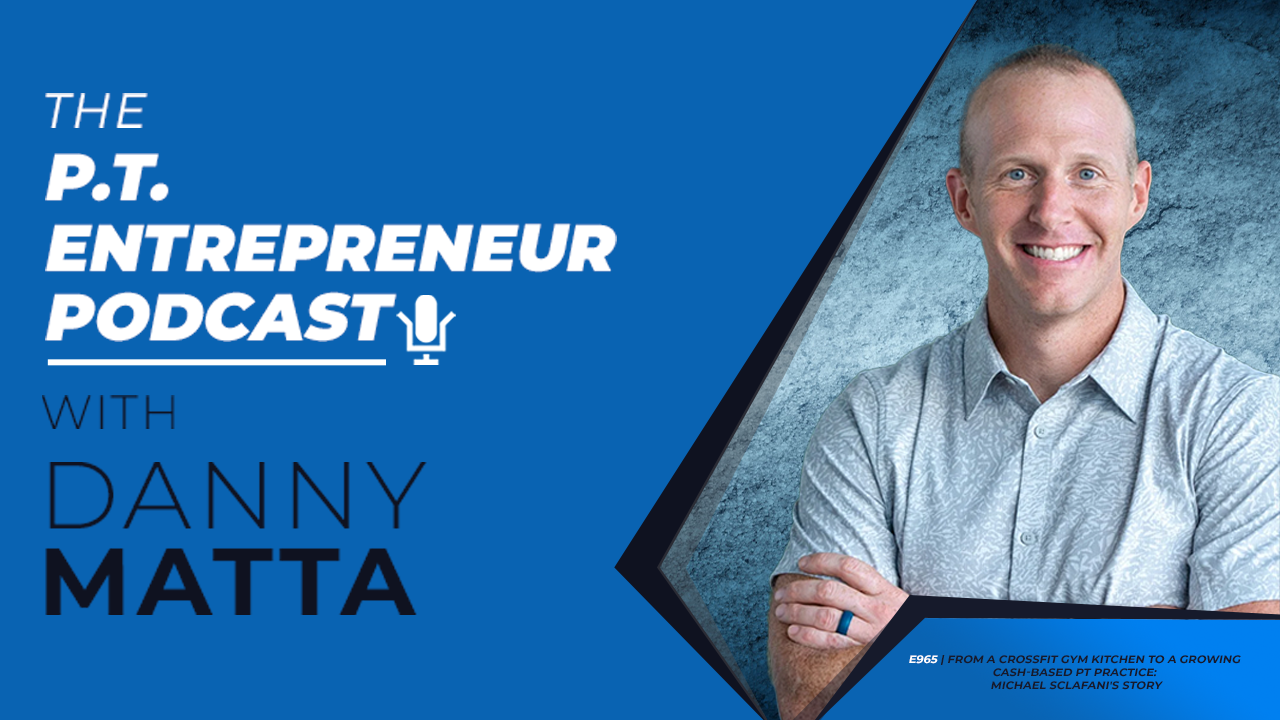
From a CrossFit Gym Kitchen to a Growing Cash-Based PT Practice: Michael Sclafani's Story
Starting a cash-based physical therapy practice doesn't require a perfect business plan, a beautiful facility, or an established network of referral sources.
Sometimes it starts with a kitchen inside a CrossFit gym.
That's exactly how Michael Sclafani built Tideline Sports Performance and Rehabilitation in Sarasota, Florida.
In 2020, Michael moved across the state with his wife, Ashley, without knowing anyone in the area. He had an impressive clinical background, including experience with the Cleveland Clinic, professional sports organizations, and collegiate athletics.
But running a business was completely different.
He didn't have a patient list waiting for him.
He didn't have a recognizable local brand.
And he didn't have the security of a hospital system behind him.
What he did have was a willingness to take action, build relationships, and figure things out along the way.
In this episode of the PT Entrepreneur Podcast, Courtney Morse talks with Michael about how he started his practice, developed his first business systems, hired his initial employees, and eventually transitioned from being the primary clinician to leading a growing team.
Michael also shares lessons from his experience as a coach inside the PT Biz Clinical Rainmaker program.
His story is a great example of what happens when a physical therapist combines clinical expertise with consistent marketing, strong patient relationships, and the willingness to become a business owner.
Why Michael Sclafani Started His Own PT Practice
Michael didn't always dream of owning a physical therapy clinic.
In fact, he was comfortable working within established healthcare organizations.
His background included sports medicine, strength and conditioning, residency training, and working with high-level athletes.
He enjoyed the structure and security that came with those opportunities.
But when he and Ashley decided to move to Sarasota in 2020, Michael struggled to find a job that matched what he wanted professionally.
Ashley encouraged him to consider starting his own practice.
It was an idea she'd brought up before, but Michael hadn't seriously pursued it.
This time, the circumstances were different.
Rather than accepting a job that didn't fit his goals, he decided to create the opportunity himself.
Around that time, he'd also been listening to the PT Entrepreneur Podcast and learning about the cash-based physical therapy model.
He eventually joined the PT Biz Clinical Rainmaker program to get help establishing the systems he needed.
Unlike many clinicians who begin with a part-time side business, Michael went directly into full-time entrepreneurship.
That created pressure.
He needed patients.
He needed revenue.
And he needed to learn how to run a business while actively building one.
Starting a Cash-Based PT Practice Inside a CrossFit Gym
When Michael arrived in Sarasota, he didn't know anyone.
His first priority was finding a place where he could connect with the kinds of people he wanted to treat.
He began visiting local CrossFit gyms.
After reaching out to five gyms, he secured a sublease inside one of them.
His treatment space?
The kitchen.
It wasn't glamorous.
But it gave him access to an established fitness community filled with people who valued exercise, performance, and staying active.
And that was far more important than having an impressive facility.
Michael immediately began building relationships with gym owners, coaches, and members.
He also introduced a marketing strategy that became an important part of his early success.
How One Injury Screen Generated 11 Evaluations
One of Michael's first marketing activities was a Meet the Doc event.
The concept was straightforward.
He offered gym members an opportunity to schedule a brief injury screen, discuss their concerns, and learn whether physical therapy could help them.
He scheduled 12 available spots for a Wednesday evening.
Every spot filled.
And 11 of those conversations turned into evaluations.
For a new practice with no established patient base, that was a significant result.
But the lesson isn't that every injury screen will generate the same numbers.
It's that Michael put himself directly in front of people who were likely to benefit from his services.
He didn't wait for a website to start ranking on Google.
He didn't spend months creating the perfect social media strategy.
He went into his community and started conversations.
This is one of the most important principles we teach clinicians inside the Rainmaker program.
Early in your business, relationships are often your most valuable marketing asset.
A gym owner who trusts you can introduce you to members.
A coach who understands your services can recommend you when someone is struggling with an injury.
A patient who has an exceptional experience can tell friends about your practice.
Those relationships create opportunities that are difficult to replicate through advertising alone.
Why Your First Marketing Strategy Should Be Simple
When physical therapists start their own practices, they often make marketing more complicated than it needs to be.
They think they need a professional website, polished branding, a large Instagram following, and paid advertising campaigns.
Those things can eventually become useful.
But they're not necessarily the best place to start.
Michael's approach was much simpler.
He identified local communities where his ideal patients already spent time.
Then he showed up.
He introduced himself.
He developed relationships.
And he created opportunities for people to experience his expertise.
That might mean visiting a CrossFit gym.
It could mean connecting with a running club, strength coach, personal trainer, or recreational sports organization.
The specific community matters less than whether it's a good fit for the patients you want to help.
The important part is consistently putting yourself in environments where meaningful relationships can develop.
When Michael was later asked what he would do first if he had to start his practice again, his answer was to rebuild those grassroots marketing systems.
He would create his list of local businesses, schedule gym visits, organize injury screens, and start developing relationships.
Because even the best clinician needs a way for people to discover their services.
Building the Patient Experience Before Scaling
Getting people through the door was only one part of Michael's early strategy.
He also knew that the experience patients received needed to be different from what they'd encountered in traditional healthcare settings.
His clinical background had prepared him to evaluate and treat patients.
But owning a cash-based practice required him to think about everything surrounding that treatment.
How would someone first hear about the clinic?
What would happen when they reached out?
How would the initial conversation feel?
What would patients experience during their evaluation?
How would Michael explain the treatment plan?
And what would happen after they left?
He began working backward from the experience he wanted patients to have.
That helped him identify the systems needed to make the process consistent.
Two areas became especially important.
The Discovery Call Is More Than a Clinical Conversation
Michael places significant emphasis on the discovery call.
For many cash-based practices, this is the first meaningful conversation a prospective patient has with the business.
It's an opportunity to understand the person before they ever schedule an evaluation.
But many clinicians approach these conversations almost entirely from a clinical perspective.
They ask where it hurts.
They ask how long the symptoms have been present.
They ask what activities make the problem worse.
Those questions have value.
But they don't always reveal why someone is seeking help.
Michael wanted to understand what the problem was preventing that person from doing.
Maybe knee pain was keeping someone from running.
Maybe back pain was affecting their confidence in the gym.
Maybe an injury was preventing a parent from participating in activities with their children.
Understanding those deeper motivations changes the conversation.
You're no longer simply discussing symptoms.
You're learning what matters to the person and why resolving the problem is important.
That allows you to explain how your services may help them return to the activities they care about.
It also builds trust before the first appointment.
Why Cash-Based PT Patients Need a Clear Plan
The second major system Michael focused on was the PT Biz Three-Step Process.
In a traditional insurance-based setting, patients may be accustomed to attending physical therapy a couple of times per week without fully understanding the overall plan.
But when someone is choosing to pay directly for care, clarity becomes especially important.
They need to understand what they're working toward.
They need to know what the process involves.
And they need to understand why the recommended care makes sense for their goals.
Michael wanted patients to feel informed and involved throughout the experience.
That meant communicating in a way that was easy to understand rather than overwhelming them with clinical terminology.
It also meant helping patients develop the knowledge and confidence to manage their health independently.
His goal wasn't to create patients who depended on treatment indefinitely.
It was to help people build resilience, return to meaningful activities, and take ownership of their long-term health.
That's an important distinction for cash-based PT owners.
Patients aren't simply paying for an hour of your time.
They're investing in a process designed to help them achieve a specific outcome.
The more clearly you communicate that process, the easier it becomes for patients to understand the value of your services.
From a Gym Kitchen to a Standalone Clinic
Michael started Tideline in October 2020.
Within several months, he began seeing signs that the business could become sustainable.
His schedule was filling.
New evaluations were coming in more consistently.
Patients were referring other people.
And he no longer had to rely exclusively on aggressive grassroots marketing to generate interest.
That gave him the confidence to make his next move.
In April 2021, approximately six months after opening, he moved into a standalone location.
It was a significant milestone.
But it also introduced new responsibilities.
Michael now had a larger facility to manage, more expenses, and a growing patient schedule.
He was approaching 30 or more patient visits per week.
The business was working.
But his available time was becoming increasingly limited.
And like many successful solo practitioners, Michael was approaching the point where he needed to decide whether he wanted to remain the person doing everything or begin building a team.
That decision would become the next major stage of Tideline's growth.
Learn more about Michael's practice at Tideline Sports Performance and Rehabilitation.
Making Your First Hire in a Cash-Based PT Practice
One of the most difficult transitions for a successful solo practice owner is learning how to stop doing everything yourself.
When Michael started Tideline Sports Performance and Rehabilitation, he was responsible for every part of the business.
He treated patients, handled scheduling, answered calls, managed marketing, and made every decision.
That worked when the practice was small.
But as his schedule approached 30 to 35 patient visits per week, it became increasingly difficult to manage everything.
After joining the PT Biz Mastermind, Michael began preparing for his first hire.
Interestingly, that hire wasn't another physical therapist.
It was an office manager.
In July 2021, he brought on his first administrative employee.
The decision allowed him to begin delegating responsibilities that didn't require his clinical expertise.
But finding the right person wasn't the only challenge.
He also had to convince someone to join a business that was still relatively new.
At the time, the front desk consisted of an inexpensive desk from Walmart and a rolling stool.
It wasn't exactly an impressive corporate office.
Instead of pretending the business was more established than it was, Michael shared his vision.
He explained what he wanted Tideline to become and invited candidates to help build it.
His strongest candidates came through relationships he'd developed with local gyms rather than traditional job postings.
That reinforced something he'd already learned through marketing.
Relationships can become one of the most valuable assets in your business, whether you're looking for patients or employees.
Learning to Delegate Without Losing Control
Hiring someone doesn't automatically make your life easier.
You also have to learn how to delegate.
And for Michael, that was uncomfortable.
He's naturally detail-oriented and likes having control over how things are done.
When he was the only person working in the clinic, he could ensure that every patient interaction happened exactly the way he wanted.
But once he hired an office manager, he had to trust someone else to represent the business.
That required three important changes.
First, he needed to teach employees how to complete their responsibilities.
Second, he needed systems that made those responsibilities clear.
And third, he needed to become comfortable with the idea that someone else might do things differently.
Not every task needed to be completed exactly the way he would have done it.
Sometimes an employee completing something effectively, even if it wasn't perfect, was enough.
This is an important lesson for physical therapists who want to scale.
If every task requires your personal involvement, your business will eventually reach a ceiling.
You can only treat so many patients, answer so many calls, and manage so many responsibilities.
Delegation creates capacity.
But it only works when you give people the training, expectations, and trust they need to succeed.
Hiring Your First Physical Therapist Requires a Different Playbook
A few months after hiring his office manager, Michael brought on his first physical therapist.
That happened around October 2021, approximately one year after opening Tideline.
Hiring a clinician introduced a different set of challenges.
Administrative employees needed to understand scheduling, communication, and patient experience.
A physical therapist needed to deliver clinical outcomes while also communicating the value of cash-based care.
Michael couldn't assume that someone with strong clinical skills would automatically understand his approach to patient relationships, treatment planning, and business operations.
So he created a resource to help.
While attending a PT Biz Mastermind event in Texas, he spent time putting together a roughly 45-page clinical reference binder.
It covered clinical considerations across different body regions, along with concepts related to patient communication, the Three-Step Process, and delivering value.
The binder became a way to transfer knowledge that had previously existed primarily in Michael's head.
That's a critical part of scaling a practice.
Your employees need more than instructions to treat patients well.
They need to understand the standards, expectations, and processes that make your clinic different.
When those things are documented and taught consistently, the patient experience becomes less dependent on the owner personally delivering every visit.
The Staffing Crisis That Sent Michael Back Into Full-Time Patient Care
Growing a team doesn't mean the challenges disappear.
Michael experienced that firsthand.
At one point, Tideline had grown to include two full-time physical therapists, and Michael had dramatically reduced his own patient schedule.
During one month, he treated only eight patients.
He finally had time to focus on leadership, business development, and other professional responsibilities.
Then everything changed.
One physical therapist resigned.
Another employment relationship ended.
Suddenly, Michael was responsible for absorbing two full-time patient schedules.
His caseload climbed to approximately 45 visits per week.
The clinic was still generating demand, so the workload wasn't slowing down.
Then he experienced an additional administrative staffing disruption.
For roughly two months, he was treating between 35 and 45 patients per week without administrative support.
He was back to handling nearly everything.
It was one of the most difficult periods of his business ownership journey.
But it taught him an important lesson about prioritization.
He began separating tasks that required direct interaction with people from work that could be completed independently.
Patient care, important conversations, and immediate operational needs took priority during normal business hours.
Other responsibilities, such as marketing materials and social media work, could be handled outside those hours when necessary.
It wasn't an ideal situation.
But it helped him navigate the staffing challenges while rebuilding his team.
The experience also reinforced why developing reliable systems and hiring processes matters.
A growing business needs to become resilient enough to handle unexpected changes without depending entirely on the owner.
How Many Patients Should a PT Clinic Owner Treat?
Today, Michael has a different perspective on what his ideal role should look like.
He doesn't want to return to treating 30 or 40 patients every week.
But he also doesn't want to stop treating entirely.
For him, the ideal schedule is approximately five to ten patient visits per week.
That allows him to maintain his clinical skills and continue doing work he enjoys.
It also gives him opportunities to treat alongside his employees.
He values being present in the clinic and understanding what his team experiences.
But the lighter schedule creates time for the responsibilities that only he can handle as the business owner.
That includes leadership, planning, hiring, mentoring, and developing the business.
This is something many physical therapists struggle with.
They spend years becoming excellent clinicians.
Then they start a practice and eventually discover that growing the business requires them to spend less time treating.
That can create an identity crisis.
Michael had to learn that Tideline wasn't simply an extension of himself.
It was a business with its own team, systems, and responsibilities.
His job was no longer to personally deliver every service.
His job was to help the organization succeed.
And that meant becoming comfortable with a different role.
Giving Employees a Future Inside Your Practice
As Michael developed into a business owner, he realized that employees don't necessarily think about the company the same way its founder does.
Owners are constantly considering what comes next.
They think about growth, profitability, staffing, and long-term opportunities.
Employees often have different priorities.
They want to do meaningful work, serve their patients, earn a good living, and enjoy their lives outside the clinic.
That's completely reasonable.
But Michael recognized that he hadn't always communicated what opportunities might exist for his employees as the business grew.
He understood his vision.
His team didn't necessarily have the same clarity.
That realization pushed him to become more intentional about communicating potential career paths and professional development opportunities.
For clinic owners, this becomes increasingly important as the team grows.
Hiring good clinicians is only part of the equation.
You also need to give them reasons to stay.
That means helping employees understand their responsibilities, how they can improve, and what opportunities may be available over time.
Running a PT Practice With Your Spouse
Another important part of Tideline's development has been Ashley's involvement in the business.
Ashley has a nursing background and experience with healthcare administration.
When Michael began coaching with PT Biz, she became more involved in managing the practice.
Today, she oversees much of the day-to-day operation.
That includes patient scheduling, discovery calls, communication, and handling immediate operational issues.
Her involvement has allowed Michael to spend more time on leadership and longer-term business priorities.
But working with your spouse creates its own challenges.
At the clinic, they need to interact as business partners and coworkers.
At home, they need to protect their relationship from becoming an extension of the workday.
They've learned to establish boundaries around when business conversations happen.
Michael has also used his phone's notification settings to limit work interruptions when he's home.
Those small changes help create separation between professional responsibilities and personal time.
The bigger lesson is that working with your spouse can be a tremendous advantage when responsibilities are clear and your strengths complement one another.
But it requires communication and boundaries just like any other successful working relationship.
Why Imperfect Action Beats Waiting Until You're Ready
When Courtney asked Michael what advice he'd give clinicians who were thinking about starting a practice, one theme kept coming up.
Don't wait for everything to be perfect.
Michael admits that perfectionism created hesitation early in his entrepreneurial journey.
He wanted the right systems.
The right answers.
The right marketing.
The right setup.
But waiting until everything was ready could have prevented him from taking the actions that ultimately built his business.
His first injury screen wasn't an elaborate event.
His first treatment space was a kitchen.
His first front desk wasn't particularly impressive.
None of those things stopped him from helping patients and developing relationships.
And that's the point.
Your first attempt at something probably won't be your best.
Your first workshop may feel uncomfortable.
Your first gym visit might not generate a patient.
Your first discovery call may not go exactly as planned.
But every attempt gives you information.
You learn what works.
You improve.
And you become more comfortable taking action.
The clinicians who make progress aren't necessarily the ones who feel most prepared.
They're often the ones willing to start before everything is perfect.
Technology Spotlight
Documentation continues to be one of the biggest frustrations for physical therapists.
Claire is an AI scribe built specifically for PTs that dramatically reduces documentation time, allowing clinicians to focus on patient care instead of paperwork.
More PT Biz Training
Want more content on building a scalable cash practice?
If you're thinking about starting your own practice, the free PT Biz Part-Time to Full-Time 5-Day Challenge can help you understand your income replacement target, pricing, patient volume, and the steps needed to transition into full-time ownership.
👉 Join the Free PT Biz Challenge
You can also learn more about our Rainmaker and Mastermind coaching programs at Physical Therapy Biz.
To follow Michael's clinic and see what his team is building, visit Tideline Sports Performance and Rehabilitation or connect with them on Instagram.
Final Thoughts
Michael Sclafani's journey from a CrossFit gym kitchen to a growing cash-based physical therapy practice shows that you don't need everything figured out before getting started.
He began without local connections, built relationships through grassroots marketing, and created a patient experience that helped his practice gain momentum.
As the business grew, he learned how to hire, delegate, develop employees, and navigate difficult staffing challenges.
He also discovered that becoming a successful clinic owner requires personal growth.
You have to become comfortable with uncertainty.
You have to learn to trust other people.
And you have to recognize that the business you're building is bigger than your individual clinical skills.
If you're still working toward your first full-time cash practice, start by focusing on patient acquisition and building relationships in your community.
If you're already growing, focus on creating the systems and team that will allow your practice to operate without depending on you for everything.
And if you're waiting until you feel completely ready, remember how Tideline started.
You don't need the perfect clinic.
You need to take the first step, learn from it, and keep moving forward.