
E941 | How To Make It Through Times Of Overwhelm
Jul 30, 2026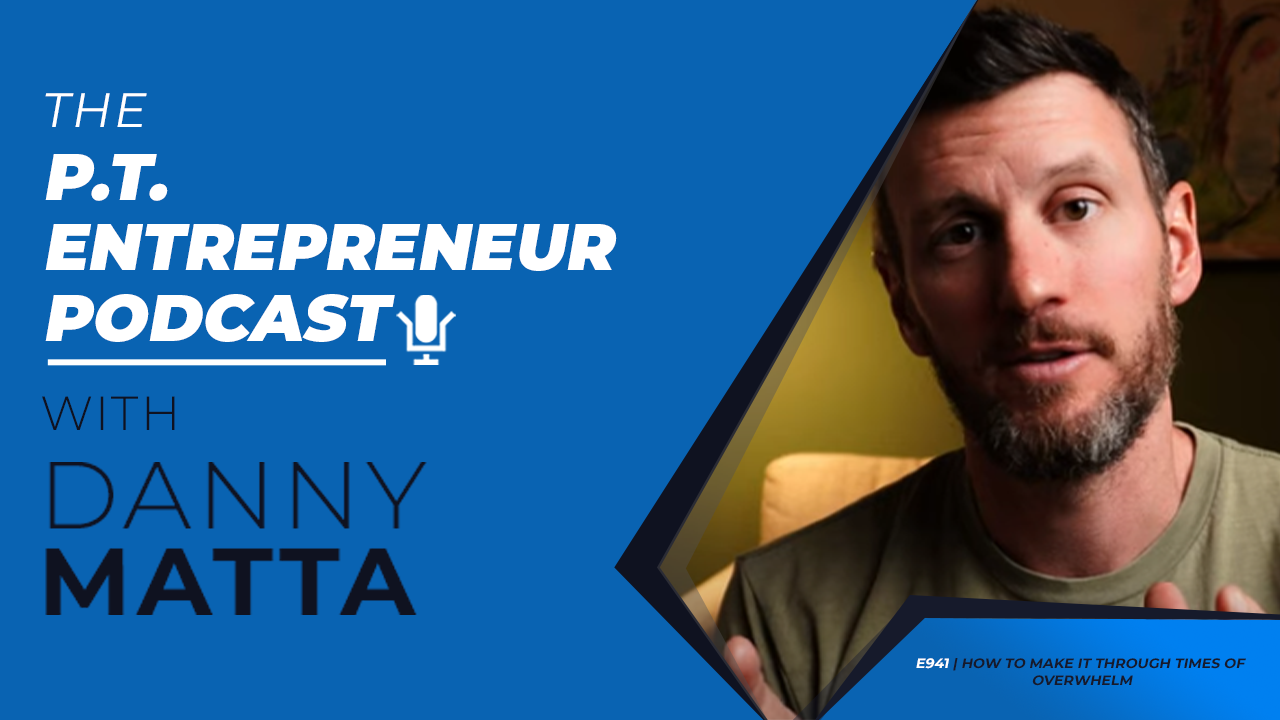
Feeling Overwhelmed? Here's How to Regain Control Without Burning Out
Every entrepreneur experiences overwhelm.
At first, it feels temporary.
Just get through this week.
Finish this project.
Close this deal.
Hire this employee.
Then life settles down.
Except it usually doesn't.
One opportunity leads to another.
The business grows.
Responsibilities multiply.
Before long, you're juggling patients, employees, finances, marketing, hiring, meetings, family, and everything else that comes with owning a business.
The truth is, overwhelm rarely appears overnight.
It builds one "yes" at a time.
In this episode of the PT Entrepreneur Podcast, Doc Danny shares lessons from his own experience navigating seasons of overwhelm. Rather than offering productivity hacks or unrealistic promises of work-life balance, he explains why overwhelm happens, how to work through it, and why learning to manage it is part of becoming a successful entrepreneur.
Overwhelm Usually Starts With Too Many Yeses
Most business owners don't become overwhelmed because they're lazy.
They become overwhelmed because they're ambitious.
New partnership?
Sounds exciting.
Expansion opportunity?
Let's do it.
A new business idea?
Why not?
Each opportunity might be good on its own.
The problem is that opportunities compound just like responsibilities do.
Eventually you realize you've committed yourself to more than one person can realistically manage.
Danny admits he's found himself in this exact situation multiple times throughout his career.
Even after learning the lesson once, it's easy to repeat.
Entrepreneurs naturally see possibilities.
Sometimes the hardest skill isn't working harder.
It's learning when to say no.
Saying No Is a Growth Skill
Many entrepreneurs think saying yes creates growth.
Sometimes that's true.
But sustainable growth also requires protecting your time and attention.
Every commitment comes with a cost.
It isn't just the hours you'll spend doing the work.
It's the mental bandwidth.
It's the context switching.
It's the energy that won't be available for something else.
The ability to decline a good opportunity today often creates room for an even better opportunity tomorrow.
That isn't laziness.
It's discipline.
Stop Fighting the Current
One of the most memorable stories in this episode has nothing to do with business.
Danny recalls surfing while stationed in Hawaii during his time in the Army.
He and a friend paddled toward a surf break beyond a shallow reef.
By the time they reached it, they realized two things.
The waves were much larger than expected.
And an incredibly strong current had carried them far away from where they intended to be.
Their first instinct was to fight it.
They paddled harder.
They tried forcing their way back.
They made almost no progress.
Instead, they exhausted themselves.
Eventually they stopped fighting, conserved energy, waited for the right opportunity, and safely navigated back through calmer water.
Business overwhelm often works the same way.
Our instinct is to paddle harder.
Work longer.
Sleep less.
Push through.
But sometimes the smartest move is to stop fighting long enough to assess the situation before deciding where your effort will have the biggest impact.
Accept Responsibility Without Beating Yourself Up
One of Danny's biggest points is personal ownership.
If you're overwhelmed, there's a good chance you played a role in creating that situation.
That isn't meant to create guilt.
It's meant to create control.
If your own decisions contributed to the problem, your future decisions can also help solve it.
Recognizing that you've taken on too much gives you the opportunity to adjust.
Instead of blaming circumstances, ask yourself:
-
What commitments can I finish?
-
What can I delay?
-
What should I stop saying yes to?
-
What actually deserves my attention?
Ownership isn't about criticism.
It's about creating options.
Task Switching Is Quietly Draining Your Energy
One of the biggest contributors to overwhelm isn't necessarily the amount of work.
It's constantly switching between different types of work.
Danny describes a day where he bounced between six completely different business responsibilities.
None of them were physically demanding.
But mentally?
He was exhausted.
That experience will feel familiar to many clinic owners.
You might spend your morning treating patients.
Then jump into a staff performance review.
Then review financial reports.
Answer landlord emails.
Meet with a marketing company.
Handle payroll questions.
Return to patient care.
Each transition requires your brain to completely change gears.
By the end of the day, you're mentally depleted—even if you never left the building.
Time Blocking Is About Protecting Mental Energy
This is where structured scheduling becomes so valuable.
Rather than jumping between unrelated responsibilities all day, group similar work together whenever possible.
Clinical days should primarily stay clinical.
Administrative work should have dedicated time.
Financial reviews belong in their own block.
Marketing deserves uninterrupted attention.
This isn't just about efficiency.
It's about reducing cognitive load.
The less frequently your brain has to switch contexts, the more energy you'll have left for making good decisions.
Many entrepreneurs underestimate how much mental fatigue comes from simply changing tasks over and over again.
Growth Often Creates Temporary Chaos
One encouraging point Danny makes is that overwhelm frequently appears during periods of growth.
Hiring new employees.
Expanding into another location.
Launching a new service.
Building new partnerships.
Those moments naturally create more work before they create more freedom.
That's normal.
Growth rarely feels organized while it's happening.
In fact, many of the challenges entrepreneurs experience are signs that the business is moving into its next stage.
The goal isn't avoiding those seasons altogether.
It's learning how to move through them without burning yourself out.
Recognize That This Season Won't Last Forever
When you're overwhelmed, it feels permanent.
Every day looks the same.
The to-do list never gets shorter.
It becomes easy to believe this is simply your new reality.
Danny offers a healthier perspective.
These seasons are temporary.
They require patience.
They require consistency.
And they require resisting the temptation to solve every problem immediately.
Some weeks, your only job is to keep making steady progress.
Chip away at what's in front of you.
Tomorrow, do it again.
Momentum often returns long before the workload completely disappears.
Communicate Before Stress Damages Your Relationships
One of the biggest mistakes entrepreneurs make during overwhelming seasons has nothing to do with business.
It's staying silent.
When you're carrying too much, the people around you notice.
Your spouse notices.
Your business partner notices.
Your team notices.
The problem is they usually don't know why you're acting differently.
You become shorter in conversations.
You're more distracted.
Small problems suddenly feel much bigger than they should.
Without context, the people closest to you may assume something is wrong with the relationship instead of recognizing that you're simply carrying an unusually heavy workload.
Danny argues that one simple conversation can prevent a lot of unnecessary conflict.
Tell your spouse you're entering a demanding stretch.
Explain what's on your plate.
Let your business partner know you're feeling pulled in multiple directions.
Set expectations before frustration spills over into the people who matter most.
Communication won't remove the workload.
But it can remove confusion.
Don't Try to Carry Everything Alone
Many entrepreneurs convince themselves they're protecting their family by keeping business stress to themselves.
In reality, the opposite often happens.
When people don't understand what's happening, they naturally begin filling in the blanks themselves.
Your spouse may think you're upset with them.
Your business partner may assume you're disengaged.
Your employees may think something is wrong with the company.
A simple conversation creates clarity.
It also gives the people around you an opportunity to help.
Maybe they can't reduce your workload.
But they can offer patience.
They can take something small off your plate.
Or they can simply understand that this is a temporary season instead of a permanent change.
Strong businesses are built on strong relationships.
Those relationships require communication, especially during difficult seasons.
Your Goal Isn't to Solve Everything Today
One of the healthiest perspectives Danny shares is surprisingly simple.
Sometimes success means surviving the season.
Entrepreneurs often believe every problem needs an immediate solution.
It doesn't.
Some challenges require weeks.
Others require months.
Trying to eliminate every problem at once usually creates even more frustration.
Instead, focus on consistent progress.
Complete today's priorities.
Wake up tomorrow.
Do it again.
Business growth isn't built through occasional heroic efforts.
It's built through repeated, disciplined action over time.
This idea closely mirrors another recurring PT Biz concept: The Compounding Clinic. Sustainable businesses aren't created through one massive breakthrough. They grow because owners consistently make small, intelligent decisions that compound over months and years.
Every Growth Stage Requires New Skills
Many clinic owners assume that once they "make it," overwhelm disappears.
It doesn't.
The challenges simply change.
Going from treating patients alone to hiring your first clinician introduces an entirely new set of responsibilities.
Now you're leading people.
Training people.
Managing payroll.
Creating systems.
As your business continues growing, those responsibilities expand again.
Opening multiple locations.
Managing department leaders.
Developing managers.
Protecting culture.
Each new level requires a new version of you.
That's why difficult growth periods shouldn't automatically be viewed as signs you're doing something wrong.
Often they're evidence that your business is preparing for its next stage.
Earn the Right to Solve Bigger Problems
Danny compares entrepreneurship to progressing through levels in a game.
You don't skip directly to the hardest level.
You earn the skills required by successfully navigating the earlier ones.
Learning how to hire.
Learning how to delegate.
Learning how to manage your time.
Learning how to communicate under pressure.
These lessons become the foundation for solving much larger problems later.
Without those experiences, future growth becomes much harder.
The discomfort you're experiencing today may actually be preparing you for opportunities you haven't reached yet.
Hard Work Is Still a Competitive Advantage
Toward the end of the episode, Danny shares a conversation with someone who openly admitted they were doing the absolute minimum at work.
That mentality exists.
Many people are simply trying to avoid additional responsibility.
Entrepreneurs choose a different game.
Building a business requires accepting uncertainty, responsibility, and sacrifice.
It isn't always fun.
It isn't always balanced.
But it's also what creates opportunities most people never experience.
That doesn't mean working endlessly without boundaries.
It means recognizing that meaningful success almost always requires effort that others aren't willing to give.
Keep Your Priorities in Order
As important as business feels, Danny finishes with an important reminder.
Business is only one part of your life.
Your family.
Your health.
Your relationships.
Your physical and mental well-being.
Those things matter even more.
He reflects on losing friends unexpectedly at young ages and reminds listeners that life is unpredictable.
Business challenges feel enormous while you're living through them.
Viewed over the course of a lifetime, they're often just a brief chapter.
Don't sacrifice everything else chasing success.
Build the business.
But don't lose yourself in the process.
Four Practical Ways to Navigate Overwhelm
If you're feeling overwhelmed today, Danny's advice can be summarized into four practical actions:
-
Stop fighting the current. Accept where you are, assess the situation, and focus your effort where it will make the biggest difference.
-
Reduce task switching. Group similar work together whenever possible to protect your mental energy.
-
Communicate early. Tell your spouse, business partners, and key people around you what's happening before stress damages your relationships.
-
Chip away consistently. You don't need to solve everything today. Progress made consistently always beats panic-driven productivity.
These habits won't eliminate stressful seasons.
But they'll help you move through them far more effectively.
Technology Spotlight
Documentation is one of the biggest hidden contributors to overwhelm inside a physical therapy clinic.
Claire is an AI scribe built specifically for PTs that dramatically reduces documentation time, allowing clinicians to stay present with patients instead of staying late to finish notes.
The less time you spend buried in paperwork, the more mental energy you have available for leadership, patient care, and the people who matter most.
👉 Try Claire free for 7 days
https://www.meetclaire.ai/?utm_source=preroll&utm_medium=podcast&utm_campaign=pt_entrepreneurs
More PT Biz Training
Want more content on building a scalable cash practice?
👉 PT Biz Training YouTube
https://www.youtube.com/@ptbiztraining
Final Thoughts
Overwhelm isn't always a sign you're failing.
Sometimes it's a sign you've outgrown your current systems.
The solution isn't simply working harder.
It's becoming more intentional with your commitments, protecting your focus, communicating with the people around you, and consistently moving forward one step at a time.
Growth will always introduce new challenges.
The entrepreneurs who succeed aren't the ones who never feel overwhelmed.
They're the ones who learn how to navigate it without losing sight of what matters most.