
E954 | What a Texas Burger Chain Can Teach You About Keeping Great People
Sep 15, 2026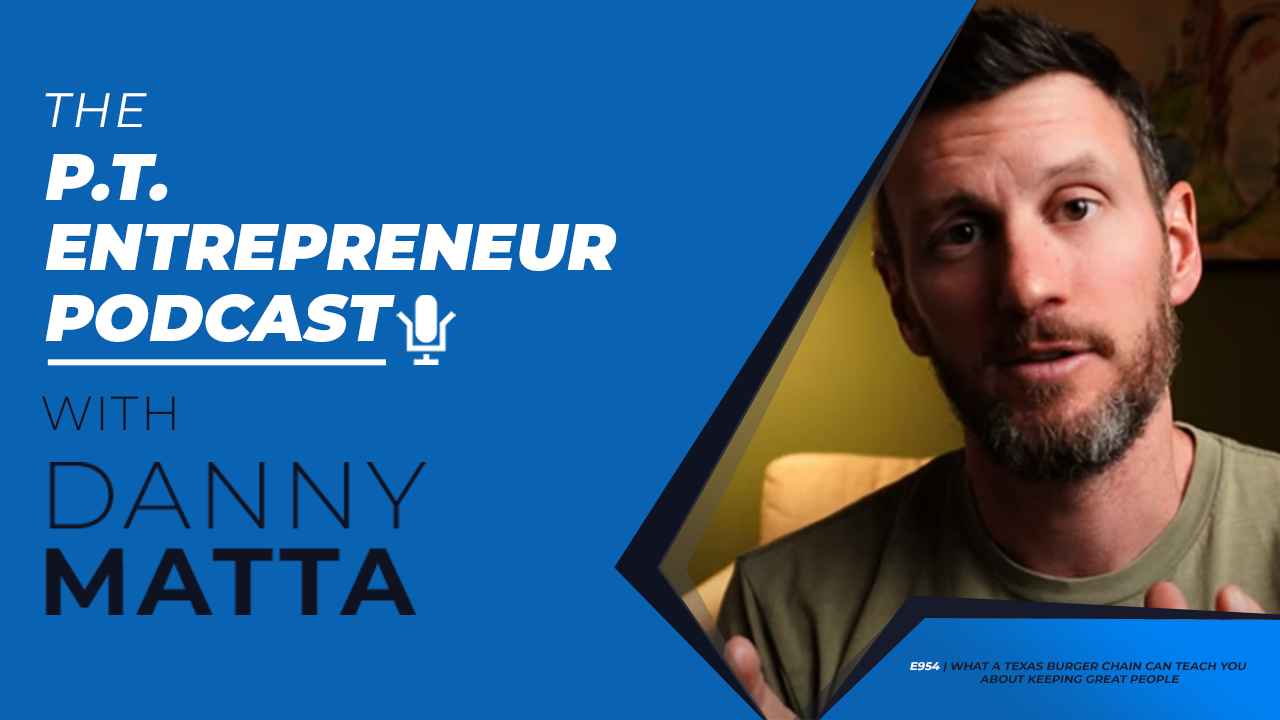
How to Build a Clinic Culture People Don't Want to Leave
Most clinic owners know culture matters.
The problem is that "culture" has become one of those business words that can mean almost anything.
Put your core values on the wall.
Plan a team dinner.
Buy everyone matching shirts.
Tell people you're a family.
None of those things necessarily create a great culture.
Culture is much more practical than that.
It's how working at your clinic actually feels.
It's the accumulation of hundreds of small decisions about how you treat people, how much autonomy they have, what happens when life gets complicated, how leaders respond to problems, and whether employees genuinely believe the business cares about them as human beings.
In this episode of the PT Entrepreneur Podcast, Doc Danny shares the story of a Texas burger company that turned seemingly small employee benefits into an enormous competitive advantage.
The lesson for cash-based physical therapy owners isn't to copy what this company does.
It's to become far more intentional about what you want working at your clinic to feel like.
Because when you get culture right, you don't just create happier employees.
You create a stronger business.
Culture Is More Than Your Core Values
Core values matter.
They can provide a framework for how people inside the company make decisions.
Think of them as a compass.
When something isn't obvious, your values help the team determine which direction makes the most sense.
But values written on a wall aren't culture.
Culture is what actually happens.
It's how your office manager gets treated when they make a mistake.
It's whether a PT can handle an unexpected family obligation without feeling guilty.
It's how you celebrate wins.
It's how you communicate when things aren't going well.
It's whether employees feel trusted.
It's whether people want to tell their friends to come work with you.
The poster is what you say.
Culture is what your team experiences.
A Burger Company Offers a Great Example
Danny came across the story of P. Terry's, a Texas burger chain that started as a single location in Austin in 2005.
It eventually expanded into dozens of locations with roughly 1,800 employees.
That's impressive on its own.
But the more interesting part of the story is how the founders thought about the company they were building.
They largely bootstrapped the growth.
Then, more than a decade into the business, they received an acquisition offer reportedly somewhere between $70 million and $100 million.
They turned it down.
Why?
One of the founders gave an answer that perfectly illustrates what culture actually means.
She wasn't convinced the buyer would continue making birthday cakes for employees.
An $80 Million Decision About Birthday Cakes
At first, that sounds almost ridiculous.
You're talking about generational money.
And the explanation involves cake?
But the cake wasn't really the point.
The cake represented the type of company the founders wanted to own.
From early on, P. Terry's made birthday cakes for employees.
When the company was smaller, the founders actually baked and delivered them themselves.
As the team grew into the hundreds, that became a significant commitment.
There were enough employees that somebody had a birthday almost every day.
But instead of deciding the tradition had become inconvenient, they built infrastructure around it.
Eventually, they hired a baker.
The company grew.
The tradition stayed.
Small Gestures Can Carry Enormous Meaning
Danny shared one detail that makes the story especially powerful.
For some employees, the cake P. Terry's gave them was apparently the first birthday cake anyone had ever given them.
Think about that.
The company wasn't simply providing dessert.
An employee was experiencing something personally meaningful that they might remember for the rest of their life.
That's culture.
It's very difficult to manufacture that feeling through another dollar per hour or a poster in the break room.
People want to feel seen.
They want to know they matter.
They want to believe they're more than labor being exchanged for money.
The cake communicated that.
Don't Copy the Cake
This is where clinic owners can miss the lesson.
You don't need to start baking cakes.
In fact, Danny points out that it probably wouldn't make much sense at Athlete's Potential.
Many people on that team are highly health-conscious, gluten-free, sugar-free, or have specific dietary preferences.
Showing up with a giant sugar-loaded cake might completely miss the mark.
That's the point.
Culture can't simply be copied.
What makes one company's culture meaningful could feel strange or forced inside another organization.
The question isn't:
What does P. Terry's do for employees?
The question is:
What would make our employees feel valued here?
Great Culture Is Personal
The best culture reflects the people inside the organization.
Maybe your team loves training.
Maybe they love continuing education.
Maybe everyone has young kids.
Maybe your clinicians value flexible schedules.
Maybe your team loves outdoor activities.
Maybe they're competitive.
Maybe they're obsessed with professional development.
Maybe they care deeply about autonomy.
Your job isn't to implement the coolest employee perk you heard about on a podcast.
It's to understand your people well enough to know what actually matters to them.
Then build around that.
P. Terry's Solved Another Employee Problem
The birthday cakes weren't the only example.
At one point, an employee called because their car needed a repair.
The repair was around $200.
The employee didn't have the money.
Without the car, they couldn't get to work.
The company could have treated this exclusively as the employee's problem.
Instead, the response was essentially:
We'll help you get to work, and we'll loan you the money.
Pay it back when you can.
That small decision eventually evolved into an interest-free employee loan program.
One Small Decision Became a Million-Dollar Program
According to the story Danny shared, P. Terry's has provided close to or more than $1 million in interest-free employee loans over time.
And the default rate has reportedly been almost nonexistent.
Employees pay the money back based on what they can manage.
The company solves a short-term problem.
The employee avoids a financial emergency.
And the restaurant retains someone who can continue showing up to work.
Everybody wins.
Again, the important lesson isn't that your PT clinic needs an employee lending department.
It's how the owners thought about the problem.
Ask How You Can Remove Friction From Employees' Lives
An employee says:
I can't get to work because my car is broken.
There are two ways to respond.
The first is:
That's your responsibility. Figure it out.
The second is:
Is there a reasonable way we can help solve this?
Both approaches can technically be justified.
But they create completely different cultures.
One reinforces a transactional relationship.
The other creates trust.
The second employee is probably going to remember what the company did for them.
And when that business needs something difficult from the team later, that history matters.
Culture Is Built During Problems
It's easy to have a good culture when everything is going well.
Culture becomes visible when something inconvenient happens.
An employee has a sick child.
Someone's car breaks down.
A clinician needs an unexpected afternoon off.
A staff member makes a mistake.
Someone is struggling financially.
A provider wants to pursue an educational opportunity that exceeds the normal budget.
Those moments reveal what the company actually values.
Your response becomes part of the story employees tell themselves about working for you.
The Dream Manager Shows the Same Principle
Danny connects the P. Terry's story to The Dream Manager, a book built around another high-turnover industry.
The company in that story was dealing with significant turnover among janitorial employees.
Instead of simply accepting turnover as inevitable, leadership tried to understand what was making employees' lives difficult.
They started talking to people about their goals.
Patterns emerged.
Some employees wanted help improving their English.
The company created English classes.
Transportation was another problem.
So the company found ways to improve transportation.
The interventions weren't random employee perks.
They solved actual problems.
Employee Retention Is a Business Problem
This matters enormously for cash PT practices.
Replacing employees is expensive.
A clinician leaves and suddenly you have unused capacity.
Patients may need to be reassigned.
Schedules have to change.
Administrative staff have to communicate with patients.
Referral relationships can become disrupted.
The owner may have to jump back into treatment.
Then recruiting starts.
Interviews.
Onboarding.
Training.
Ramp-up.
Culture isn't separate from the economics of the clinic.
Retention affects the economics directly.
Throwing More Money at People Isn't Culture
Compensation matters.
You should pay people fairly.
You should understand your market.
You should create roles where talented people can build good careers.
But money alone doesn't solve everything.
Danny references the famous scene from Mad Men where Don Draper essentially responds to an employee wanting recognition by arguing that compensation is what the money is for.
It's a perfect example of transactional leadership.
I pay you.
You work.
End of relationship.
Human beings generally don't work that way.
People Want More Than a Paycheck
Think about the best job you've ever had.
Was it purely because of the salary?
Probably not.
Maybe you liked your coworkers.
Maybe you trusted your boss.
Maybe you had autonomy.
Maybe the work was interesting.
Maybe someone believed in you.
Maybe you were learning.
Maybe the schedule worked for your family.
Maybe you felt like your contribution mattered.
Compensation keeps a job economically viable.
Culture determines much of what the job feels like.
The strongest employers understand both.
Cash PT Clinics Have an Advantage Here
Independent cash practices aren't giant hospital systems.
That's actually useful.
A small business can personalize things much more easily.
You know your people.
You probably know their spouses.
Their kids.
What they're training for.
What they care about professionally.
What they're trying to accomplish.
That creates opportunities to build an employee experience that a massive organization may struggle to replicate.
You don't need an enormous HR budget.
You need attention.
Autonomy Can Be an Employee Benefit
Danny gives a simple example from Athlete's Potential.
If an employee needs to go to the dentist, they can block their schedule.
If their child has an appointment, they can handle it.
They don't need to navigate some complicated approval process just to manage a normal life obligation.
The expectation is essentially:
Be an adult.
Take care of what you need to take care of.
Then come back.
That sounds simple.
But for clinicians coming from rigid healthcare organizations, that level of autonomy can be incredibly valuable.
Flexibility Can Be Worth More Than You Think
Clinic owners sometimes undervalue flexibility because it doesn't appear directly on a compensation statement.
But imagine two jobs.
Job A pays slightly more but makes every personal obligation difficult.
Job B trusts you to manage your schedule responsibly.
Which one works better for the parent who occasionally needs to pick up a sick child?
Which one works better for someone with appointments of their own?
Which one makes an employee feel more like a professional?
For the right person, autonomy has significant value.
Treat Professionals Like Professionals
There's an important qualifier.
Autonomy works when expectations are clear.
It doesn't mean people can do whatever they want without regard for patients, coworkers, or the business.
The expectation is responsibility.
If you're going to give adults more freedom, you also need them to understand the standard they're responsible for maintaining.
That's the trade.
Trust plus accountability.
When you hire the right people, that can create a much healthier environment than building policies around the assumption that everyone will abuse flexibility.
Continuing Education Can Become Part of the Culture
Another example Danny shares is continuing education.
A clinic may have a defined annual CE budget.
That's useful.
But what happens when a great clinician finds something they're genuinely excited about that exceeds the normal allowance?
At Athlete's Potential, there are situations where the business will help cover more.
Why?
Because they want clinicians who are obsessed with getting better.
They want people who care deeply about outcomes.
If someone is voluntarily asking to go deeper into their craft, that's behavior worth encouraging.
Invest More in the Behaviors You Want More Of
This is a useful leadership principle.
What behaviors do you want your team to repeat?
Curiosity?
Professional development?
Great patient care?
Leadership?
Community involvement?
Mentoring younger clinicians?
Creating content?
Developing new services?
If someone is demonstrating exactly the behavior you say you value, find ways to reinforce it.
Culture becomes much stronger when employees see that the company actually invests behind its stated priorities.
Your Budget Doesn't Have to Become a Ceiling
This doesn't mean saying yes to every request.
A business still needs boundaries.
You need healthy margins.
You need budgets.
You need consistency.
But there is a difference between having a guideline and treating every policy as inflexible.
Maybe your normal CE allowance is one amount.
Then an exceptional opportunity appears that directly supports the clinician's development and the clinic's goals.
You can make a judgment call.
That's one advantage of being an independent owner.
Team Experiences Matter Too
Athlete's Potential also holds an annual team offsite.
The team gets out of the normal clinic environment.
There is structured business work.
There is unstructured time.
Maybe pickleball.
A hike.
Time together in the North Georgia mountains.
The point isn't simply entertainment.
It's giving people space to build relationships outside the normal pace of patient care.
Those relationships matter when everyone returns to work.
People Stay Where They Have Strong Relationships
Employees don't experience your clinic only through their relationship with you.
They experience it through the entire team.
Do they like the people they work beside?
Do they trust them?
Can they laugh together?
Do they help each other?
Do they enjoy being around each other?
A strong team creates its own retention advantage.
Leaving a job becomes harder when you're also leaving people you genuinely enjoy working with.
Retention Makes Recruiting Easier
Culture doesn't only help you keep employees.
It helps you find the next ones.
Imagine interviewing a clinician and introducing them to someone who has worked at your clinic for six years.
Then another person who has been there for years.
Then an office manager who has been around for more than a decade.
That communicates something.
People don't usually remain in terrible workplaces for that long.
Long-tenured employees become evidence that the opportunity you're describing is real.
Happy Employees Become Super Brand Ambassadors
This is where culture begins to compound.
A clinician enjoys working for you.
They tell a friend.
That friend is another great PT.
The employee says:
You should come work here.
That recommendation carries far more weight than your Indeed posting.
Your staff knows what working there is actually like.
If they're willing to attach their reputation to recommending the clinic, prospective employees notice.
That's how great employees become Super Brand Ambassadors for the business.
Culture Can Become a Recruiting Moat
Salary can be copied.
PTO can be copied.
Benefits can be improved.
Another clinic can buy similar equipment.
They can build a nice facility.
Culture is harder to copy because it develops through years of decisions and relationships.
That's what makes it valuable.
When talented people want to stay and other talented people want to join them, you have created something competitors can't easily reproduce.
And that starts with something much smaller than an HR strategy.
It starts with deciding what you want working at your clinic to actually feel like.
Your Culture Is Built in the Small Decisions
It's easy to overcomplicate this.
You don't need to immediately create an elaborate employee experience program.
Start paying attention to the little decisions.
What happens when someone needs an afternoon off?
How do you recognize birthdays or major life events?
What happens when a clinician wants to pursue additional education?
How do you respond when an employee is going through something difficult?
How much autonomy does your team have?
Do employees feel comfortable bringing problems to you?
Those moments accumulate.
Eventually, they become the story people tell about what it's like to work at your clinic.
Ask Your Team What Would Actually Make Their Lives Better
One of the easiest places to start is simply asking.
Sit down with your team and ask:
What are some small things we could change that would make working here better?
You might be surprised by the answers.
They may not ask for some massive new benefit.
Maybe the scheduling process is unnecessarily frustrating.
Maybe there's a piece of equipment that would make treatment easier.
Maybe clinicians want more control over their schedules.
Maybe the team wants more opportunities to spend time together.
Maybe there's an administrative task everyone hates that could be automated or delegated.
The only way to know is to have the conversation.
Asking Doesn't Mean You Have to Say Yes
This is important.
Listening to employees doesn't mean turning your business into a democracy.
You're still responsible for the company.
You understand the finances.
You understand the constraints.
You have to make decisions that protect the entire organization.
Sometimes an employee will ask for something that doesn't make sense.
You can say no.
Great culture isn't about saying yes to everything.
It's about creating an environment where people feel comfortable sharing ideas and trust that you'll genuinely consider them.
Explain the Why When the Answer Is No
When possible, give people context.
Instead of:
No, we're not doing that.
You can explain why.
Maybe the economics don't work.
Maybe it creates an unfair precedent.
Maybe it would negatively affect patients.
Maybe it's simply not aligned with the direction of the company.
People don't have to agree with every decision.
But understanding the reasoning behind decisions builds trust.
Transparency helps employees see the business as a system instead of assuming every decision is arbitrary.
Your Culture Should Reflect Your Values
This is where core values become useful.
Not because they're printed on the wall.
Because they help you decide what fits.
If professional development is genuinely important to your clinic, your decisions around continuing education should probably reflect that.
If family is important, your scheduling policies should reflect that.
If clinical excellence matters, your providers need the time and resources required to deliver excellent care.
If autonomy matters, your systems shouldn't require employees to ask permission for every small decision.
Values become meaningful when they cost you something.
Otherwise they're just words.
Every Clinic Should Feel Different
This is one of the most important ideas from the P. Terry's story.
There isn't one correct company culture.
Another successful burger chain might make completely different decisions.
That doesn't mean either business is wrong.
The same is true for physical therapy practices.
One clinic might have a highly structured environment with clear systems, defined schedules, and significant accountability.
Another may provide more flexibility and autonomy.
One team might love competitive fitness events.
Another might want family-friendly gatherings.
One clinic might invest heavily in advanced clinical education.
Another might put more resources toward performance coaching, leadership development, or community involvement.
The goal isn't to create the "best" culture according to somebody else's definition.
It's to build one intentionally.
Your Culture Is an Extension of the Owner
Especially early on, the owner's personality influences almost everything.
How you communicate.
What you tolerate.
What you celebrate.
What you prioritize.
How you respond under stress.
How you treat patients.
How you treat employees.
The business absorbs those behaviors.
That's why culture requires some self-awareness from the owner.
You have to decide what kind of organization you actually want to lead.
Start Before You Have Employees
You don't need a team to start thinking about culture.
If you're still solo, this is actually a great time to define it.
How do you want patients to feel?
What kind of clinicians would you eventually want to hire?
How would you want those clinicians to describe working for you?
What behaviors will matter?
What won't you tolerate?
How flexible do you want the organization to be?
What type of professional development do you want to encourage?
The earlier you answer those questions, the easier hiring becomes later.
You're not inventing the company culture after five people arrive.
You're inviting people into something you've already started building.
Hire People Who Fit the Environment You're Building
Culture becomes significantly harder when you hire solely for clinical skill.
Someone can be an excellent physical therapist and still be the wrong fit for your clinic.
Maybe they don't communicate well.
Maybe they don't enjoy collaboration.
Maybe they dislike the level of autonomy you're offering.
Maybe they're uncomfortable with the expectations of a cash-pay environment.
Maybe their professional goals simply don't align with the opportunity.
That's okay.
Not every great clinician should work at your clinic.
You're looking for alignment.
Hire the Right People, Then Work Hard to Keep Them
Retention starts with selection.
If you hire someone whose values, expectations, and goals are completely different from the organization, no amount of birthday cakes will fix it.
But once you have the right person, retaining them becomes incredibly valuable.
They know the systems.
They understand the patient experience.
They have relationships with patients.
They know the community.
They know the team.
They understand your expectations.
Every year they remain, that institutional knowledge compounds.
Turnover Resets More Than a Schedule
When a clinician leaves, owners often calculate the obvious loss.
Their schedule is no longer producing revenue.
But the actual cost is much bigger.
Patients have relationships with that clinician.
Referral sources may have relationships with that clinician.
Administrative employees have developed workflows around them.
Other providers rely on them.
The culture changes.
Then the owner has to recruit.
Interview.
Hire.
Onboard.
Train.
Build a schedule.
Develop the new person's confidence.
It can take months to fully replace what walked out the door.
Turnover Can Force the Owner Back Into Treatment
This is especially painful in smaller clinics.
You've finally reduced your treatment schedule.
You're spending more time leading.
Marketing is improving.
The team is growing.
Then a provider leaves.
Suddenly there are 25 patient visits per week that need somewhere to go.
Who becomes the easiest solution?
You.
Now you're back in the clinic.
The leadership work gets pushed aside.
Marketing slows.
Recruiting becomes urgent.
And the owner can quickly become the Rainmaker and primary clinician again at the exact moment the business needs leadership most.
That's why retention is not a soft HR metric.
It's operational stability.
Retention Helps You Scale Faster
Imagine two clinics.
Both hire one clinician every year.
Clinic A retains almost everyone.
Clinic B loses someone every year.
After five years, the businesses look completely different.
Clinic A is stacking talent.
Each new hire adds capacity on top of the existing team.
Clinic B keeps replacing capacity it already had.
One is compounding.
The other is running in place.
That's why Danny emphasizes how valuable staff longevity becomes.
Keeping the right people creates momentum.
This Is Another Piece of the Compounding Clinic
We often talk about compounding in terms of patients.
A patient gets a great result.
They refer someone.
That person gets a great result.
They leave a review.
The reputation grows.
Acquisition gets easier.
The same thing happens internally.
A great employee stays.
They become better clinically.
They understand the systems.
They develop community relationships.
They refer another great employee.
That person stays.
The team gets stronger.
Recruiting becomes easier.
That's internal compounding.
Long-Term Employees Create Stability
Danny points to the tenure of people at Athlete's Potential.
Some employees have been around for many years.
Their office manager has been there for roughly a decade.
That type of longevity matters.
It creates continuity.
It creates institutional knowledge.
It creates leadership beneath the owner.
It also sends a signal to newer employees:
People can build a career here.
That's very different from a clinic where everyone seems to disappear after 12 months.
Not Every Departure Means Your Culture Is Broken
People will still leave.
That's reality.
Someone's spouse gets a job in another state.
Someone wants to start their own practice.
Family circumstances change.
Career goals change.
People move.
You cannot create a culture so good that nobody ever leaves.
And you shouldn't try.
The goal is to reduce preventable turnover.
You want good people to stay because the opportunity continues to make sense for them.
When someone has a legitimate reason to move on, you can support them and keep the relationship intact.
Don't Confuse Retention With Avoiding Accountability
There's another side to this.
Keeping people isn't always the goal.
Keeping the right people is.
A toxic employee who produces a lot of revenue can damage culture.
A clinician who doesn't meet standards can create problems for patients and coworkers.
An administrator who repeatedly drops important responsibilities creates stress for everyone else.
Great culture isn't endlessly accommodating poor performance.
In fact, protecting culture sometimes requires making difficult personnel decisions.
Your best employees notice what you tolerate.
Culture Requires Standards
Trust matters.
Flexibility matters.
Autonomy matters.
But so do expectations.
If one clinician consistently arrives late while everyone else is on time, that's culture.
If someone treats administrative staff poorly and nothing happens, that's culture.
If people ignore follow-up expectations, that's culture.
If the owner constantly makes exceptions for one person, that's culture.
What you tolerate becomes just as influential as what you reward.
The Best Cultures Combine Freedom and Accountability
This is why the "big boy, big girl rules" idea works when the right people are involved.
You can give people autonomy because expectations are clear.
Need to go to the dentist?
Go.
Need to take care of your child?
Take care of them.
Want to pursue an educational opportunity?
Let's talk about it.
But the freedom exists alongside responsibility to patients, teammates, and the business.
That's a mature professional environment.
And for clinicians coming from organizations that micromanage every minute of their day, it can be extremely attractive.
Don't Underestimate the Value of Being Treated Like an Adult
Many independent clinic owners assume they have to compete primarily through compensation.
Compensation absolutely matters.
But there are other forms of value.
Autonomy.
Flexibility.
Clinical freedom.
One-on-one care.
Better patient populations.
Professional development.
Strong relationships.
A leader who knows you personally.
An environment where your opinion matters.
A schedule that allows you to have a life.
Those things don't replace fair pay.
They complement it.
Together, they can create an employment opportunity that a much larger organization has trouble matching.
Your Culture Becomes Part of Your Recruiting Message
When you interview a clinician, don't only explain compensation and benefits.
Show them what working there is actually like.
Talk about how schedules work.
Explain how continuing education is handled.
Let them meet the team.
Talk about the patient population.
Show them how much autonomy clinicians have.
Explain what happens when someone has a family obligation.
Share examples of people who have grown inside the company.
If you've intentionally created a great place to work, don't hide it.
That's part of your offer.
Your Current Employees Are the Proof
Anybody can say:
We have a great culture.
Almost every company does.
The better evidence is your team.
How long have people stayed?
Do they enjoy being there?
Would they recommend the clinic to another PT?
Do they spend time together outside work?
Have they grown professionally?
Have people taken on more responsibility?
Can they describe why they like the organization?
Prospective employees will trust those signals far more than the phrase "great company culture" in a job posting.
Culture Affects the Patient Experience Too
Employees don't leave their feelings in the break room when a patient arrives.
A frustrated team feels different.
A burned-out clinician delivers a different experience.
An administrator who hates their job communicates differently on the phone.
A team with constant turnover creates inconsistency.
On the other hand, people who enjoy working together tend to create a better environment for patients.
They communicate.
They help each other.
They have energy.
Patients notice.
So while culture starts internally, it eventually becomes visible externally.
Your Reputation Isn't Just What Patients Say
Clinic owners spend a lot of time thinking about Google reviews.
That's important.
But there's another reputation developing at the same time.
What do former employees say?
What do current employees tell other clinicians?
What does your local PT community think about working for you?
What do students hear?
What do referral partners hear from your team?
As your clinic grows, your employer reputation becomes increasingly important.
The best clinicians often have options.
They'll ask around.
Culture becomes part of your brand whether you intentionally build it or not.
You Get to Decide What Your Business Represents
This is ultimately what Danny found compelling about the P. Terry's story.
The founders made choices based on what mattered to them.
They weren't simply following the standard playbook.
They had a vision for what kind of company they wanted to own.
That vision influenced how they treated employees.
It influenced how they grew.
It even influenced how they evaluated an enormous acquisition offer.
Your decisions probably won't involve turning down $80 million.
But the principle is the same.
What are you building?
Don't Accidentally Build a Business You Don't Like
Clinic owners can become so focused on growth that they never stop to answer this.
They want more patients.
Then another clinician.
Then more space.
Then another location.
Then higher revenue.
But what does the company actually feel like along the way?
Do you like the environment you've created?
Do you enjoy the people?
Are you proud of how the company treats them?
Does the business reflect your values?
Would you want to work there if you weren't the owner?
Those questions matter.
Culture Should Make You Proud of the Business
One of the best parts of owning a company is watching other people grow through it.
Someone buys a home.
Someone pays off student loans.
Someone has a child.
Someone becomes a better clinician.
Someone develops into a leader.
Someone reaches a financial goal.
You get to play a small role in those milestones because the business created an opportunity for that person.
That's one of the most meaningful parts of entrepreneurship.
The business stops being only about what it provides to you.
It becomes a vehicle that improves other people's lives too.
Start With One Small Change
You don't need a culture initiative.
You need intentionality.
Talk to your team.
Ask questions.
Pay attention.
Find one friction point you can remove.
Maybe you give clinicians more autonomy over their schedules.
Maybe you improve your continuing education policy.
Maybe you create a better process for recognizing important milestones.
Maybe you plan an annual team offsite.
Maybe you simply start celebrating employees more intentionally.
Pick something that genuinely fits your people.
Then do it consistently.
Culture Is What You Repeatedly Do
One birthday cake doesn't create culture.
One team dinner doesn't create culture.
One generous decision doesn't create culture.
Repetition does.
The reason the P. Terry's story is meaningful isn't that the founders once baked an employee a cake.
It's that they kept doing it.
When they had dozens of employees, they did it.
When they had hundreds, they did it.
When it became inconvenient, they built a system to continue it.
That's when an action becomes culture.
Protect the Things That Matter as You Scale
This becomes harder as the clinic grows.
When you're solo, you know everything happening in the business.
With two employees, you know nearly everything.
At 10 or 20 people, you don't.
That's why owners have to identify which parts of the culture need to be deliberately protected.
Maybe it's autonomy.
Maybe it's clinical excellence.
Maybe it's personalized employee development.
Maybe it's how patients are treated.
Maybe it's team connection.
Growth creates pressure to standardize.
Some standardization is necessary.
But don't accidentally standardize away the things that made people want to work there in the first place.
Technology Spotlight
Documentation continues to be one of the biggest frustrations for physical therapists.
And if you're serious about building a better employee experience, documentation burden is part of that conversation.
Claire is an AI scribe built specifically for PTs that dramatically reduces documentation time, allowing clinicians to focus on patient care instead of paperwork.
That's not just an efficiency improvement.
Giving clinicians less administrative work to take home can improve what working at your clinic actually feels like.
👉 Try Claire free for 7 days
https://www.meetclaire.ai/?utm_source=preroll&utm_medium=podcast&utm_campaign=pt_entrepreneurs
More PT Biz Training
Want more content on building a scalable cash practice?
👉 PT Biz Training YouTube
https://www.youtube.com/@ptbiztraining
Final Thoughts
Culture isn't your core values painted on the wall.
It's what your employees experience every day.
It's whether you trust them.
How you respond when life happens.
What you invest in.
What you celebrate.
What you tolerate.
And whether people feel like they're an important part of something instead of simply an employee filling a schedule.
You don't need to copy P. Terry's.
You don't need birthday cakes or an employee loan program.
You need to decide what matters to you and your team, then make small decisions that reinforce those values consistently.
Start by asking your staff one question:
What's one small thing we could change that would make working here better?
Listen to the answers.
You don't have to say yes to everything.
But you'll learn what your people value.
Then build intentionally from there.
Because when you hire the right people and create an environment where they genuinely want to stay, you aren't just improving morale.
You're improving patient experience, protecting capacity, making recruiting easier, reducing turnover, and creating a business that can compound for years.
That's what great culture can do for a cash PT clinic.