E880 | 4 Hard Lessons From 2025 (That Will Make You a Better Clinic Owner in 2026)
Jan 01, 2026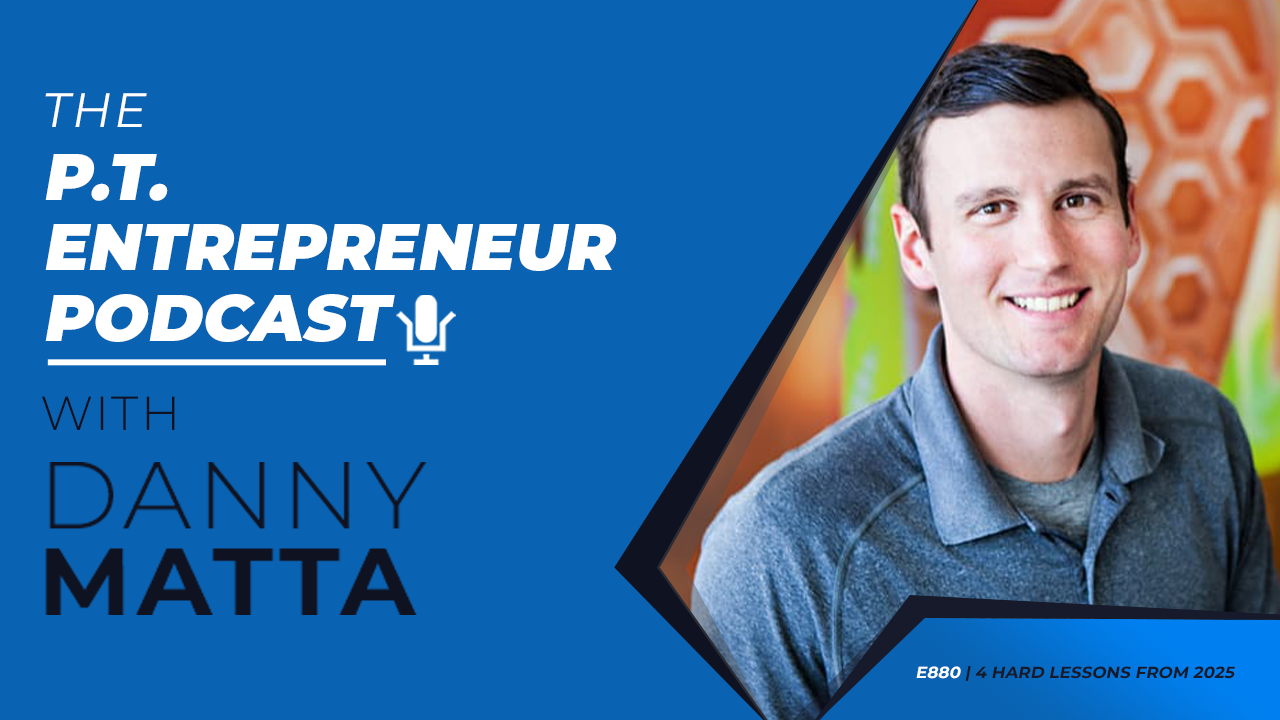
Four Lessons From 2025 for Cash-Based PT Owners
Every December, Danny sits down, looks back at the year, and asks a simple question. What did I actually learn?
This time, the answers hit on four big areas that matter for clinic owners: revenue dips, the rise of corporate cash clinics, the longevity boom, and why your happiness cannot live and die with your numbers.
Here is the breakdown in plain language.
1. The First Year Revenue Went Backwards
Outside of the COVID shutdown year, PT Biz had never seen a drop in annual revenue. In 2025, it finally happened. The drop was small, but it was still a step back on the scoreboard.
The team made a bet going into the year. Go hard on brand and visibility. More clinic tours. More polished content. More YouTube. More professional video across the board. The idea was simple. If the brand looked and felt like what PT Biz actually delivers, it would lift everything else.
That part worked. The brand now looks sharper and more consistent than ever.
The tradeoff came from what got pushed aside. Core sales and marketing systems that directly feed client acquisition were not getting the same level of attention. The “boring” fundamentals that built the company were no longer the main focus.
The lesson is pretty clear. Big creative bets are fine, but you cannot rob the fundamentals to pay for them. Momentum comes from effort multiplied by accuracy. The effort was high this year, but the target was slightly off, and revenue told the truth.
2. Corporate Cash Clinics Are Coming
In markets across the country, regional cash and hybrid groups are growing. These are performance-based clinics with strong operators, multiple locations, and a clear brand.
As interest rates drift down, money gets cheaper. That is when bigger players and private capital start looking harder at models that work. Cash-based PT is attractive. It is still fragmented. It can be profitable. And the demand is growing.
That creates a fork in the road for smaller owners.
You can stay small, owner-operated, and lifestyle focused. Keep overhead lean, do great work, and accept that your personal capacity caps your growth. There is nothing wrong with this.
Or you can decide to grow and compete. If you choose that route, you have to accept that your limiting factor is no longer manual skills. It is business skill. Hiring. Leading. Keeping people. Managing cash flow. Building a team you do not micromanage. Driving marketing that goes beyond your personal network.
The middle ground of “I will just wing it and hope” is where people get hurt. In a future where corporate cash groups offer better pay, benefits, and career paths, you either commit to becoming a real business owner or you stay intentionally small.
3. Health Is Wealth, And It Is Your Biggest Opportunity
There is a cultural wave forming around health and longevity.
People are listening to three-hour podcasts about zone 2 training and REM sleep. Functional medicine clinics are everywhere. High-end gyms are launching “longevity programs” that bundle training, testing, and recovery work for tens of thousands of dollars a year.
A decade ago, almost nobody walked into a PT clinic asking for help with proactive longevity. Today, patients are far more aware that they can live longer and move better if they take this seriously.
For a performance-based, movement-focused clinic, this is a gift.
You can be the person who gets them out of pain and then helps them stay strong, mobile, and independent for years. That might look like:
-
Regular strength and mobility progressions
-
Periodic movement and performance testing
-
Coaching around sleep, recovery, and training habits
-
Long-term continuity options that keep them in your world
This is not fluff. It increases lifetime value. It stabilizes your revenue. More importantly, it lets you do the deeper work you probably wanted to do when you chose this career.
If you do not have a long-term health and performance offer for your best-fit patients yet, now is the time to build one.
4. Happiness Is Not Tied to “Winning”
For a long time, Danny treated revenue like a scoreboard. Hit the number and you feel like a winner. Miss it and you feel like a loser. That mindset bleeds into every part of your life if you are not careful.
In earlier years, a miss like 2025 would have wrecked his mood for weeks and spilled into how he showed up with his family.
This year was different. The goals were missed, but life was still good. Very good.
When he zoomed out, here is what he saw:
-
A rebuilt knee that finally let him run, hike, and play again
-
A marriage that is stronger after nearly twenty years together
-
Kids who are healthy, growing, kind, and ambitious
-
A local community of friends that actually feels like home
Seen through that lens, a modest revenue drop is not a life crisis. It is a data point.
The practical tool behind that shift is gratitude, but not the vague social media version. It is specific and grounded. When business feels heavy, you stop and ask:
What went right this year
What did I learn
What would I never trade for a slightly higher revenue number
That reframes the entire year. You can still be competitive. You can still push. You just refuse to let one dimension of your life define all the others.
What To Do With This As a Clinic Owner
If you want to put this episode into action, here are a few simple steps.
-
Review the year honestly. Where did you misdirect effort away from proven fundamentals
-
Decide your path. Are you building a lifestyle clinic or a scalable business that will have to compete with bigger players
-
Build your long-term health offer. Start talking about performance and longevity, not just pain relief
-
Protect your perspective. Take time to write down what went right this year in your business, your health, your family, and your community
If you want help figuring out what to work on next, you can jump on a call with a PT Biz advisor and look at your numbers, your goals, and your next moves together:
👉 https://vip.physicaltherapybiz.com/discovery-call
And if you want your documentation time back so you can actually be present with your patients, you can try Claire for free:
Do you enjoy the podcast? If so, leave us a 5-star review on iTunes and tell a friend to do the same!
Ready to elevate your practice? Book a call at the link below with one of our expert consultants today and start your journey to delivering unparalleled physical therapy.

Podcast Transcript
Danny:
[00:00:00] Hey, what's going on? Doc Denny here with the PT Entrepreneur Podcast, and it's the end of the [00:00:05] year. It's the end of 2025. [00:00:10] And one of the things I love to do with this podcast is [00:00:15] to sit down and really think through what I learned this year [00:00:20] and, and, you know, today what my process was was, um. I went on a [00:00:25] walk, I sat in my office and really just did some journaling, [00:00:30] um, and tried to come up with what I thought were the most impactful things that I've learned this year.[00:00:35]
And these are mostly business, but business and personal. They overlap. [00:00:40] So these are the four things that I took away from this year [00:00:45] that are lessons learned that I hope I can share with you. And they'll help you, [00:00:50] um, you know, grow in these areas as well. Maybe not make the same mistakes, uh, and, [00:00:55] um, you know, and, and just see that number one, like that doesn't matter how long [00:01:00] you've been in business doing things.
We still make mistakes. I don't think [00:01:05] that ever changes. You know, this, I, I'm over a decade at this point into, [00:01:10] um, being, you know, an entrepreneur, being self-employed, running multiple [00:01:15] businesses, bigger teams, small teams. You know, like [00:01:20] I've, I've, I've had experienced a number of different businesses and, um, [00:01:25] you know, this year I would say the theme of this year [00:01:30] has been, uh, uh.
I guess a little bit of [00:01:35] frustration and missing the mark, and I'll kind of talk a little bit about what I, I mean by that as [00:01:40] far as some of the things that, that I learned. But number one is this is the [00:01:45] first year that I've ever been a part of a business where we've actually [00:01:50] had a revenue decline. And, uh, aside from [00:01:55] when I ran our, our clinic during COVID, so.
[00:02:00] That was different. The clinic was shut down for a number of weeks, and then it was, [00:02:05] um, obviously a very challenging time to run an in-person business in, uh, 2020. [00:02:10] But other than that, I've never experienced that. So, um, this is the first [00:02:15] year where we, we've had that, and it wasn't a, a major drop in revenue by any means.
It was, it [00:02:20] was, um, fairly minor, but uh, top line revenue was higher for [00:02:25] our pt b last year than it. And it is this year, and I'm gonna kind of talk to you a little about [00:02:30] why in retrospect I think that happened. So [00:02:35] when we went into 2025, we always plan on things that we want to do, [00:02:40] uh, as most business owners that are, you know, pretty, pretty squared away [00:02:45] business owners are gonna do, and we usually have.
Really important things we wanna focus [00:02:50] on, not necessarily, uh, we, we have KPIs we track and things of that nature, right? So we'll say, okay, we need [00:02:55] this number of clients, this number of calls, this number of things that we're gonna, you know, back into just like you [00:03:00] would, we need this number of new patients, number of staff, this number of visits that we need to see in the year, [00:03:05] um, as far as, you know, hitting, uh, gross revenue goals.
But one of the [00:03:10] things that we thought, the hypothesis we had was that. [00:03:15] If we could really lean into our brand, right, really lean into sharing and, [00:03:20] um, professionalizing our brand, that that would have [00:03:25] a corresponding positive effect on, uh, the revenue of [00:03:30] the business, right? So. That's what we did, and it's something that we've [00:03:35] wanted to do for a long time.
Really, um, you know, lean more into [00:03:40] professionalizing what we're doing visibly and uh, and to work on projects that we [00:03:45] felt were important for the profession. For instance, one of those big things for me is clinic [00:03:50] tours. I really enjoy sharing [00:03:55] the, um, you know, the clinics of. Clients we get to work with and friends [00:04:00] of ours that, that we get to highlight.
I love that the, the profession gets to see [00:04:05] that. Um, it does take a lot of time, effort, energy, [00:04:10] and money to be able to go and do those things. And, [00:04:15] um, you know, and there, it's, it was a part of our, uh, essentially [00:04:20] our, our brand and marketing strategy in [00:04:25] 2025. A big part of it. And, you know, not just that, but [00:04:30] also leaning into professionalizing short form content, longer form content, [00:04:35] YouTube, you know, being able to be more visible on video as well, which in its own right is a lot [00:04:40] of additional effort, a lot of additional time.
Um, and I think we did a really [00:04:45] good job actually of professionalizing our brand of, of, um, [00:04:50] making it more consistent, coherent. Uh, ma making [00:04:55] it like really look, uh, the way that we feel our [00:05:00] company should be represented. And, but, uh, on the [00:05:05] corresponding, you know, aside of that, what we didn't do was [00:05:10] continue to work on many of the fundamental things within our sales and marketing [00:05:15] pipeline that.
Got us where we are because of [00:05:20] re uh, redistribute redistributing effort, energy, attention [00:05:25] towards these other KPIs and these other projects. And we were [00:05:30] wrong. Um, at least as far as in the short term goes, as far as our KPIs go, [00:05:35] we, um, it did not, uh, generate. [00:05:40] As many opportunities, as many potential clients and as much brand trust as we thought that it [00:05:45] would.
We felt that it would also help share just how much great work we're doing and the people that we're working [00:05:50] with. Um, but you know, if anything else, like it didn't, it [00:05:55] didn't help as much as we thought that it would, we were wrong. Uh, and it's funny [00:06:00] because, you know, as you plan your year out, you're not [00:06:05] always gonna be right.
And. You also can't necessarily [00:06:10] look in the, the scope of just a year. We might be right actually [00:06:15] in a couple years. Uh, and it's not like we're changing what we're [00:06:20] doing. Um, we just are, uh, refocusing on other things that are [00:06:25] more KPI driven specifically for the, you know, the, the new [00:06:30] acquisition of, uh, clients in the business.
And that's what we got away from. [00:06:35] More really focused more on, um, engagement, growth of [00:06:40] platforms than anything else. So, you know, long term over the next few [00:06:45] years, is there anything that makes you think that like. You know, a more professionalized brand, [00:06:50] uh, decreases the likelihood a cus that a company will have success.
Probably not, but it [00:06:55] may not be as impactful as we thought that it would actually be. And [00:07:00] you know, this is actually a really important lesson. That I think you can learn for your clinics as [00:07:05] well. And this is like, I see this with people when they do big rebrands and [00:07:10] you know, brand refreshes or they think that, you know, some, I don't know, [00:07:15] social media campaign or some ad strategy is gonna, this [00:07:20] one thing is gonna really make you know this huge difference and have this sort of domino [00:07:25] effect.
And oftentimes that's not actually what drives the business forward. [00:07:30] What it usually tends to be is. It's lots of little problems that you [00:07:35] have to effectively deal with along the way. Um, it's not like this silver bullet, [00:07:40] right? It's not this one big thing. And I would say be [00:07:45] careful, uh, you know, reallocating your time, attention and resources on a big [00:07:50] bet.
Something like what we did, um, when in actuality, you know. [00:07:55] The, the fundamental things, the things that work over and over and over again, you've gotta stay on top of those as [00:08:00] well, right? So if you're in a clinic, it's making sure that you are, [00:08:05] you know, a part of your local. Uh, community, you're, you have a presence there that you are creating content and [00:08:10] you're putting that out on a regular basis, specific to the niche that you wanna serve.
That you [00:08:15] are training your staff to have the correct conversations with people so that they can maintain a high P of care [00:08:20] conversion, training your staff on what they can do with people long term so that they can have a high lifetime value [00:08:25] and help people long term with their health and wellness proactively.
You know, it's, it's making sure [00:08:30] that there's consistency in your product and it's, some of this is like kind of the boring stuff, right? [00:08:35] Um, and that's somewhat where, uh, I felt. You know, I focused my attention on, in [00:08:40] 2024 when we actually had, uh, the, the biggest growth year that we've, that we've [00:08:45] seen, um, that, that year.
And, you know, for me to express my [00:08:50] creative outlet more didn't necessarily lead to the outcomes that we wanted on the business [00:08:55] side. As much as I enjoyed a lot of the things that we're doing, you know, it's really a mixture of the two that is [00:09:00] necessary. So don't forget about the fundamentals. Don't forget about the.
Things you have to do on a regular [00:09:05] basis that lead to the outcome that you want. Um, but then also. It's totally [00:09:10] fine. Right? Like, even though this is the only time that we've ever seen a drop in revenue, aside from like I said, the COVID year with our [00:09:15] clinic, um, our business is in a fantastic spot. It's like there's so many business owners that would [00:09:20] switch places with me though.
I mean it, we have a incredible business where we get to work with [00:09:25] mission driven people. We have a team that's just really sharp. [00:09:30] Uh, our culture is healthy. You know, we enjoy. Working with one [00:09:35] another. We have a team of professionals that trust one another that do the work that they say they're gonna [00:09:40] do.
I, I think we deliver things at a very high level. I think that, [00:09:45] um, you know, our brand reputation is that of people that are, uh, [00:09:50] trustworthy, that have high integrity, that know what they're talking about, um, and that they, [00:09:55] uh, they help really build true, you know, clinical business owners, um, in the [00:10:00] profession and are changing the profession.
And I'm very, actually, I'm very, very proud of our team. I think our team has done a [00:10:05] fantastic job this year. Just a, uh, a wonderful job of working together. What it [00:10:10] highlights is. That, you know, I still have room to grow [00:10:15] as a, uh, as a leader. Uh, I still, I mean, that never changes. It just [00:10:20] highlights that the accuracy of the work.
I talk about this a lot, like momentum [00:10:25] is the effort you put in, multiplied by the accuracy of the work that you're doing. [00:10:30] And we put a lot of effort in and our accuracy was off a little bit this year. [00:10:35] And that's something that, um. You know, it's frustrating because it's a lot of work [00:10:40] regardless, right?
You wanna make sure you're working on the right things. So that comes down to accuracy of [00:10:45] decision making on the front end, you know, at the beginning of the year, or, uh, reviewing [00:10:50] things more, more quickly as far as like course direction change, which [00:10:55] is exactly what happens. So basically. You know, as we lean into this, really in the first half of the year, [00:11:00] that's where we took a, um, uh, more of a step, uh, a step backwards.
And then [00:11:05] over the Q3 four, you know, we really course corrected in our back where we, [00:11:10] we wanna be from a trajectory standpoint. But it took us six months to really fair it out, what was [00:11:15] going on and why we were, um. Why we're not seeing the progress that we wanted to. So imagine six [00:11:20] months of effort that wasn't really focused on the right things.
That's where you lose momentum, right? So make sure [00:11:25] that you're taking your time to really pick what you're focused on and you need to understand like. [00:11:30] Is it gonna get you the outcome that you want? 'cause it might be something that you want to do and you enjoy doing, [00:11:35] but it also might deter your ability to focus on the things that are gonna drive the business forward.
So, [00:11:40] um, incredibly proud of our team. Not, not like irritated or [00:11:45] unhappy, like I'm quite content. Uh, and I'll talk about that, that later. But, [00:11:50] um, you know, just be careful. Make sure that you're focused on the right things and that you're planning the right things and that [00:11:55] you're, you're thinking about the outcomes that you want and if the work that you're doing.
[00:12:00] Eventually gets you to that, uh, you know, spot in your business. So that's number one. [00:12:05] Alright, number two, uh, look, corporate cash-based PT clinics [00:12:10] are coming. It's gonna happen. Is it gonna happen next year? Um, [00:12:15] I don't know. Maybe not. It's gonna happen in the next three years for sure. Now, here's what I [00:12:20] see.
Uc Regional, uh, cash based, maybe they're [00:12:25] hybrid, you know, I would kind of throw those in there as well. But a lot of cash services, similar sort of, um, [00:12:30] avatar that works with these businesses, more performance based, um, service-based [00:12:35] clinics. And you see regional ones that are developing. [00:12:40] That are doing a great job.
Uh, great brands, great operators, very smart [00:12:45] entrepreneurs, and they are, you know, growing [00:12:50] multiple clinics, uh, maybe multiple states. And this is something [00:12:55] that I actually didn't think was even possible 11 years ago, you know, when we started Athletes' Potential, [00:13:00] but. Um, it's happening. They're doing a great job.
And [00:13:05] what is happening economically is we're starting to see interest rates are trending down. That means [00:13:10] borrowing is going to be, uh, cheaper. That, and when you have businesses like [00:13:15] this, the. The, the cost really is in the physical [00:13:20] cost of getting places up and running. So your, your location, build [00:13:25] outs, equipment, all that stuff.
And then the operations of people. [00:13:30] So early on, these, these clinics are actually you. Kind of, um, a [00:13:35] drain on your cash flow because it's not like you can just put up a website and [00:13:40] then start making sales like an e-commerce, right? Like that you have to get a physical building. You have to actually [00:13:45] have more space than you need to be able to hire people.
Uh uh, so you're [00:13:50] essentially net negative for a while as you're building into the space that you need to be in. Um, [00:13:55] and for a lot of people that we work with. You know, they start in a very small location and then they, they make a lateral [00:14:00] transfer into a little bigger one, and then maybe an even bigger one after that.
So they kind of do it in a [00:14:05] manner that is not as, um, it's not as resource heavy, it's not as cash heavy [00:14:10] upfront. But with true scale, what happens is, uh, these proven [00:14:15] businesses will leverage money to open. Locations having a [00:14:20] very clear idea of how long it's gonna take for them to get to break even or to profitability.[00:14:25]
And the financial backers, knowing that are quite patient about it, [00:14:30] they, you know, they, they're going to invest millions of dollars to stand up, you know, however [00:14:35] many clinics and not expect that they're gonna be profitable day one. Knowing that, being totally fine with [00:14:40] that because they have a lot of money.
To invest and they'll get their return over time in a very, very [00:14:45] stable business. Now, the reason I think this is gonna happen is, well, number one, I already see it [00:14:50] happening. I, I see it happening, you know, across the country, um, with different brands, [00:14:55] even in different regions. And that's usually how it works, right?
If you look at, if you look at what's happened with in-network [00:15:00] physical therapy, it was far more fragmented, uh, for, for years. And then their [00:15:05] consolidation starts to occur. Um, you know, within. Private equity [00:15:10] money or individual backers or family offices or whatever, they just see an opportunity where this [00:15:15] a fragmented system, but also that these are healthy, you know, profitable businesses [00:15:20] and.
Trending in a very positive direction, meaning a lot of people [00:15:25] are looking to work with clinics like this. So when you see that, I'm not the only one [00:15:30] that sees that. You know, there's plenty of private e private equity firms out there that are [00:15:35] actively, um, you know, even looking to acquire. Cash-based physical therapy clinics that are of, of a certain size and a [00:15:40] certain niche.
So that's happening right now, and the only reason that's happening is because they see [00:15:45] that there's an opportunity with a fragmented market to consolidate it and to [00:15:50] basically, you know, create a. Um, a, a big increase in [00:15:55] value for themselves, right? Um, and with brands, if you have a proven brand and you have [00:16:00] a financial backer that wants to back that, then they can scale much faster.
So this is what's happening now, and I [00:16:05] think you're gonna see this over the next couple years, uh, in your, in your area. And it's normal. [00:16:10] It's normal to see that. Uh, I wouldn't freak out over it. I think it's just normal [00:16:15] competition within a, um, capitalistic environment. A free market. [00:16:20] But what you have to realize is you can't just, um, you can't be [00:16:25] average as a business owner anymore.
You just can't, like, if [00:16:30] you think that you can just be a great clinician and not understand how to run a business, you [00:16:35] probably can get to a point where your schedule is busy, and that's about it. [00:16:40] Um, if you try to scale past that, you're gonna run into a lot of problems. Mainly, [00:16:45] you're probably gonna have a lot of turnover.
Uh, you're gonna lose a lot of money because you're going to, [00:16:50] you know, move into a bigger space, have no idea how to hire, retain, compensate [00:16:55] people, how to scale your marketing past yourself, how to manage cash flow. These are all things that you must [00:17:00] learn. And if, if you are a great clinician and you want to just be really small, a lifestyle [00:17:05] business, there's nothing wrong with that either.
I, I would actually recommend that you stay small if you have no desire [00:17:10] whatsoever to learn how to be a business owner, because you're gonna then be competing with people that [00:17:15] are professionals. This, these are professionals. Professionals that have systemized things, who have [00:17:20] far better recruiting than you do, have far more resources than you do can, can provide [00:17:25] far better benefits to their staff and upward mobility.
Then you can. So if you don't [00:17:30] want to, uh, lean into being a great business owner, your best bet is just stay, stay [00:17:35] small, stay small, lean, and you know, accept the fact that that's just, uh, the, where the business will [00:17:40] cap out. And there's nothing wrong with that either. But if you do want to. [00:17:45] Grow and compete, then you have to put your big boy, [00:17:50] big girl pants on as a business owner and understand that the limiting factor for you is [00:17:55] not gonna be whether you can dry needle somebody's back or not.
That is not it that used to be special [00:18:00] 10 years ago. I would've, people who come to me specifically, because I was one of the few people that [00:18:05] was doing dry needling in the city of Atlanta, it is not special anymore. It's a [00:18:10] commodity, right? That is not why people are coming to see you. They're coming to see you for a number of other reasons, [00:18:15] you know, that your, your brand represents and that your people represent and your company represents.[00:18:20]
Uh, that you have to learn how to really, you know, leverage grow. And it, it, it's [00:18:25] like learning how to, um. You know, drive a vehicle. Like if you want to, [00:18:30] uh, drive a vehicle that's very easy to drive, then that's one set of skill sets. If you wanna drive something that's very hard, [00:18:35] then it is a different set of skill sets and you need to understand which one you want.
So, clarity in your path is [00:18:40] gonna be important, and either way, if you're looking to continue to [00:18:45] grow and, and, uh, give your folks opportunity, you really gotta. [00:18:50] Ideally focus on the business and become more and more of a business owner and less and less of a [00:18:55] clinician. You know, that's hard for some people.
That was actually really hard for me whenever I would drop my patient schedule, you [00:19:00] know, it's something that you work really hard to get. Uh, to become good at and, [00:19:05] uh, at the same time like that, that time you spend with a patient versus that time you [00:19:10] could spend really mentoring a staff member to improve what they're doing or [00:19:15] to work with your admin on something, or to improve a system or to be in the [00:19:20] community and driving more, uh, you know, visits into the clinic.
Like these are actually like [00:19:25] very far more sort of dollar productive activities. So you, you need to make a [00:19:30] decision. But either way, uh, it's coming corporate cash-based PT clinics and [00:19:35] consolidation of those, I think is right around the corner. Number three, [00:19:40] health is wealth and it's also probably the [00:19:45] greatest, uh, wealth generation opportunity for you as a cash based clinic owner over [00:19:50] the next few years.
So what do I mean by that? Well, you know, if [00:19:55] somebody's worth a billion dollars and they're. Dying of cancer and they only have a year left, I [00:20:00] bet they give the vast majority, if not all that money away to get, uh, you know, more time [00:20:05] for that disease to go away. Right? Like, and people are leaning into, [00:20:10] uh, health as the new variation of wealth, and they're [00:20:15] looking for longevity partners.
So [00:20:20] this trend is something that. You know, it's, it's not really [00:20:25] anything new to people that are, have kind of been in that space. There's sort of this more performance based space, [00:20:30] but it's becoming very mainstream. So this is what's interesting is [00:20:35] there's, there's this sort of like marketing opportunity where [00:20:40] somebody has a problem and they're looking for a [00:20:45] solution that is a great place to be.
Because if you can solve their problem, they know [00:20:50] they have a problem, it's much more likely that they're gonna come in and and work with you. [00:20:55] Well, up until now, a lot of people didn't know they had a [00:21:00] problem and didn't know that you could help them with it. They didn't know that they should be. You know, working [00:21:05] on proactively improving their health.
Or may maybe they, maybe they did, but they didn't really realize that there were [00:21:10] people out there helping them. Now you see things like Peter Atia on 60 Minutes, right? You, you hear people [00:21:15] talking about sauna and cold plunge and longevity and, you know, [00:21:20] VO two, you know, or zone two training. It's just like being thrown around like.
This is the average [00:21:25] person saying these things. You've got three hour humor in lab podcasts on A DHD and [00:21:30] uh, you know, REM sleep that accountants are listening to. This is not [00:21:35] where we were at a decade ago, like it, me talking to somebody about why they would want to [00:21:40] do proactive longevity training was very hard con.
It was a very hard conversation to have. People were not [00:21:45] seeking those folks out. Just look at this, look at the number of functional [00:21:50] med clinics that are popping up around your areas. 10 years ago, me [00:21:55] finding a functional med doc to work with was very hard. Now. They're all [00:22:00] over the place and it's, it's not because there's just more functional med doctors, it's because [00:22:05] there is a market for it.
More so now than there ever was because people want to go and [00:22:10] work with somebody proactively as well as like maybe that isn't just prescribing [00:22:15] whatever medication, uh, they are most incentivized to prescribe. People have a bit [00:22:20] more distrust in the medical system and they are looking for alternative solutions, [00:22:25] especially when it comes to, uh, being proactive and.
Increasing [00:22:30] not just their lifespan, but increasing their quality of life over that time. Like I think that's [00:22:35] actually more important, I think for most people. If you said, [00:22:40] okay, you have two choices, you can either live longer. [00:22:45] And during that time, you'll, you're still gonna have whatever [00:22:50] normal, you know, decrease in function that you would normally see for [00:22:55] anybody that's an aging adult.
Right. So you get to a certain point where eventually you're, you're gonna be very dependent on [00:23:00] other people. And, um, you know, it's, it, it's like seeing somebody age [00:23:05] now, right? Or you live the same amount of years as you would live. [00:23:10] But you're able to be independent and you're able to do things that you want to do and [00:23:15] function at a high level for much, much longer of whatever that time [00:23:20] is.
Which would you choose? Most people are gonna pick, [00:23:25] gimme the higher functioning, gimme the higher quality of life, gimme the independence over, [00:23:30] you know, an extra five years of being dependent and maybe [00:23:35] very, very unhappy. And for [00:23:40] people, like, they realize they're gonna live longer. Um, it's happening, it's [00:23:45] happening with medicine advancements, not for everybody, but for people that are, you know, [00:23:50] that have some amount of disposable income, it's definitely gonna happen for them.
Um, [00:23:55] proactive, you know, testing to rule out, you know, really nasty systemic [00:24:00] diseases, catching things early, like cancer. These are all getting better. That means. Our life expectancy is [00:24:05] probably gonna go up. People realize that and they want to be able to enjoy the world around [00:24:10] them with the people that, that they enjoy being with for as long as they possibly can.
[00:24:15] Massive growing population of these folks. If you do not [00:24:20] have messaging, have an offer, have conversations about [00:24:25] this with people that are coming into your clinic, you are missing out on a [00:24:30] golden opportunity. To work with people for a very long time to [00:24:35] dramatically increase your lifetime value, more importantly, to dramatically [00:24:40] increase their quality of life over a very long period of time.
This [00:24:45] is why we get in the profession and it just so happens that [00:24:50] a business opportunity matches up with a phenomenal opportunity for [00:24:55] you as a clinician to really make lifelong changes for people. That is awesome. [00:25:00] Keep that in mind. Peter Atias, clinic 10 Squared. As an [00:25:05] example, in Austin, performance-based clinicians that are working with people, [00:25:10] tens of thousands of dollars a year to do that.
Equinox just came out with [00:25:15] a longevity program that combines personal training and programming and blood [00:25:20] tests and some massage therapy. It's like 40 grand a year now. Yes, these [00:25:25] are somewhat out outliers, but that's where it starts. And as you can figure [00:25:30] out more. Economical ways to work with people. The, the [00:25:35] less elite, uh, folks that maybe you work with in your clinic.
You're gonna be able to [00:25:40] create fantastic changes with folks and for it to really increase the [00:25:45] continuity percentage of your business, which really stabilizes it. It also increases your [00:25:50] valuation and it increases your profitability. So if you do not know [00:25:55] how to work with people long term. Well, what a great opportunity for you to lean [00:26:00] into being a lifelong learner.
If you don't know anything about blood panels, if you don't know [00:26:05] anything about, uh, longevity testing, if you don't know about VO two max [00:26:10] testing, if you don't know how to test people, uh, functionally, if you don't know how to build [00:26:15] programs out for people that are gonna help them retain strength and mobility, if you don't [00:26:20] know how to have conversations about sleep, like these are all things that.[00:26:25]
You can absolutely learn that are not outside your scope of practice by any [00:26:30] means. And frankly, I mean there's people that ha are less [00:26:35] educated, that are trainers. They could be fantastic trainers, and they're doing some of these things [00:26:40] already, you know, like we see that. So if you want to fit into this sort of like [00:26:45] quarterback of somebody's health and wellness, really be.
Uh, someone who focuses not just on getting [00:26:50] them out of pain, but then helping them live a high performance, pain-free life for as long as possible. [00:26:55] Like, what a great place to be. Do not miss this trend. This [00:27:00] trend is, is growing more and more each year, and it's something that I really think that, [00:27:05] uh, if you, if you do not have this as a part of your business where you're having those [00:27:10] conversations, well, it's because one or two things, maybe you're very, very niche focused, you know?[00:27:15]
I don't know, maybe you do a lot of vestibular work or, [00:27:20] uh, you know, I don't know. Something, something that doesn't really line up with people looking for, like performance [00:27:25] based work, right? If, if you're doing general orthopedic sports medicine kind of movement based [00:27:30] performance clinics, this is an ideal fit for that.
You know, if, if you're, if you're [00:27:35] out and you're kind of more an extreme niche or something like. Outside of that, then it, maybe it's not the best fit, [00:27:40] but that is the vast majority of people that we work with, and probably the vast majority of people that listen to this podcast. So I think it's a [00:27:45] fantastic place to be, great for your business, great for you and your staff to learn going forward.
You're gonna really be [00:27:50] able to help a lot of people and it's gonna make a, a meaningful difference in your business. So that's number three. [00:27:55] Okay, last one, number four. So [00:28:00] this year I learned that happiness is not tied to winning. And this is [00:28:05] a little bit more on the personal side. Um, like I said, this is the first [00:28:10] year where we've, uh, actually had a gross revenue drop, uh, [00:28:15] year over year in any business outside of a pandemic that I've been a part of, I've never ever [00:28:20] seen, I've never had that even a, even though it's not a substantial, you know, significant drop, it still, we [00:28:25] still didn't hit our goals.
And for somebody who's a high achiever, who's very goal oriented. [00:28:30] Um, you know, business is one of those things that's a game to me. It's just a game. [00:28:35] And it's a fun game to play because in a lot of ways revenue is a scoreboard, right? So you're either [00:28:40] winning or you're losing. Are you achieving the things that you want to achieve, are you not?
Um, it's objective. I [00:28:45] like that about it. You know, it's, it's, uh, it's fair as well. You [00:28:50] don't, you, if you're better, you're going to have a better business. You know? That's just the way it's, [00:28:55] so I would say this year. Uh, [00:29:00] as far as the scoreboard goes, we lost, like, we didn't win by hitting our goals, [00:29:05] so we lost In previous years, that would have ruined my year.
It [00:29:10] would've ruined my year for my family, uh, and my spouse. It would [00:29:15] have stressed me out so bad, and [00:29:20] I didn't have that this year. I mean, don't get me wrong, I was frustrated, [00:29:25] uh, as we were trying to figure out problem solve, you know, where we, where we missing the mark as [00:29:30] we're really correcting things.
But I wasn't, and [00:29:35] I didn't feel the way that I would've felt if this would've happened even like five years ago, [00:29:40] uh, maybe even a couple years ago. Because, you know, [00:29:45] this, this is sort of my approach when I look at these things, right? So, um. [00:29:50] For me, if we don't hit a goal, [00:29:55] you know, it ruins my, my day. Or if, if I'm not, if I don't achieve something I'm [00:30:00] trying to achieve, it ruins my day.
That means that it's a loss. That [00:30:05] means that I'm a loser and then I'm a miserable person. And deep [00:30:10] down, like we all have these sort of preconceived notions and [00:30:15] constructs that we've developed. Um. And everybody has their own [00:30:20] things. That's a silly kind of way to view it. You know, like, [00:30:25] oh, just because you know you have a.
Multimillion dollar [00:30:30] business that has fantastic, a fantastic team, great, [00:30:35] you know, mission, uh, you, you get to really help amazing people. [00:30:40] And you had a slight drop in revenue. That means you're a loser. Like that's dumb, right? [00:30:45] But it's still a loss. And it could feel that way to some people, and you may feel this way yourself, and [00:30:50] it's typically very common in high achievers.
And the reason I'm bringing this up is because for a lot of you, you're [00:30:55] probably. Listen to this and you are, [00:31:00] uh, you know, you may be older than me, maybe younger than me, whatever, but you're probably a [00:31:05] little bit behind me as far as your entrepreneurial journey is concerned. [00:31:10] So when I share these things, because a younger [00:31:15] me would've really, really, uh, struggled mentally [00:31:20] this year, and I didn't, and in fact, I would actually say.[00:31:25]
I'm as happy this year as I've ever been, ever, and what you [00:31:30] have to understand is you have to leave work at [00:31:35] work, which is a very hard thing to do when you [00:31:40] run a business. It's hard to do that, but what I mean by that is. You have to [00:31:45] disassociate outcomes that you have, and maybe your clinic isn't growing the way that you want.
Maybe you've had some staff [00:31:50] turnover, maybe. It's been a very hectic year, very stressful year, and I've had years like this as [00:31:55] well. Don't get me wrong. We've had years where we've had a bunch of staff turnover, a bunch of, [00:32:00] you know, competition, move in. Um, just, you know, a lot [00:32:05] of things to deal with that are, that are stressful and negative and getting sucked back into a massive amount of [00:32:10] work.
And I definitely let [00:32:15] my bad days turn into my family's bad night or evening, and it's [00:32:20] because I didn't leave it at work. But [00:32:25] what, which, which option do you think is better? [00:32:30] Right? Is it that you're so solely fixated on this outcome that [00:32:35] you have to get that if you don't get it, you're a miserable piece of shit [00:32:40] or?
You can be incredibly focused on that. And if you don't achieve it, [00:32:45] that's fine. You leave it in the business and you go be what your family needs you to be. [00:32:50] You go be what your friends need you to be. You know you. You go be what your spouse needs you to be [00:32:55] and not drag the frustration that you [00:33:00] feel in one domain of your life over into all of the rest of them.
And [00:33:05] that's something that. Whether I wanted to or not. This year, I got a great opportunity to [00:33:10] work on it and I'm very thankful that I did. And this is something too, at the end of the year, [00:33:15] taking the time to reflect on what [00:33:20] you took away from it, what you learned. It's a very useful [00:33:25] exercise. And for clinic owners, the end of the year, you're usually not as busy.[00:33:30]
You know, people are traveling, they're this holidays, they're not coming in for as many [00:33:35] visits like. You can freak out over that or you can say what a blessing it is that I get a [00:33:40] chance to, uh, reflect on my year. Take some time to do that and [00:33:45] not just reflect on the things that didn't go the way that you want.
That's usually where we're, where we focus, but just [00:33:50] reflect on like you as a person, your business, the growth that you did see, the [00:33:55] amazing things that happen along the way. Like that is really important. [00:34:00] And this year, you know. [00:34:05] My perception has changed a lot, right? Where it's like [00:34:10] my business goals weren't necessarily achieved, but I was incredibly proud of our team and the effort [00:34:15] they put in.
I realized I need to be a better leader, especially when it comes [00:34:20] to accuracy of decisions and what we're gonna focus on, [00:34:25] and I'm excited to grow next year in that capacity. It's something that I, [00:34:30] that I learned that I get now to, to work on and move forward with that. [00:34:35] As long as I do a good job of, uh, focusing on learning the right things, then [00:34:40] we're gonna generally improve because of that as a business.
Right. Um, [00:34:45] but. I'm also, so I'm very grateful for just the year that we had the things that we got to do, [00:34:50] the places we got to go with our, with our staff, the events that we put on. I think this, these are the best events we've ever put [00:34:55] on in the history of PT business. Every year they get better, but this year in particular, they were special.
I think [00:35:00] we did a, a really, really good job. I think the people that came to those got a lot out of 'em. They [00:35:05] got to expand their network. They got to meet amazing people from all over the country. We changed some people's lives. [00:35:10] Like I, anytime somebody comes up to me and tells me that in an event it's. In, in a [00:35:15] lot of ways it's shocking.
It's just like, oh wow. Like you forget what income or what, [00:35:20] what impact you have on other people. You know? It's just like with your patients like, like you're changing [00:35:25] their life. I mean, you may be frustrated in business, maybe you didn't have the year that you wanted, [00:35:30] but damn. Think about the little miracles that you help people with this year.[00:35:35]
I, I promise you, they're out there. You just gotta think about 'em. You gotta reframe the way [00:35:40] that you're looking at it and not be so hard on yourself, man. Like, don't, don't. [00:35:45] I, I, I guess like, think of it as your, your internal voice. Like we talk about this a lot, right? [00:35:50] Like, like, you're gonna beat yourself up.
If you don't achieve a goal, you're gonna be really hard on yourself. But [00:35:55] like, what would you tell somebody that was a friend? What would you tell somebody that was your kid? You know, we'd just be like, dude, [00:36:00] you suck. Like you fuck you're bad at this. Like, what are you doing? You don't have any business with [00:36:05] this.
Why are you, why are you, you know, whatever. Like, be better. You not talk to somebody you [00:36:10] care about that way. Why would you talk to yourself that way? And yet we do it all the time, and it's a very, very [00:36:15] negative habit that many of us who are high achievers who we got that way through a number of different [00:36:20] channels.
Right. Okay. Nature nurture, you're wired that way. Maybe you realized that you got [00:36:25] paid attention to more. If you achieved something, maybe you realized that you got picked on less. If you achieved [00:36:30] something, maybe you realized that if you worked really hard at things, you were able to get [00:36:35] things in life that you wanted.
And you didn't want to go back to wherever it was before that, right? [00:36:40] I don't know what got you where you're at, but you're obviously trying to achieve a lot in life. For better or worse, [00:36:45] you're there. That's the type of person that you are. You just gotta give yourself a little bit of freaking, you know, [00:36:50] grace when it comes to maybe things aren't going exactly the direction that you want.
And this is where this whole [00:36:55] concept of gratitude, I think has been, I don't know. It is. [00:37:00] Uh, it's all over Social media. People talk about this [00:37:05] as, it's like this. I don't know, man. It's, it seems fake. It seems [00:37:10] like people are, you know, saying to focus on gratitude. Be grateful, have [00:37:15] gratitude, carry gratitude throughout the day.
What the fuck are you talking about? You [00:37:20] know, like, gimme something actionable to talk about gi, gimme something actionable to think about. And that, that's where I [00:37:25] always struggled with it. But the truth is, when shit sucks or shit's frustrating you, [00:37:30] that's the time when you have to think to yourself, what am I grateful for?
Because [00:37:35] obviously, like many things have changed in your life, just look back over the course of the year, what are you proud of? [00:37:40] What happened in your life that was really good? What happened in your life where you learned so. Maybe it [00:37:45] came from something you didn't even really want. Gratitude is not something that is just [00:37:50] like a blanket, have gratitude for this, this, and this.
It's like, no, no, no. You have to have the opposite side of that. [00:37:55] To truly have gratitude for something, it's like you can't know if something's hot, if you don't know what something cold feels [00:38:00] like. So to truly experience gratitude, you have to be frustrated with something else or [00:38:05] experience something that is not uncomfortable for you or painful.
That is where you [00:38:10] can practice it. That is where you truly really feel grateful [00:38:15] for the things that have happened. Right. And you know, I I, [00:38:20] I'll give you a couple things for me as I was, as I was going through this exercise today and just really thinking about [00:38:25] my year. And so last year, uh, towards the end of the year, I [00:38:30] had knee surgery.
It was my second knee surgery on the same knee. I was very frustrated the [00:38:35] entire year. Just physically I couldn't do a lot of things I wanna do. I tried to avoid surgery as best I could, [00:38:40] eventually, gotta the point where I, I just, I, I couldn't, so I had [00:38:45] surgery and I had a, a slightly slower response for the amount of workout I was [00:38:50] putting in pre and post that I would've expected.
The healing time took longer, [00:38:55] probably took twice as long as I was expecting, and I really wasn't feeling good until probably [00:39:00] the summer. And now, [00:39:05] now my knee feels great and I was able to do some really difficult hikes with my family [00:39:10] this summer that I wouldn't have been able to do if I hadn't had surgery.
Um, I would've felt very [00:39:15] limited and I'm, I'm grateful for the health that I have now because I feel. Unrestricted [00:39:20] to play basketball with my kids. I can run, you know, uh, further [00:39:25] distances now without, without pain. I can squat again without, you know, my knee killing me. I [00:39:30] can change direction without it giving way on me.
Like, all these things that you kinda take for granted, but it's like, man, if you wanna play [00:39:35] basketball with your kids or you want to go and do a workout with your friends, and you literally are hurt, like it sucks. [00:39:40] And I'm incredibly grateful for the health that I've gained back through, you know, a [00:39:45] surgery that I eventually needed.
And a lot of hard work that I put in to build [00:39:50] my, my joint, uh, and, and, and the, the functionality [00:39:55] of the area around it back up. Um, this is a year where [00:40:00] I, you know, my wife and I, we've been together for, um, [00:40:05] we've been married for like 18 years, right? But we've been together for about 20, which is a long time.
It's a long time to be with anybody, [00:40:10] but you know, to really have a. Uh, [00:40:15] uh, somebody that you still thoroughly enjoy being around, who you [00:40:20] find funny, who you find attractive, who you enjoy living [00:40:25] life with, who is becoming a, you know, [00:40:30] more, uh, effective parent with you along the way, that's growing as a person, and you get a [00:40:35] chance to experience that.
Like you should be very. Grateful for that [00:40:40] and it being able to take a step back and, uh, appreciate a relationship like [00:40:45] that. It just, honestly, it takes a bit of effort and it takes a bit of [00:40:50] patience and time to just, to, to just appreciate somebody else and we're in. [00:40:55] We, I think our relationship is better now than it's been.
Maybe in our entire, you [00:41:00] know, life together. Um, and that's because of a lot of work we put in together that's, it's, it's work, [00:41:05] trying to better understand each other. It's work trying to, uh, be helpful to the other person as [00:41:10] much as you can and make their life better. Um, and respecting the other person and their opinions as [00:41:15] well as, as you continue to grow as people.
And that, that's something that is like a huge [00:41:20] win for, for us this year. You know, so between personal health, uh, you know, relationship [00:41:25] health. My family's incredibly helpful, or health, uh, healthy. Uh, they're doing [00:41:30] great in school. They have friends, you know, they, they are, um, [00:41:35] they're learning things. They're motivated.
They're, they're growing as people. I see them, uh, making progress [00:41:40] in a positive direction every single day. And for [00:41:45] many, you know, for, for many people, they, they may have a, uh. [00:41:50] A health issue in their family. They, they may have something unexpected, they may have a death, they may [00:41:55] have, uh, you know, significant setbacks.
We have none of that. And I'm incredibly grateful for the [00:42:00] fact that we are fortunate enough to have a, uh, a, a healthy [00:42:05] family that is, that is, you know, just, uh, turning into great little, [00:42:10] little people, great humans, right? That is something that I'm, that I'm [00:42:15] incredibly grateful that my kids, you know, are. Uh, developing [00:42:20] and growing and, uh, they're ambitious, but they're [00:42:25] kind, you know, they're smart and they're healthy.
This is fantastic, right? [00:42:30] What, what, what would I rather have? What would I rather have, uh, slightly more business success [00:42:35] or, uh, healthy a relationship with my spouse and my kids. I take it all day. [00:42:40] Not even close. It's, it is not even close, but we forget about that stuff. Sometimes we get [00:42:45] frustrated when we're not hitting a goal that we've set out for ourself.
So taking a step back and realizing that [00:42:50] it's so helpful, it's so important. The last thing is community. You know, this is a, this is a year [00:42:55] where I would say Ashley and I have [00:43:00] really, you know, developed tighter friendships with people in our community. We feel like [00:43:05] we're, uh, a, a bigger part of our community.
Uh, it's, it's [00:43:10] just been very, very enjoyable for us. To, you [00:43:15] know, grow in that area because it's not something that we really ever had. [00:43:20] Both, you know, military brats growing up, moving a lot. Uh, we don't have these deep [00:43:25] roots anywhere necessarily, and this is the first place we've ever been where we really [00:43:30] feel a part of, uh, of, of a group of people that, you know.
[00:43:35] Knows each other well and, uh, is is there to help each other and, um, [00:43:40] and really enjoyable people that I, that I just, I think are, are fantastic human beings. And I, and I enjoy my [00:43:45] kids being around them. And I just love the fact that, you know, we have a community that, that we've [00:43:50] been, you know, blessed to be a part of that is just continuing to get better and better and, um.[00:43:55]
You know, these are all variables that have nothing to do with business and [00:44:00] revenue and profit and KPIs, nothing. [00:44:05] And it's important to remember that stuff because you may have a [00:44:10] frustrating year, you may have a great year, you may have an awesome year, but it's still important to remember these other [00:44:15] things because if not, like business is not just.
So you can make more [00:44:20] money. I think that's what a lot of people think. That's what I thought. I thought, okay, I'm just do a business so that I [00:44:25] can make more money than I can in the army and I can kind of do some stuff the way that I wanna do it 'cause I wasn't able to. [00:44:30] But business, whether you like it or not, [00:44:35] is a, uh, journey and personal development.
And it is the greatest [00:44:40] opportunity to develop as a person. And if you're lucky enough, if you're fortunate enough and you work hard enough, [00:44:45] you very well might develop. Financial and time freedom in conjunction. But don't [00:44:50] forget that the byproduct of being able to develop yourself personally is the greatest [00:44:55] benefit.
And sometimes it's the most painful, uncomfortable aspect of the whole thing. [00:45:00] But if you can just understand that and lean into it, it's like, you [00:45:05] know, just if, if you knew something hard was. Coming up, like if you [00:45:10] knew that you had to run a marathon and it's 12 months, [00:45:15] it would be a lot easier on you mentally to prep for [00:45:20] that, to train for that than if in 12 months somebody just said, Hey, you gotta run a marathon today.
And you [00:45:25] had no idea. Surprise. Like part of what I, what I share with this [00:45:30] stuff is that I want you to understand like, if you're not where I'm at, like hopefully this helps [00:45:35] you because. If you have to figure all this shit out the hard way, like, you know, I, I like I did. [00:45:40] That's okay. I'm still here. I've learned a lot this way, but damn, [00:45:45] like running a marathon's hard, no matter what.
Better to know it's coming than be surprised by it. [00:45:50] So I hope that, that this helps you. My reflection on my year, I try to do this every single [00:45:55] year, and it's always different, you know, it's always, it's always different, [00:46:00] um, every, every year. Um, but it's a fun exercise for me to do. I, I highly recommend you, you take some [00:46:05] time to really, you know, decompress.
Think about your year. It's a good time to do it. [00:46:10] Um. And yeah. I guess last thing, just, I [00:46:15] just wanna say number one, you know, thank you so much for, for watching and listening to the [00:46:20] podcast. I know that this one, this one's pretty long. I try to keep 'em a little bit shorter [00:46:25] for my own lack of attention span, but it's hard to, it's hard to [00:46:30] wrap up a year.
In, uh, 20 minutes. So, but I do appreciate it. You [00:46:35] know, it always surprises me when people listen and, and, uh, talk to me about the podcast or, [00:46:40] uh, I meet them in person and they've been listening to it. It is a one way channel. I forget, you know, it, it's not like I can hear anything back. But, [00:46:45] um, it's, it's, it's something that I appreciate very much [00:46:50] and, uh, you know, I'll keep putting these out as long as people keep listening, which, [00:46:55] you know, we're almost on 900 podcasts at this point, so, um.
I don't plan on [00:47:00] stopping any time soon. So thank you so much for listening. Hope you had a great year, uh, in 2025, and I hope [00:47:05] 2026 is even better. Take your time to reflect on it. Take your time to plan, and uh, as [00:47:10] always, thanks for listening. Catch up to the next [00:47:15] one.