
E951 | What's Working Now In Cash-Based PT With Courtney Morse
Sep 03, 2026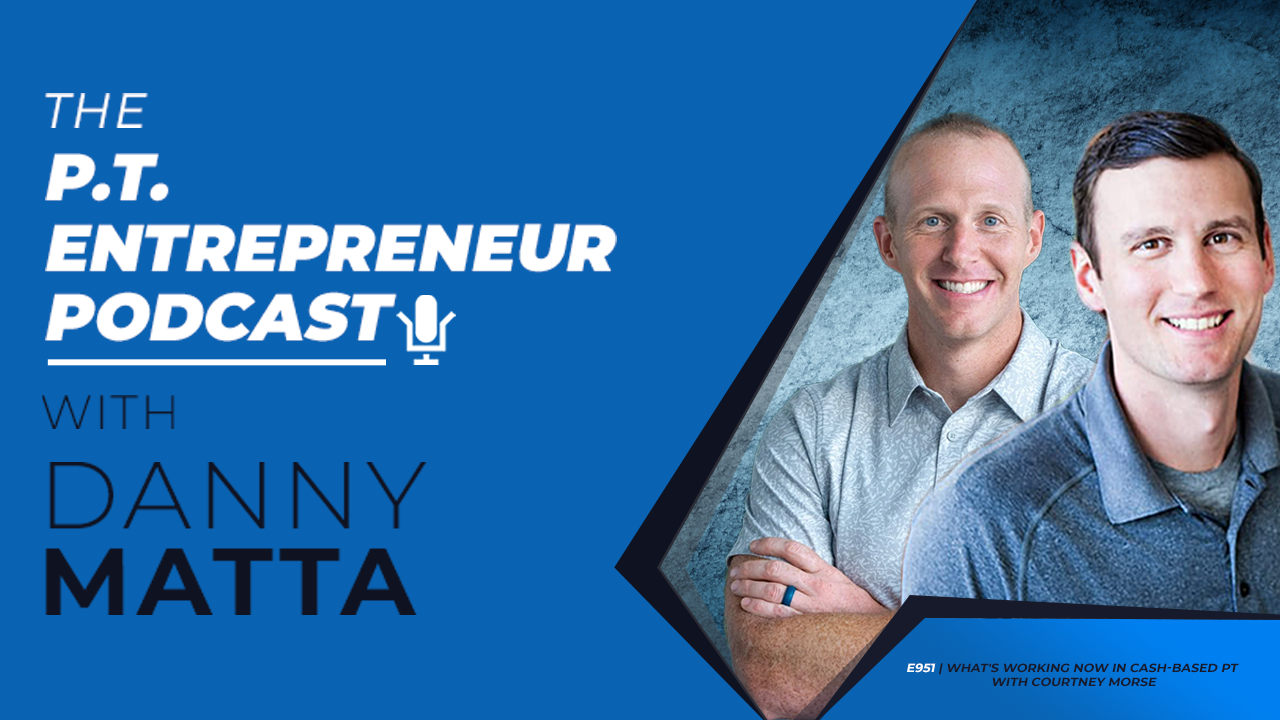
What Great PT Entrepreneurs Learn When They Stop Thinking Like Clinicians
Building a cash-based physical therapy practice forces you to learn things PT school never taught you.
Sales.
Marketing.
Hiring.
Leadership.
Finance.
Management.
Culture.
And maybe most importantly, how to stop making every decision through the lens of being a clinician.
That transition is difficult because most physical therapists didn't get into the profession because they wanted to become business owners. They got into it because they wanted to help people.
In this episode of the PT Entrepreneur Podcast, Doc Danny sits down with Courtney Morris, PT Biz's head coach, to talk about Courtney's path from clinician to clinic owner to business coach, the lessons he's learned after thousands of hours coaching PT entrepreneurs, and why some of the characteristics that make someone an exceptional physical therapist can actually make scaling a business harder.
The conversation also introduces a new direction for the podcast, with Courtney interviewing PT Biz members and sharing the real stories behind clinics at every stage of growth.
But the bigger lesson is about the evolution almost every PT entrepreneur has to go through.
At some point, you have to learn how to build the business that supports the clinical work you care so much about.
Nearly a Decade of Watching Cash PT Businesses Grow
Courtney has a unique perspective inside PT Biz.
He originally joined as a client.
Then he became a coach.
Today, he's the head coach and has been coaching inside the company for roughly six years.
Before that, he spent several years in the Mastermind himself.
That means he's watched the cash PT industry evolve from the days when a PT Biz live event could fit around a dining room table to events with hundreds of clinic owners in the room.
He's also coached businesses at almost every stage.
Someone trying to leave their employed job.
A new owner building toward full-time.
A growing clinic adding its first employees.
A multi-provider practice trying to scale.
And businesses pushing into seven figures and beyond.
Those repetitions matter.
There are only so many ways a cash practice gets stuck.
After enough coaching calls, patterns start becoming obvious.
Every Successful Clinic Has an Embarrassing Beginning
It's easy to look at an established clinic and assume the owner knew what they were doing from the beginning.
Usually, that's nowhere close to reality.
Danny started his practice inside a CrossFit gym that was eventually shut down by the city.
Courtney treated patients in a hair salon.
His first patient was treated on the floor of an Orangetheory.
Years later, that patient is still connected to the business and is married to one of Courtney's physical therapists.
Those aren't polished entrepreneurial origin stories.
They're real ones.
Most successful businesses begin with imperfect spaces, incomplete systems, uncertain decisions, and an owner figuring things out in real time.
That's worth remembering if your clinic doesn't look like the business you ultimately want to build.
You don't need the final version on day one.
You need to start.
You Have to Be Average Before You Can Become Great
One of the ideas Danny brings up is something a friend once told him:
You have to be "mid" at something before you can become good at it.
Business is no different.
Your first marketing campaign probably won't be your best.
Your first hire may expose gaps in your leadership.
Your first sales conversation may be uncomfortable.
Your first office may look nothing like the clinic you eventually build.
Your first systems may be messy.
That's part of the process.
The owners Courtney has watched build impressive businesses didn't start with everything figured out.
They accumulated experience.
They made mistakes.
They adjusted.
They kept going.
Eventually, those repetitions compounded.
Courtney Didn't Even Know What Physical Therapy Was
Courtney's path into physical therapy wasn't particularly traditional.
He grew up in a town of roughly 1,200 people in Kansas.
There wasn't a physical therapist in the town, so PT wasn't even a profession he seriously understood while growing up.
He went to Kansas State and earned a kinesiology degree.
After graduating, he knew one thing:
He didn't want to go back to school.
So he didn't.
He started driving a Schwan's truck.
He worked roughly 55 to 60 hours per week while his wife began her teaching career.
Eventually, the schedule became unsustainable.
Courtney started calling former classmates asking what they were doing with their kinesiology degrees.
The answer kept coming back:
Physical therapy school.
So he observed at a PT clinic.
Realized it was something he could see himself doing.
Then went back and completed the prerequisites he had avoided in the first place.
He didn't begin PT school until he was 27.
That life experience would eventually become an advantage.
Life Experience Can Become a Business Advantage
Physical therapists often spend years collecting clinical credentials.
Those credentials can absolutely make you a better clinician.
But Courtney and Danny discuss another skill set that doesn't show up behind your name.
Life experience.
Communication.
Emotional intelligence.
Leadership.
The ability to connect with another person.
The ability to explain something complicated simply.
The ability to persuade someone to actually follow through.
Those skills matter in patient care.
They matter even more when you're building a team.
A perfectly accurate diagnosis isn't particularly useful if you can't get the patient to buy into the behavioral changes required to improve.
Similarly, having a brilliant business strategy doesn't matter if you can't lead your employees well enough to execute it.
Time Freedom Was the Initial Goal
Courtney spent about five years working in traditional in-network physical therapy.
Like many clinicians, he eventually hit the ceiling.
There was a limit to what he could make.
A limit to how much time he could take off.
A limit to how much control he had over the way he worked.
Eventually, he and his wife decided to do something different.
They took their kids and traveled.
Courtney worked skilled nursing positions while the family spent months living in Oregon, Tennessee, and the Blue Ridge area.
That experience was transformative.
For the first time, they had a different kind of control over their lives.
Eventually they returned home and moved back into jobs very similar to the ones they'd left.
That's when something became obvious.
The location hadn't been the problem.
The structure of the work was.
Burnout and Exhaustion Aren't the Same Thing
Courtney makes an important distinction in the episode:
Burnout and exhaustion can physically feel very similar.
In both cases, you're tired.
You may be working long hours.
You may have periods where you're stretched thin.
The difference is what the work is building toward.
When Courtney was exhausted building his own business, he could see a future benefit.
He was building something for himself and his family.
There was a reason for the effort.
Burnout feels different.
You're exhausted, but you don't see anything changing.
The same schedule is waiting for you next month.
The same frustrations.
The same limitations.
As Courtney puts it, the cavalry isn't coming.
That's why clinic owners can sometimes work harder inside their own business and still feel more energized than they did as employees.
The work finally has direction.
Entrepreneurship Gives You Control Over the Work
Danny talks about two major benefits that often draw clinicians toward starting a practice.
The first is control over time.
You may still work hard.
Sometimes you may work more than you did as an employee.
But you decide when.
You can build your schedule around dropping your children off at school.
Training for something you care about.
Taking a trip.
Being home at a certain time.
The work starts fitting around the priorities of your life instead of your entire life being forced around someone else's schedule.
That's powerful.
The Other Benefit Is Clinical Freedom
For Danny, the bigger motivation wasn't necessarily financial.
It was clinical.
He had spent years developing his skill set and wanted an environment where he could fully use it.
More time with patients.
More individualized care.
Better buy-in.
More control over how the plan was structured.
Patients who were genuinely invested in the outcome.
That is one of the most compelling parts of the cash model.
The business can create an environment where a skilled clinician can actually practice the way they hoped they would when they entered the profession.
And that's where an interesting tension begins.
Great Clinicians Can Become Terrible Business Owners
Danny makes a point that may be uncomfortable for some PTs.
The same traits that make someone deeply committed to being an exceptional clinician can sometimes make them harder to coach as a business owner.
Why?
Because they evaluate almost every decision from the perspective of patient care.
That's admirable.
But a business has other requirements.
It needs profit.
It needs marketing.
It needs hiring.
It needs systems.
It needs financial discipline.
It needs leadership.
It needs enough margin to employ people and continue operating.
If every business decision is made purely through the lens of clinical preference, eventually the business can become unstable.
And an unstable clinic can't help very many patients.
A Functional Business Lets You Help More People
This is one of the mindset shifts clinicians have to make.
Profit and patient outcomes aren't opposing forces.
A healthy business can actually support better care.
It can hire great clinicians.
It can give those clinicians more time with patients.
It can provide better equipment and resources.
It can invest in continuing education.
It can create attractive jobs that clinicians don't want to leave.
It can market effectively enough to connect more people with the service.
And it can survive long enough for all of those things to compound.
The goal isn't to stop caring about clinical quality.
The goal is to build the business infrastructure that allows clinical quality to exist at scale.
Clinical Excellence Can Become a Comfort Zone
Danny admits that he stayed in full-time patient care longer than he probably should have.
Why?
Because he liked it.
He was good at it.
He understood it.
Treating patients was comfortable.
Running a growing company wasn't.
That's a common trap.
A clinic owner can spend years becoming an exceptional physical therapist.
Then the business reaches a stage where their greatest contribution isn't another treatment session.
Maybe it's hiring.
Developing the team.
Building referral relationships.
Reviewing finances.
Improving systems.
Training clinicians.
Leading.
Those things often feel less comfortable because you don't have thousands of repetitions in them yet.
But if you want the clinic to scale beyond you, you eventually have to learn them.
More Credentials Don't Automatically Make Scaling Easier
Courtney jokes that the more letters someone has behind their name, the harder they may be to coach.
There is some truth buried in the joke.
Highly trained clinicians can become deeply attached to the clinical identity they've spent years developing.
They know what good patient care looks like.
They've invested heavily in becoming exceptional at it.
Stepping away from treatment can feel like abandoning the thing they're best at.
But the business eventually requires a different skill set.
That doesn't mean clinical expertise stops mattering.
It means leadership becomes another discipline you have to learn.
Emotional Intelligence Is a Business Skill
Danny points to people like Kelly Starrett as an example.
There may be clinicians with more academic credentials or more research experience.
But one of Kelly's biggest strengths is his ability to communicate.
He can take something complex and make it understandable.
He can connect with people.
He can create buy-in.
Those skills matter enormously.
You need them with patients.
You need them with employees.
You need them when selling.
You need them when hiring.
You need them when giving feedback.
You need them when casting a vision for where the clinic is going.
Business ultimately involves getting other human beings aligned around something.
Clinical knowledge alone can't do that.
Different People Need Different Coaching
Courtney has learned this after thousands of coaching interactions.
Not everyone responds to feedback the same way.
Some business owners want direct answers.
Tell them exactly what is wrong.
Tell them what to fix.
They'll go execute.
Others need to talk through the problem.
They need questions.
They need to work their way toward the answer themselves.
If you give them a direct instruction too early, they resist it.
Neither approach is necessarily wrong.
They're different people.
The same lesson applies when you're leading employees.
You can't assume everyone wants to be managed exactly the way you want to be managed.
A strong leader learns how the person in front of them responds best.
Leadership Starts With Knowing Yourself
One tool Courtney uses in his clinic is the Working Genius assessment.
The idea is relatively simple.
There are types of work that energize you.
Types you're competent at.
And types that drain you.
That matters because entrepreneurship exposes you to almost everything.
You may discover that numbers energize you.
Or they make you want to avoid your financials for three months.
You may love sales.
You may love developing people.
You may love creating new ideas.
You may hate operations.
The goal isn't to become equally great at everything.
It's to understand where you're strongest and eventually build a team that complements you.
You Don't Need to Lead Like Someone Else
Danny also brings up the idea from The Charisma Myth that charisma isn't one universal personality trait.
Some leaders are energetic.
Some lead through intelligence.
Some through compassion.
Some through conviction.
The mistake is assuming you need to imitate somebody else's personality to become a good leader.
You don't.
You need to understand your natural style.
Then improve the parts of it that create problems.
Maybe you're extremely direct and need to develop more empathy.
Maybe you're highly relational but avoid difficult conversations.
Maybe you're great at inspiring people but terrible at holding them accountable.
The goal isn't to become a different person.
It's to become a better version of the leader you already are.
And as a cash PT practice begins growing beyond the owner, that becomes one of the most important skills in the entire business.
Your Team Will Tell You Whether You're Leading Well
Leadership can feel subjective until you look at what the team actually does.
Do people stay?
Do they grow?
Do they refer other great clinicians into the business?
Do they feel comfortable bringing up problems?
Do they understand what the clinic is trying to build?
Those are useful signals.
Danny makes the point that staff turnover is one of the clearest forms of feedback a business owner can get.
If great people constantly leave, something is wrong.
Maybe it's compensation.
Maybe it's culture.
Maybe it's communication.
Maybe it's the workload.
Maybe it's leadership.
Whatever the cause, turnover is expensive and disruptive.
And in a growing clinic, constant provider churn can become one of the biggest brakes on scale.
Great Leaders Create Jobs People Actually Want
This is where cash-based and hybrid clinics have an enormous opportunity.
Most physical therapists didn't go to school dreaming of seeing four patients an hour.
They imagined having enough time to think.
Enough time to listen.
Enough time to coach.
Enough time to actually use the skills they spent years developing.
A well-run cash clinic can offer exactly that.
Courtney talks about students observing in his practice and recognizing that the job looks much closer to what they expected physical therapy to be.
That's an advantage.
Not just for patient care.
For recruiting.
Your Clinic May Have a Better Product Than You Realize
Clinic owners often talk about how difficult it is to hire physical therapists.
Courtney challenges that assumption.
If your clinic offers competitive compensation, better flexibility, more autonomy, lower patient volume, and a patient population clinicians genuinely enjoy working with, you may have one of the best PT jobs in your market.
The problem may not be the job.
The problem may be that the right clinicians don't know the job exists.
That's a marketing problem.
And just like patients, great clinicians often aren't actively searching for you.
The Best Clinicians May Not Be Looking on Indeed
This is one of the most practical hiring lessons from the conversation.
Good physical therapists are often already employed.
They may not love their current job.
They may be frustrated with volume.
They may wish they had a better patient population.
But they're competent, stable, and busy.
They're not necessarily spending every night refreshing job boards.
If you only recruit people who are actively applying on Indeed, you're limiting the pool.
Courtney argues that clinic owners need to become more proactive.
Find the great clinicians.
Build relationships.
Let them know what kind of job you've created.
Show them the environment.
Give them a reason to consider something different.
Go Find the Talent You Want
Some owners feel uncomfortable with the idea of recruiting someone who already has a job.
Courtney brings up the word "poaching."
It can sound negative.
But businesses in every other industry actively compete for great talent.
Call it recruiting.
Call it headhunting.
Call it whatever you want.
If there is an exceptional physical therapist in your market who would be a great fit for your patients, culture, and team, why wouldn't you talk to them?
You aren't forcing them to leave.
You're showing them an opportunity.
They get to decide.
Patient Niche Can Be a Recruiting Advantage
Danny shares a story from Athlete's Potential that illustrates this.
A clinician was exploring another job because she didn't particularly enjoy the patient population she was treating.
Danny asked her to describe the kind of patient she would fight to have on her schedule.
Her answer was something like a middle-aged runner training for a 10K or half marathon, or someone who wanted to stay active playing pickleball.
The Athlete's Potential team started laughing.
She had basically described their patient population.
That's powerful.
Your clinic doesn't simply offer a salary.
It offers a type of work.
If your team gets to spend their days working with the exact patients they enjoy helping, that matters.
A lot.
Your Current Team Can Become Your Best Recruiting Channel
Danny and Courtney both like employee referral systems.
Why?
Because great employees tend to know other great people.
They also care about who joins the team.
They're the ones who will have to work next to that person every day.
They don't want to bring in someone who is unreliable, difficult, or bad clinically.
They have an incentive to protect the culture.
Instead of spending thousands of dollars on job boards and recruiters, Danny suggests redirecting some of that budget toward meaningful internal referral bonuses.
Pay employees for introducing another A-player.
Then structure part of the bonus around that person staying long enough to prove the fit.
That's a simple strategy with powerful alignment.
The First Hire Is Usually the Hardest
Referral-based recruiting works much better once you already have a team.
Your staff has networks.
Your clinicians know former classmates.
They know coworkers.
They know people from continuing education.
They know clinicians who are quietly frustrated in other jobs.
Your first hire is different.
You're still building the network.
You also don't yet have employees who can validate the culture for you.
That means the first recruiting process may require much more effort from the owner.
But once you have great people, let them help you find more great people.
Hiring Is Really About Culture
A strong clinician can become a bad hire if the values don't match the clinic.
That's why the goal isn't simply to hire someone technically competent.
You need someone patients trust.
Someone teammates enjoy working with.
Someone who cares about outcomes.
Someone who communicates well.
Someone who fits how the clinic operates.
One bad hire can create enormous friction.
One great hire can make the next five hires easier because great people attract other great people.
This is where the Compounding Clinic applies to the team as much as it does to patients.
The better the existing experience, the easier growth becomes.
Retention Matters as Much as Recruiting
Hiring gets most of the attention because it's visible.
But retention may be even more important.
Courtney talks about clinicians in his own clinic who have stayed for years.
The clinical director has been there around six years.
Another provider has been there four or five.
Another has been there multiple years.
That kind of continuity changes a business.
You're not constantly retraining.
You're not constantly rebuilding patient schedules.
You're not constantly introducing new clinicians to referral partners.
You're not constantly repairing culture after departures.
Long-tenured employees accumulate knowledge.
They become leaders.
They make the clinic more stable.
Employees Should Be Able to Grow Inside the Business
If your best clinicians have nowhere to go, eventually some of them will leave.
Growth doesn't necessarily mean everyone becomes an owner.
It means people can continue developing.
Maybe that's clinical leadership.
Mentoring younger PTs.
Managing a location.
Specializing in a niche.
Helping with education.
Taking responsibility for parts of the business.
A growing clinic should create opportunities that a standard staff PT position may not.
That's another reason scaling can become attractive to high-quality clinicians.
The Business Side Eventually Becomes Patient Care
This is the connection PT owners sometimes miss.
Hiring great clinicians is patient care.
Building a healthy culture is patient care.
Having enough profit to retain the team is patient care.
Creating a sustainable schedule is patient care.
Training employees is patient care.
Marketing the clinic effectively is patient care.
Because without those things, fewer patients get access to the clinical work you're so passionate about.
The business isn't separate from the mission.
The business is the vehicle that delivers the mission.
Courtney's New Podcast Role Is Built Around Real Stories
The second half of the episode also sets up a new direction for the PT Entrepreneur Podcast.
Courtney will begin hosting a Thursday interview series featuring clinic owners from inside the PT Biz community.
That's significant because Courtney has coached many of these people directly.
He knows their businesses.
He knows the problems they've faced.
He knows where they've improved.
He knows which parts of their story are worth digging into.
The goal is not just to spotlight successful clinic owners.
It's to show the path.
Nobody Had It All Figured Out
This is one of Courtney's biggest goals for the interview series.
He wants the person listening from the sidelines to realize that the clinic owners they admire weren't uniquely prepared.
They didn't have some secret advantage.
They didn't start with a perfect plan.
They weren't guaranteed to succeed.
They took action.
Then they figured things out.
That matters because plenty of clinicians have listened to podcasts like this for years without moving.
They keep collecting information.
Keep researching.
Keep waiting.
Meanwhile, the environment they're unhappy with isn't changing.
There Is No Perfect Time
Courtney has seen people remain stuck for years because they're waiting for certainty.
But certainty rarely comes before action.
You don't know exactly how the first office will work.
You don't know exactly where the first ten patients come from.
You don't know exactly when you should leave your job.
You don't know whether the first hire will work.
You don't know how the business will look three years from now.
Nobody does.
The people who build successful practices learn by moving.
They solve one problem.
Then the next one becomes visible.
Then they solve that.
That's entrepreneurship.
Don't Compare Your Beginning to Someone Else's Year Eight
The new interviews will include owners at very different levels.
Someone generating $10,000 per month.
Someone trying to replace their salary.
Someone hiring their first provider.
Someone operating a seven-figure clinic.
Someone generating hundreds of thousands per month.
If you only look at the final number, that comparison can be discouraging.
Instead, look at the sequence.
What did they do when they were where you are now?
What mistake did they make?
What system unlocked the next stage?
What did they stop doing?
What did they have to learn?
Those lessons are much more useful than admiring the current size of the company.
Learn From Other People's Failures Too
One of the benefits Courtney sees inside the PT Biz community is that owners openly share what doesn't work.
That's valuable.
A mistake can still become an asset if someone else doesn't have to repeat it.
Maybe someone tried a marketing strategy that failed.
Maybe they hired too early.
Maybe they expanded into the wrong space.
Maybe they priced incorrectly.
Maybe they built a bad compensation structure.
If they explain what happened and why, the rest of the group can learn without paying the same tuition.
That's one of the biggest accelerators of being around other business owners.
You shorten the feedback loop.
Community Can Compress Years of Trial and Error
Courtney describes PT Biz's community as unusually generous.
Owners operating much larger practices will sit down with newer owners and openly talk through their businesses.
Someone doing $150,000 per month might have a conversation with somebody doing $15,000.
Both can still learn something.
That's important.
Business isn't a ranking system.
Someone with more revenue doesn't automatically have every answer.
The smaller clinic may have an incredible referral strategy.
The larger owner may have solved a hiring problem the smaller clinic hasn't encountered yet.
Different stages create different expertise.
Somebody Will Always Be Ahead of You
Danny makes a broader point here.
There will always be someone who appears ahead.
Taller.
Faster.
Smarter.
More credentialed.
More profitable.
Larger business.
More locations.
It never ends.
If your benchmark is always somebody else's scorecard, you can make yourself miserable at any level of success.
What matters is what you're actually trying to build.
A $40,000-per-month clinic with a small team and incredible owner freedom may be exactly right for one person.
Another owner may genuinely want to build multiple locations.
Different goals require different businesses.
The comparison only matters if the other person is building what you actually want.
Business Problems and Life Problems Are Connected
One of the things Danny appreciates most about the PT Biz community is that conversations don't stop at revenue and KPIs.
Business owners bring their lives into the room.
Health.
Marriage.
Kids.
Stress.
Career transitions.
Fear.
Family responsibilities.
That's appropriate because entrepreneurs can't completely separate those things.
A business decision affects the family.
A health issue affects the business.
A difficult relationship affects leadership.
A new child changes risk tolerance.
Life and business overlap.
Good coaching has to understand both.
The Business Should Ultimately Support the Life
Danny tells a story about a former client whose father had spent years working as a corrections officer.
What the father really wanted to do was fish.
Eventually, he retired and started running fishing charters.
He was finally spending his days doing something he loved, with people who wanted to be there.
For physical therapists, Danny argues, there's a similar opportunity.
Your version of the fishing charter may already be the thing you're trained to do.
Helping motivated people get better.
You don't necessarily need to leave the profession.
You may simply need a different business model around your skill set.
Cash PT Can Reinvigorate Clinicians Who Were Ready to Leave
This is one of the patterns Courtney expects the interview series to highlight repeatedly.
Burned-out clinician.
Frustrated with volume.
Limited income.
Limited control.
Limited time.
Then they start something of their own.
Patients are invested.
They do the homework.
They follow through.
They improve.
The clinician starts enjoying the profession again.
It's not that physical therapy suddenly became different.
The environment did.
That's a powerful distinction.
Patients With Skin in the Game Behave Differently
When someone chooses to invest directly in their care, they often show up differently.
They do the exercises.
They ask better questions.
They pay attention.
They participate in the plan.
That makes the clinician's job easier.
It can also improve outcomes.
Nothing is more energizing for a physical therapist than seeing a motivated patient actually implement what you've asked them to do and get better.
For clinicians who have spent years battling low adherence in high-volume environments, that can completely change how the profession feels.
Cash Practices Are More Scalable Than We Used to Think
Years ago, it was common to assume cash PT clinics were basically solo lifestyle businesses.
Maybe one clinician.
Maybe a tiny team.
Good income, but limited scale.
That assumption no longer holds.
Danny and Courtney now work with clinics at seven figures and multiple seven figures.
Some have grown far beyond what early cash practice owners thought was possible.
The model has matured.
The systems have improved.
Owners have learned how to hire.
How to market.
How to build continuity.
How to create a Stability Layer.
How to develop leadership.
How to operate clinics that aren't dependent entirely on the founder.
Mature Clinics Can Become Extremely Stable
Danny points out that well-run clinics can become difficult to disrupt once they have enough history.
Referral relationships compound.
Brand reputation compounds.
Patient relationships compound.
Continuity compounds.
Great employees attract other employees.
Former patients send new patients.
Systems improve.
The clinic becomes increasingly insulated from individual problems.
That's what the Compounding Clinic looks like when it has enough time to mature.
It doesn't mean the business becomes effortless.
It means you're no longer restarting from zero every month.
This Is Expanding Beyond Pure Cash Practices
Another evolution is the growth of hybrid clinics.
PT Biz increasingly works with insurance-based practices that don't necessarily want to eliminate every contract.
They want to improve the economics.
Maybe they add cash services.
Maybe they create hybrid offerings.
Maybe they reduce their dependence on low reimbursement.
Maybe they restructure parts of the patient experience.
The mission is similar.
Create a business with enough margin to provide excellent care, employ excellent clinicians, avoid crushing patient volume, and remain financially healthy.
For some owners, pure cash is the answer.
For others, hybrid may make more sense.
Independent Insurance Clinics Need Another Lever
The economic pressure on independent insurance-based clinics is real.
If reimbursement continues to tighten while wages and overhead increase, owners only have so many options.
See more volume.
Cut costs.
Accept lower margins.
Or change the unit economics.
Even a partial shift toward higher-value cash services can materially change the health of a clinic.
That's why the lessons coming from cash practices increasingly matter to traditional clinic owners too.
The principles around offer design, retention, continuity, patient experience, marketing, leadership, and profitability translate.
The Bigger Mission Is Keeping Great PTs in the Profession
One of the most compelling parts of the episode is the idea that clinic ownership often becomes about more than the owner.
At first, the goal may simply be:
Replace my salary.
Get out of my current job.
Control my schedule.
Then the owner starts seeing what's possible.
They create a great job for another clinician.
Then another.
They realize they can give talented PTs a place where they aren't overloaded and burned out.
That can become its own mission.
Build the type of place you wish existed when you were an employee.
Technology Spotlight
Documentation continues to be one of the biggest frustrations for physical therapists.
Claire is an AI scribe built specifically for PTs that dramatically reduces documentation time, allowing clinicians to focus on patient care instead of paperwork.
For growing clinics, that efficiency becomes even more valuable. Reducing the administrative burden on clinicians can help protect the patient experience and create a better job for the people you're trying to retain.
👉 Try Claire free for 7 days
https://www.meetclaire.ai/?utm_source=preroll&utm_medium=podcast&utm_campaign=pt_entrepreneurs
More PT Biz Training
Want more content on building a scalable cash practice?
👉 PT Biz Training YouTube
https://www.youtube.com/@ptbiztraining
Final Thoughts
You don't have to stop being a great clinician to become a great business owner.
But you do have to expand your identity beyond clinical care.
Learn the numbers.
Learn how to hire.
Learn how to lead.
Learn how different people need to be coached.
Build a culture where great clinicians want to stay.
And remember that none of the owners you admire started with all of this figured out.
Courtney's story started with a Schwan's truck, a hair salon, and a patient on an Orangetheory floor.
Danny's clinic started inside a gym that got shut down by the city.
The businesses came later.
The leadership came later.
The systems came later.
The confidence came from repetitions.
So whether you're trying to see your first cash patient or you're building your fifth location, the principle is the same:
Don't wait until you feel completely ready.
Take the next step, learn what the next problem is, and keep building from there.