
E943 | The Clinic Foundation You Can't Skip
Aug 07, 2026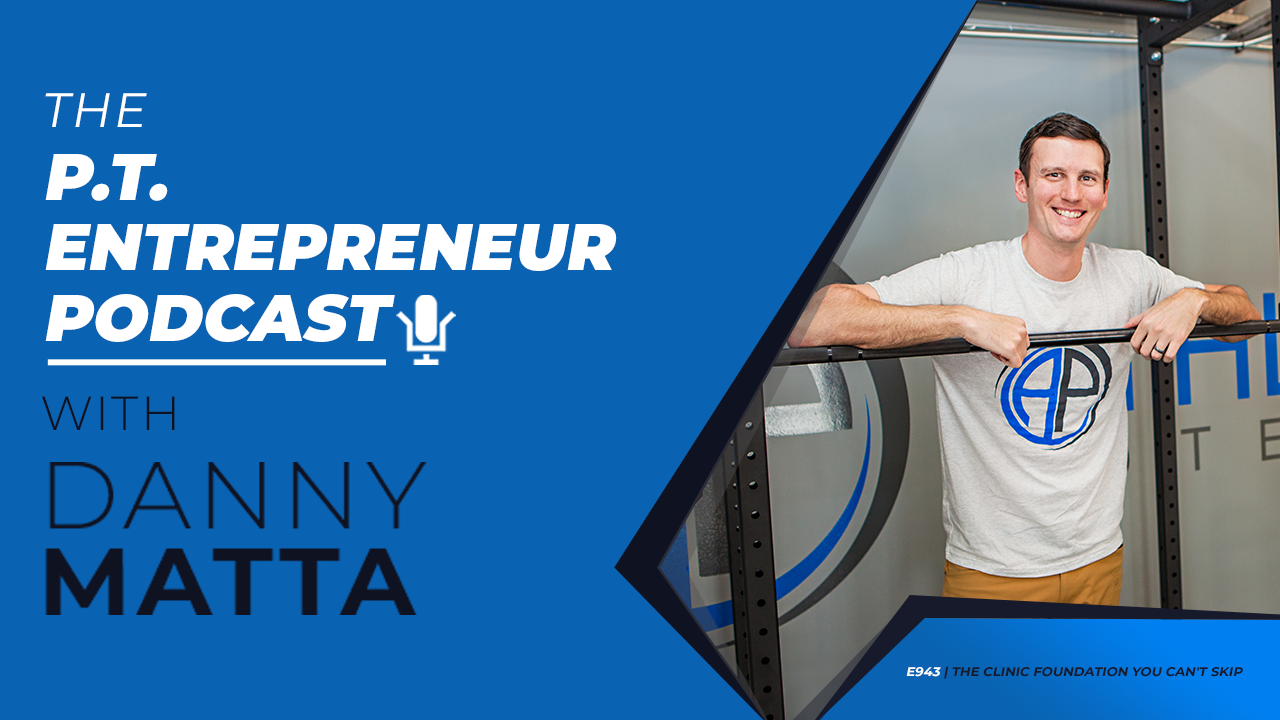
Don't Open a Cash Practice Until You Can Pass This One Test
One of the most common questions new physical therapists ask is:
"When is the right time to open my own clinic?"
It's an exciting question.
You're motivated.
You want more freedom.
You want to build something that's yours.
But according to Doc Danny, most clinicians are asking the wrong question.
Instead of asking when you should start your own practice, you should first ask whether you're truly prepared to deliver the outcomes patients are paying for.
In this episode of the PT Entrepreneur Podcast, Danny explains why becoming an exceptional clinician should come before becoming a business owner, and shares a simple litmus test that every aspiring clinic owner should pass before launching a cash-based practice.
There Isn't One Right Timeline
Some clinicians are ready to start a practice much earlier than others.
The difference isn't necessarily years of experience.
It's depth of expertise.
Danny shares examples of two students he met who had already developed significant experience in very specific niches before graduating from physical therapy school.
One specialized in working with bodybuilders.
The other worked extensively with dancers.
They weren't simply learning physical therapy.
They had already spent years coaching people within those communities.
One was even generating well over six figures before graduation.
For clinicians like that, opening a practice earlier may make perfect sense.
They've already earned credibility.
They already understand their niche.
They've spent years solving problems for the exact people they want to serve.
That isn't the typical path.
Most New Graduates Should Slow Down
For the majority of clinicians, Danny recommends patience.
Not because starting a business is a bad idea.
Because learning to become an outstanding clinician and learning to become a great business owner at the exact same time is incredibly difficult.
Both require enormous amounts of attention.
Both demand years of deliberate practice.
Trying to master both simultaneously often slows progress in each.
Danny reflects on his own experience.
He didn't start his cash practice until roughly five years after graduating.
Even then, after years of continuing education, mentorship, teaching other clinicians, and building confidence, he still questioned whether he was truly ready.
That uncertainty isn't weakness.
It's humility.
The clinicians who understand how much there is still to learn often become the ones who continue improving throughout their careers.
The One Question Every Future Clinic Owner Should Answer
Danny offers one of the simplest—and most powerful—tests you'll ever hear.
Imagine your business operated under one rule:
You only get paid if the patient achieves the outcome they came for.
Would you take that bet?
If your immediate answer is yes, you're probably much closer to being ready for private practice.
If your answer is no, there's still work to do.
That doesn't mean you aren't talented.
It doesn't mean you shouldn't eventually own a practice.
It simply means your next investment should be in your clinical skills rather than your business entity.
Cash-based physical therapy is outcome driven.
Patients aren't paying for time.
They're paying for results.
That's a different level of responsibility.
Clinical Excellence Comes Before Marketing
One of the biggest mistakes Danny sees is clinic owners trying to solve an outcome problem with better marketing.
They invest in:
- Facebook ads
- Google ads
- Websites
- Funnels
- Social media
- Sales systems
Marketing absolutely matters.
But marketing only amplifies what's already there.
If your service consistently produces excellent outcomes, marketing helps more people discover it.
If your service isn't producing exceptional outcomes, marketing simply brings more people into an experience that isn't yet strong enough.
Eventually, referrals slow down.
Retention drops.
Growth stalls.
The foundation has to come first.
Become Obsessed With Getting Better
So what should newer clinicians focus on?
Improving.
Constantly.
Danny believes becoming an outstanding clinician requires a level of obsession.
When a patient isn't improving, it should bother you.
Not because you're chasing perfection.
Because you're genuinely curious.
You want to understand what you're missing.
That curiosity drives growth.
It leads you to:
- Read more research.
- Attend continuing education.
- Watch lectures.
- Find mentors.
- Discuss difficult cases with other clinicians.
- Spend time learning your niche.
Those habits compound over time.
Just like great businesses compound, great clinicians do too.
Find the Right Mentors
Not every job is meant to be permanent.
Sometimes the best opportunity isn't the highest-paying position.
It's the one where you'll learn the fastest.
A clinic with exceptional mentorship may provide far more long-term value than one offering slightly better compensation.
If your goal is eventually owning your own practice, think beyond your first paycheck.
Ask yourself:
Who can teach me?
Who consistently gets outstanding outcomes?
Who challenges me to become better?
Those experiences become the foundation you'll eventually build your own clinic upon.
You Can't Skip Mastery
Many entrepreneurs are eager to control their own schedules.
Build their own brand.
Create financial freedom.
Those are great goals.
But Danny reminds listeners that cash-based clinics succeed because patients trust they're working with experts.
That trust has to be earned.
The fastest path isn't always the shortest one.
Sometimes taking another year to sharpen your clinical reasoning saves years of frustration once your business opens.
The goal isn't simply becoming self-employed.
The goal is becoming exceptional enough that patients confidently choose you over every other option in your community.
Great Outcomes Are Only Half the Equation
Clinical skill is essential.
But it's only one part of building a thriving cash-based practice.
Danny explains that every successful clinic ultimately wins in two areas:
- Outstanding patient outcomes
- An outstanding patient experience
Some clinicians are incredible with people.
Patients love them.
They connect naturally.
They build trust quickly.
But clinically, they may struggle to consistently solve the problems patients came in with.
Others are the opposite.
They're exceptional diagnosticians.
They consistently produce excellent clinical outcomes.
Yet they struggle to connect emotionally with patients.
Neither approach is enough on its own.
The best clinicians master both.
They help people get better.
And they make people feel understood throughout the process.
Referrals Tell You the Truth
One of the simplest ways to measure clinical success isn't through surveys.
It's through referrals.
Danny encourages clinic owners to ask a simple question:
Are patients specifically asking to see this clinician?
That's one of the clearest indicators that something special is happening.
When patients consistently tell friends and family:
"You have to go see Sarah."
"You need to work with Mike."
That's trust.
That's reputation.
That's proof that someone isn't just treating patients.
They're creating memorable experiences that people naturally talk about.
If those referrals aren't happening, it's worth investigating why.
Every Clinician Leaves Clues
Danny explains that referral patterns become a form of quality control.
Imagine two clinicians working in the same clinic.
One receives ten patient referrals in a single quarter from former patients.
The other receives none.
That doesn't automatically mean one clinician is bad.
But it does tell you something deserves a closer look.
As a clinic owner, your responsibility is to figure out what's creating the difference.
Is it clinical skill?
Are they struggling to produce consistent outcomes?
Or is it the patient experience?
Do patients leave feeling confused or disconnected despite improving physically?
Those are two very different problems.
Each requires a different solution.
Quality Control Never Stops
This is one of the biggest responsibilities of a clinic owner.
You can't simply hire talented clinicians and assume everything will take care of itself.
You need systems for observing, mentoring, and improving your team.
That may include:
- Sitting in on evaluations
- Reviewing patient outcomes
- Monitoring referral patterns
- Evaluating retention
- Watching how clinicians communicate
The goal isn't criticism.
It's development.
Strong clinic cultures are built when owners help clinicians improve instead of simply measuring performance.
Retention Matters Just as Much
Referrals tell one story.
Retention tells another.
Danny points out that some clinicians struggle with initial conversions.
They don't always close as many evaluations into plans of care.
But once patients begin working with them, they stay for months or even years.
Others convert nearly everyone.
Yet patients disappear after a few visits.
Those are completely different challenges.
Retention often reflects the strength of the ongoing relationship.
Patients continue returning because they trust the clinician, enjoy the experience, and believe they're receiving long-term value.
That creates something every cash practice owner wants:
Predictability.
Long-Term Relationships Build Stronger Businesses
If you've been following the Compounding Clinic series, this idea will sound familiar.
Recurring relationships reduce the constant pressure to replace discharged patients with new evaluations.
When patients continue working with your clinic through wellness visits, performance training, maintenance care, or ongoing coaching, the business becomes more stable.
Schedules stay fuller.
Revenue becomes more predictable.
Referrals increase naturally because patients remain engaged with your clinic.
Clinical excellence creates the initial relationship.
An exceptional patient experience keeps it going.
Great Clinicians Become Great Mentors
Danny also explains why experienced clinicians often perform exceptionally well after opening their own practices.
They've already spent years solving difficult cases.
They've refined how they communicate.
Many have mentored younger clinicians or taught continuing education.
That experience makes them better clinic owners.
Why?
Because they can identify where another clinician is struggling.
They can recognize whether someone needs help with communication, clinical reasoning, patient education, or relationship building.
Then they know how to coach that person forward.
That's one of the biggest advantages of delaying private practice until your clinical foundation is strong.
Eventually, your success won't depend only on your own outcomes.
It will depend on your ability to help others produce great outcomes too.
Build the Product Before You Build the Marketing
Throughout this episode, Danny returns to one consistent message.
Your service is the foundation.
Marketing amplifies it.
It doesn't replace it.
Too many clinic owners chase better advertising before they've created a remarkable patient experience.
That strategy almost always stalls.
Outstanding outcomes.
Outstanding relationships.
Outstanding patient experiences.
Those are the things that fuel word-of-mouth growth.
Everything else becomes easier once those pieces are in place.
Technology Spotlight
Documentation continues to be one of the biggest frustrations for physical therapists.
Claire is an AI scribe built specifically for PTs that dramatically reduces documentation time, allowing clinicians to focus on patient care instead of paperwork.
Ironically, better documentation isn't just about saving time.
It's about giving clinicians more opportunity to improve what matters most: patient outcomes and patient relationships.
👉 Try Claire free for 7 days
https://www.meetclaire.ai/?utm_source=preroll&utm_medium=podcast&utm_campaign=pt_entrepreneurs
More PT Biz Training
Want more content on building a scalable cash practice?
👉 PT Biz Training YouTube
https://www.youtube.com/@ptbiztraining
Final Thoughts
Opening your own clinic isn't a race.
It's a responsibility.
The best clinic owners don't succeed because they learned marketing first.
They succeed because they spent years becoming clinicians that patients couldn't stop talking about.
Before you invest in ads, funnels, or branding, invest in yourself.
Become the clinician who would confidently accept payment only after delivering the outcome your patient came for.
Once you've built that level of trust and expertise, growing a business becomes dramatically easier.
That's the foundation every successful cash practice is built upon.