
E961 | How Luke Barhorst Built a Cash-Based PT Practice for Time Freedom
Oct 08, 2026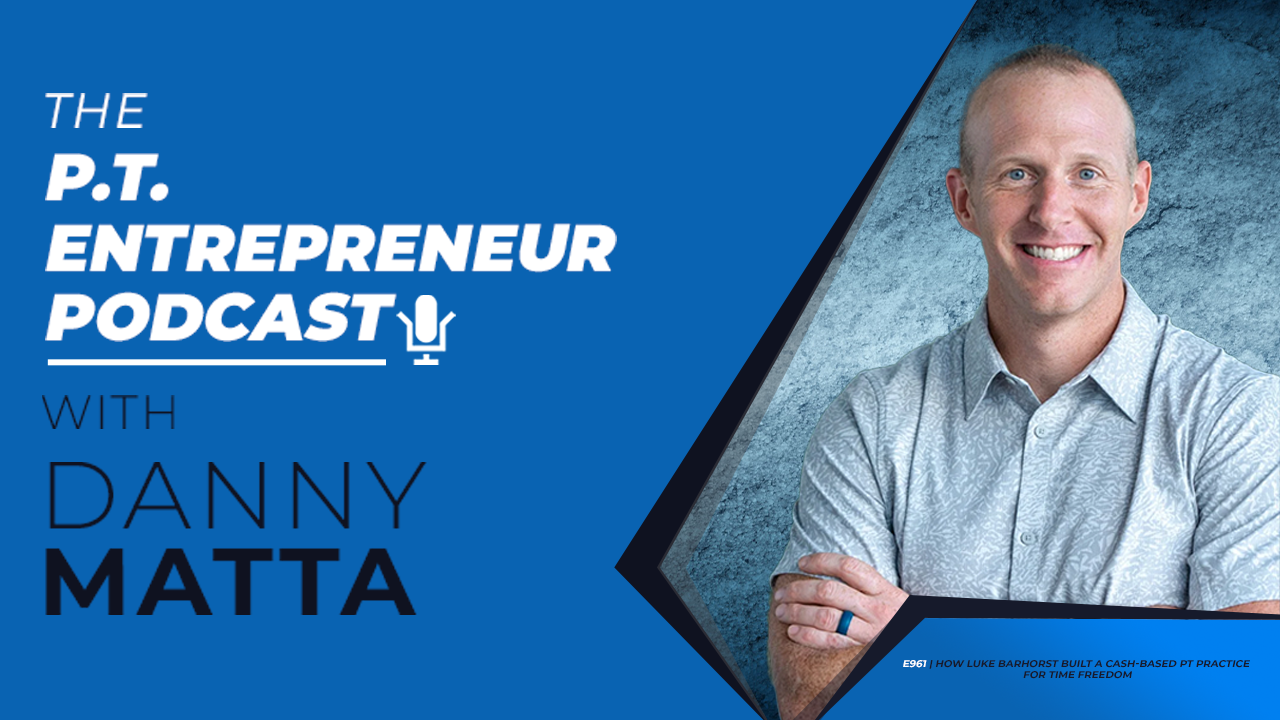
How to Build a PT Practice Without Sacrificing Your Life
Luke Barhorst didn't start Training Nation Performance Therapy with a perfectly mapped-out business plan.
In early 2020, he and his wife, Allie, moved back to Ohio after working as traveling healthcare professionals in Seattle and San Diego.
They had jobs lined up.
Allie was pregnant with their first child.
Then COVID hit.
Their expected start dates disappeared, and suddenly they were living with Luke's parents without either of those jobs.
For Luke, that uncertainty created the push he probably wouldn't have given himself otherwise.
He started Training Nation.
Six years later, he has a team, two locations around Dayton, four kids, and much more control over his time.
But his story isn't about escaping a job and instantly finding freedom.
It's about what happens when the business you build for freedom starts demanding nearly all of your time, and how your role has to keep changing if you actually want to get that freedom back.
Sometimes You Need a Push to Start
Luke had thought about owning his own practice before COVID.
His experience as a travel PT had shown him different sides of the profession.
While working in San Diego, he spent time at Sports Performance, where Chris Garcia and Seth Garcia exposed him to the cash-based practice model.
He liked the idea.
He just hadn't made the leap.
Then the decision became easier because the traditional option temporarily disappeared.
When Luke and Allie returned to Ohio in March 2020, the jobs they expected to start were repeatedly delayed.
Allie gave Luke the encouragement he needed.
Go do it.
Luke had already found the PT Entrepreneur Podcast, read F** Insurance*, and started learning more about the cash-practice model.
Now he had a reason to act.
Training Nation Started Wherever Luke Could Treat
There wasn't a beautiful standalone facility.
Luke had a Camaro.
He stuffed a treatment table into the back and drove around seeing people.
Homes.
Gyms.
Even dental offices.
Wherever he could make it work.
Eventually, he developed relationships with a few gyms around Dayton and started building a patient base.
Then something unexpected happened.
His old employer, Dayton Children's, called.
They needed help.
Luke agreed.
Within one workday, the request progressed from occasional help to a few days per week and eventually back to full-time employment.
So Luke did what many early cash-practice owners do.
He tried to do both.
The Side Hustle Became a Second Full-Time Job
Luke would see Training Nation patients early in the morning.
Sometimes starting around 5:00.
Then he'd head to Dayton Children's for the workday.
Afterward, he'd return to the gym and sometimes treat until around 10:00 at night.
Not every day was that extreme.
But enough of them were.
And he maintained some version of that schedule for roughly a year.
This is where "part-time to full-time" can become deceptive.
A practice may technically be part-time because you still have another job.
That doesn't mean it's requiring part-time effort.
At some point, you're not protecting yourself with the job anymore.
You're trying to maintain two careers simultaneously.
Delayed Gratification Can Be a Superpower Until It Isn't
Luke related strongly to something Danny has talked about on the podcast: being comfortable with delayed gratification.
That quality helped him tremendously.
He could tolerate long days because he believed he was building toward something better.
But there is a limit.
Eventually, the question becomes:
What exactly are you waiting for?
The practice is producing demand.
You're spending mornings and evenings treating your own patients.
The numbers increasingly support the move.
Yet you're still afraid to leave the guaranteed paycheck.
That's a very normal place for a clinic owner to get stuck.
Luke Wrote the Resignation Letter and Still Couldn't Completely Leave
By the summer of 2021, Luke knew something had to change.
He wrote his resignation letter.
Then he walked into his supervisor's office shaking as he handed it over.
Her response was unexpected.
She handed it back.
Rewrite it.
Instead of completely leaving, she offered Luke the opportunity to stay part-time while continuing to build Training Nation.
It was an unusually supportive transition.
Luke accepted.
Over the following months, he continued reducing his role until November 2021, when he finally went all-in on Training Nation.
The second resignation conversation felt completely different.
This time, there was confidence.
Confidence Usually Comes After the Reps
That's a theme that runs throughout Luke's story.
He didn't suddenly become fearless.
He accumulated evidence.
Patients kept coming.
The business kept operating.
He got more repetitions.
The thing that once felt incredibly risky started feeling increasingly obvious.
That's an important lesson for someone waiting to feel completely confident before making a move.
You probably won't.
Confidence often follows action instead of preceding it.
Freedom Was the Goal From the Beginning
Luke's motivation wasn't simply making more money.
He wanted control over his time.
That matters because entrepreneurship can easily become the opposite.
You leave the 9-to-5 and accidentally create a 24/7.
Luke experienced that firsthand.
The early Training Nation schedule wasn't freedom.
It was 5:00 AM patients, a full workday, evening patients, and a newborn at home.
The difference was that Luke believed the difficult season was building toward something.
Today, he can see more of the return.
Training Nation Looks Very Different Today
Training Nation now has two full-time physical therapists in addition to Luke.
There's a part-time administrator who also does personal training.
They work from two locations around Dayton.
One is a standalone clinic in South Dayton.
The other operates inside a gym in North Dayton, where Luke still treats a handful of patients.
Luke's personal caseload has dropped to roughly 10 to 15 patients per week.
His next goal is closer to five to ten.
That's where another difficult transition begins.
Getting Out of Patient Care Can Be Harder Than Getting Into Business
Luke has longstanding relationships with many of his patients.
Some have been with him for years.
They've helped build the business.
They've referred people.
They trust him.
Luke genuinely enjoys working with them.
So reducing his schedule isn't simply a math problem.
It can feel like walking away from relationships.
This is a common bottleneck for successful clinic owners.
You know your time needs to move toward leadership and growth.
But every patient on your schedule has a name and a story.
That makes delegation emotional.
Longtime Patients Don't Necessarily Need You Forever
Courtney went through this transition in his own practice.
He eventually stopped treating entirely in January 2025.
His approach was to give longtime patients plenty of warning.
He started preparing them months in advance.
When another clinician was taking over, he introduced that person and created a smoother transition rather than abruptly disappearing.
Some patients stayed.
A few didn't.
And life continued.
That's worth remembering.
Clinic owners often assume their longtime patients will never accept anyone else.
Usually, we're overestimating how indispensable we are.
Your Goal Should Be to Build Clinicians Patients Trust Too
If every patient insists on seeing the owner forever, you haven't really built a scalable clinical business.
You've built a personal brand with employees around it.
The goal should be for the patient to trust the company.
That means hiring clinicians who share your standards.
Training them.
Creating a consistent experience.
Helping patients understand that the person you're handing them to is someone you trust.
The transition doesn't diminish the relationship you've built.
It proves the business has grown beyond one provider.
Pricing Can Become Part of the Same Problem
Luke also has another challenge tied to those longstanding relationships.
Some of his older patients are still paying grandfathered rates from years ago.
Training Nation's pricing has increased substantially since then, with a 10-session package now working out to $210 per visit.
Luke knows his own time is becoming more valuable elsewhere in the company.
But telling longtime patients that their price needs to change is uncomfortable.
Again, this isn't really a pricing problem.
It's a leadership problem.
The owner knows what the business needs.
The difficult part is having the conversation.
People Will Tell You You're Expensive at Almost Any Price
Luke noticed something useful after raising Training Nation's rates.
When the price was lower, some people said it was expensive.
At the new price, some people still say it's expensive.
That's important for owners who assume every objection means their price is wrong.
Price resistance doesn't suddenly disappear because you charge less.
Some people won't be the right fit.
Others will understand the value and move forward.
Your job isn't to make the price comfortable for everyone.
It's to build an experience and outcome that justify what you charge for the people you're best equipped to help.
The Owner Eventually Has to Choose Where Their Best Hours Go
Luke could keep seeing 15 patients per week.
He's good at it.
Patients want to see him.
It produces revenue.
But there's an opportunity cost.
Every hour treating is an hour he isn't spending on the things only the owner can do.
Developing his clinicians.
Improving systems.
Building relationships.
Reviewing the business.
Recruiting.
Leading.
Planning where Training Nation goes next.
At a certain point, the question isn't whether the owner can still treat patients.
It's whether treating those patients is the highest-value use of the owner's time.
That Creates an Identity Problem
Luke openly admits he's still working through this.
For years, his goal was to become an exceptional physical therapist.
He wanted great outcomes.
He wanted to know more.
He wanted patients to trust him.
Now his ambition is changing.
He wants to become an exceptional business owner and leader.
Those are different jobs.
And moving from one to the other can create a strange feeling:
If I'm not treating as much, am I still doing enough?
Luke can look at a light clinical week and feel uncomfortable even though he knows he should be spending more time working on the business.
That's the transition.
Your Value Can't Always Be Measured by Patients on Your Schedule
Clinicians are used to tangible productivity.
You treated eight people today.
You know exactly what you accomplished.
Leadership doesn't always feel that way.
Maybe you spent an hour coaching an employee.
Maybe you reviewed compensation.
Maybe you worked on recruiting.
Maybe you improved an operational problem that has been wasting five hours every week.
Maybe you had one important conversation.
The calendar can look less full while the work becomes more valuable.
That's difficult for high-performing clinicians to accept.
But it's necessary if you want the clinic to grow beyond your own capacity.
Imposter Syndrome Doesn't Disappear When the Business Grows
Luke still deals with it.
Earlier in his career, it showed up clinically.
If a patient improved, Luke was grateful.
If someone didn't improve, he immediately wondered what he had missed.
What course did he need?
What technique didn't he know?
Would another PT have handled this better?
Even after years of experience and strong outcomes, his brain could focus on the patient who wasn't improving instead of all the people who were.
Now that same tendency is following him into leadership.
The Question Changes From "Am I a Good PT?" to "Am I a Good Leader?"
Luke now asks different questions.
Are we paying people appropriately?
Am I giving my team enough?
Is this somewhere they want to stay?
Am I leading them well?
Can they be proud to tell people where they work?
The imposter syndrome didn't disappear.
The subject changed.
That's probably familiar to a lot of growing clinic owners.
Every time you reach a new stage, you're inexperienced again.
You Don't Need to Eliminate Doubt to Keep Growing
Luke tried out for basketball repeatedly growing up and never made the team.
He applied to PT school three times before getting accepted.
His path into the profession wasn't straightforward.
Neither was his path into business.
But he kept going.
There is a useful balance here.
Self-doubt can become destructive if it constantly convinces you that you're inadequate.
But dissatisfaction can also push you to learn.
Luke takes courses.
Asks questions.
Gets coaching.
Looks for people ahead of him.
Then he gets more repetitions.
That's where his confidence actually comes from.
Not convincing himself that he already knows everything.
Doing the work enough times that he has evidence he can handle it.
And now he has to apply that same process to becoming the leader Training Nation needs next.
The Next Challenge Is Creating Freedom for the Team
Luke started Training Nation because he wanted more control over his own life.
Now he's asking a different question:
How do I create that same opportunity for the people on my team?
He doesn't want clinicians to simply work for him.
He wants to build a place where people have flexibility, autonomy, meaningful work, and enough control over their schedule to have a life outside the clinic.
That's a significant shift.
The first stage of entrepreneurship is often about creating a better situation for yourself.
The next stage is creating it for other people.
A Great Clinic Should Create Great Jobs
Luke has experienced both sides of physical therapy.
He's worked in environments where clinicians were seeing three or four patients in an hour.
He knows what it feels like to work for the weekend.
Training Nation gives him an opportunity to build something different.
That doesn't mean every employee needs to become an entrepreneur.
Some clinicians don't want ownership.
They want to treat patients, make a good living, have flexibility, and go home without carrying the entire business with them.
There's tremendous value in creating that job.
Retention Starts With Building Somewhere People Want to Stay
Luke learned this lesson in a painful way.
At one point, Training Nation had three PTs.
Then two clinicians started dating and eventually moved out of state.
Suddenly, a team Luke had worked hard to build was significantly smaller.
It was deflating.
And it forced him to think more seriously about retention.
His goal isn't to constantly remind employees how badly he wants them to stay.
He wants to build a company where leaving would be a difficult decision because the job is genuinely good.
That's a much stronger retention strategy.
You Can't Control Every Reason Someone Leaves
Luke's story is also a good reminder that not every departure is evidence of a broken culture.
People move.
Relationships change.
Families make decisions.
Life happens.
You can't create a workplace so perfect that nobody ever leaves.
What you can control is the environment you're creating while they're there.
Are people respected?
Do they have autonomy?
Can they grow?
Are expectations clear?
Can they make a reasonable living?
Do they enjoy the patients they treat?
Do they trust the people leading them?
Those are things worth obsessing over.
Time Freedom Is Finally Starting to Look More Real
Luke's life today is dramatically different from those early 5:00 AM to 10:00 PM days.
He and Allie now have four children.
And because he owns the business, Luke can structure parts of his schedule around them.
He can attend gymnastics.
Take his daughter to swim lessons.
Coach his kids' soccer teams.
He can be on a podcast on a Wednesday morning instead of being locked into somebody else's schedule.
That was one of the reasons he wanted to build Training Nation in the first place.
Freedom Doesn't Mean There Isn't More Work to Do
Luke is also transparent about the other side.
He still works too much sometimes.
His mind is still on the business when he wants to be fully present with his family.
There are evenings when he's still trying to finish something at 7:30.
So this isn't a story about achieving perfect time freedom.
It's about moving closer to it.
Owning a clinic gives you control.
But you still have to learn how to use that control well.
Don't Leave a 9-to-5 Just to Build a 24/7
This is one of the biggest traps in entrepreneurship.
You start the business because you want freedom.
Then you become the salesperson.
Clinician.
Marketer.
Manager.
Recruiter.
Bookkeeper.
Problem solver.
And suddenly your old job starts looking pretty simple.
The goal isn't simply to own your schedule.
It's to build the business so that the schedule eventually reflects your priorities.
For Luke, those priorities are clear.
Faith.
Family.
Then work.
He openly admits he doesn't always get that order right.
That's part of why reducing his clinical load and becoming a better leader matters so much.
The Business Should Eventually Support the Life
Luke's mentor Chris Garcia asked him an important question before he started:
Why do you want to do this?
Luke's answer was time.
That answer can become a useful filter as the business grows.
If the clinic makes more money but requires Luke to miss everything with his family, is that success?
If revenue grows but he becomes permanently attached to his phone, did the business create what he wanted?
Financial freedom matters.
But so does time freedom.
The best business creates both.
Luke Doesn't Want to Go Back
For all of the stress, Luke is clear about this.
He doesn't want to return to the old model.
He likes being able to build his schedule around his family.
He likes the opportunities the business creates.
And now he wants his employees to experience more of that too.
That's when a clinic begins becoming more than a job the owner created for themselves.
It becomes a company.
The Business Has Forced Luke to Become Better at Managing Himself
There's another benefit Luke didn't necessarily expect.
Entrepreneurship has forced him to improve his time management.
When nobody else controls your schedule, poor time management becomes obvious.
There's no employer determining what happens between 8:00 and 5:00.
You decide.
That's freedom.
It's also responsibility.
Luke knows he still has work to do here, but he's better at managing himself than he was when Training Nation started.
That's another part of becoming the owner the next version of the business needs.
Support Made the Process Less Lonely
When Courtney asks what Luke would do differently if he had to start over, his answer is interesting.
He'd sign up for coaching again.
Luke has been part of PT Biz since early in the Training Nation journey.
For him, the value isn't simply learning marketing or sales.
It's having people to ask.
Accountability.
Seeing what other owners are doing.
Being around people who are farther ahead.
Knowing somebody else has already accomplished something makes the next level feel more possible.
Sometimes You Need Proof That the Next Level Exists
Luke admits he isn't naturally the person who wants to prove everybody wrong by doing something nobody has done before.
He's more likely to see someone accomplish something and think:
Okay, it's possible.
Now I can go do it too.
That's one of the biggest benefits of surrounding yourself with other clinic owners.
Someone else becomes proof.
You see another owner hire five PTs.
Step out of treatment.
Build Recurring Revenue.
Open another location.
Create a team that runs without them.
Now the idea becomes more tangible.
You still have to do the work.
But the path doesn't feel imaginary anymore.
Know What Race You're Running
Luke references another idea Danny has discussed over the years:
What race are you running?
It's easy to look at another clinic and assume their goal should become yours.
They opened location two.
Maybe you should.
They have eight clinicians.
Maybe you need eight.
They hit a certain revenue number.
Maybe that's now your target.
But somebody else's scoreboard doesn't tell you what business you should build.
Luke knows what he's chasing.
Time with his family matters.
Serving people matters.
Building a great place for his team matters.
Financial stability matters.
Those priorities should shape Training Nation more than another owner's revenue screenshot.
You Have to Decide What "Enough" Looks Like
This becomes increasingly important as the business succeeds.
There's always more available.
More patients.
More revenue.
More locations.
More clinicians.
More programs.
More opportunities.
If you never define what you're actually trying to create, growth can become automatic.
And automatic growth can take you somewhere you never intended to go.
The business should serve the mission.
The mission shouldn't become endless growth.
Luke's Story Is Really About Persistence
He tried repeatedly to make the basketball team growing up and never did.
He applied to PT school three times before he got in.
He started Training Nation while living with his parents, with a pregnant wife and no certainty about when his old job would return.
Then he spent roughly a year balancing his practice with employment.
Later, he lost two clinicians at almost the same time and had to rebuild.
None of that created a straight path.
Luke kept moving anyway.
You Don't Need to Feel Ready Before You Start
Luke's advice to the PT thinking about starting is simple:
Talk to somebody.
Take the assessment.
Ask questions.
Find out where you actually are.
Don't assume you need to have everything figured out before taking the first step.
Luke certainly didn't.
He had uncertainty around money.
Confidence.
Pricing.
Leadership.
Hiring.
He still has questions today.
That's normal.
The goal isn't to eliminate uncertainty.
It's to get enough clarity to make the next good decision.
Your First Goal Doesn't Have to Be Building an Empire
Luke didn't need a five-location vision in March 2020.
He needed his first patients.
Then he needed enough demand to justify leaving employment.
Then he needed help.
Then he needed to become a better leader.
Now he needs to continue reducing his clinical schedule and developing a workplace where great people want to stay.
The problem changes as the business grows.
Solve the problem in front of you.
Then solve the next one.
Technology Spotlight
Documentation continues to be one of the biggest frustrations for physical therapists.
Claire is an AI scribe built specifically for PTs that dramatically reduces documentation time, allowing clinicians to focus on patient care instead of paperwork.
👉 Try Claire free for 7 days
https://www.meetclaire.ai/?utm_source=preroll&utm_medium=podcast&utm_campaign=pt_entrepreneurs
More PT Biz Training
Want more content on building a scalable cash practice?
👉 PT Biz Training YouTube
https://www.youtube.com/@ptbiztraining
Final Thoughts
Luke started Training Nation because he wanted more control over his time.
Getting there required a season that looked like the exact opposite.
Early mornings.
A full-time job.
Late-night patients.
Fear around leaving employment.
Eventually, he made the jump.
Then the challenge changed.
He had to hire.
Raise prices.
Develop other clinicians.
Reduce his own caseload.
Lead a team.
And figure out how to build freedom for his employees instead of only himself.
Six years later, Luke still doesn't pretend he has everything figured out.
That's part of what makes his story useful.
You don't need to eliminate imposter syndrome before you grow.
You don't need perfect confidence before you leave your job.
And you don't need to know exactly what your clinic will look like six years from now.
You need to know what you're trying to build and keep taking the next step toward it.
For Luke, the next step is clear.
Become less essential as a clinician and more effective as a leader, so Training Nation can keep growing without sacrificing the life he started the business to create.