
E963 | Clay & Emily Jones: From Mobile PT to a 7-PT Cash Practice
Oct 15, 2026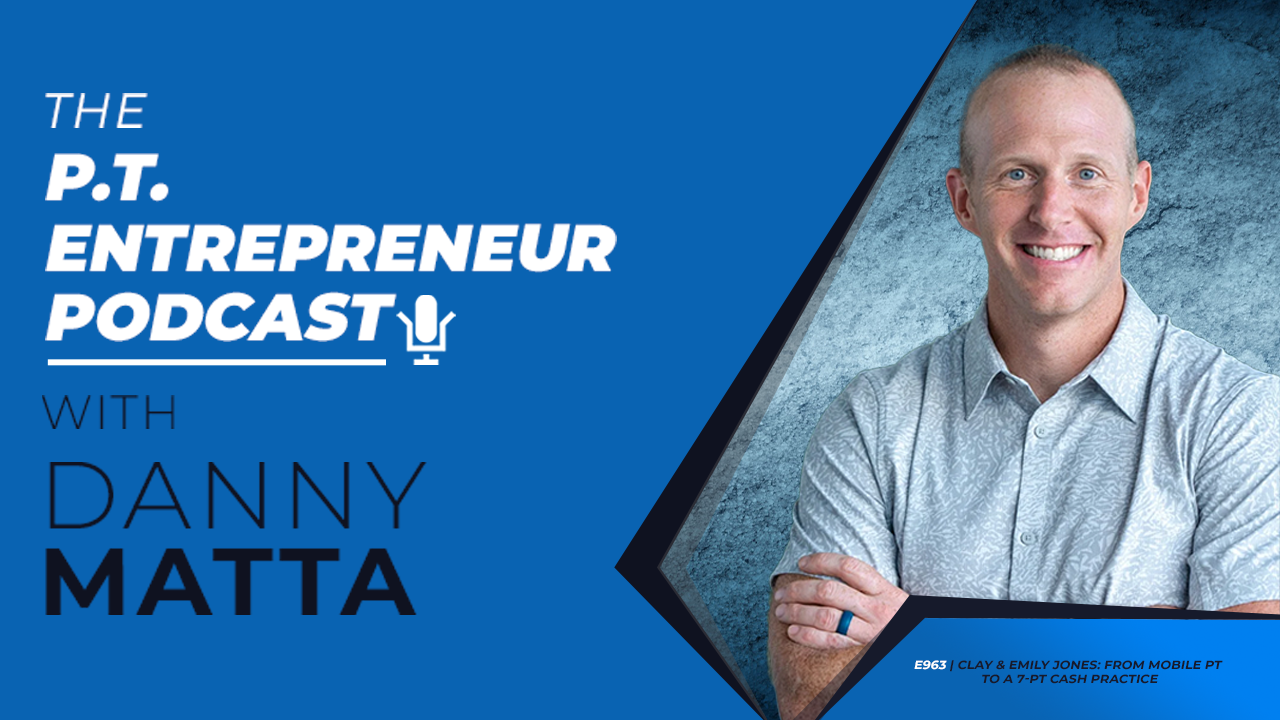
How Clay and Emily Jones Built 901 PT Into a Thriving Cash-Based Practice
Starting a cash-based physical therapy practice doesn't always require a big financial investment, a perfect business plan, or the willingness to quit your job overnight.
Sometimes it starts with a few patients, a rented room, and the decision to do things differently.
That's how Clay and Emily Jones built 901 PT in Memphis, Tennessee.
What began in 2017 as a small mobile practice eventually grew into a 5,000-square-foot clinic with six full-time physical therapists, a seventh joining the team, dedicated administrative staff, and a growing strength training program.
But the most interesting part of their story isn't the size of the business.
It's how they've built it together.
Clay is a clinician who genuinely loves treating patients. Emily is the person who enjoys organizing the business, managing finances, and figuring out how everything fits together.
Neither considers themselves a natural risk-taker.
And neither originally planned on running a large physical therapy practice.
Their experience offers some valuable lessons about starting small, growing responsibly, and finding the right roles as your business evolves.
Why Clay Wanted Something Different From Traditional Physical Therapy
Before starting 901 PT, Clay spent years working in traditional outpatient physical therapy.
He graduated in 2008, completed a fellowship in Seattle, and eventually returned to Memphis, where he worked in physician-owned and PT-owned clinics.
He enjoyed many aspects of those jobs.
But two frustrations kept coming up.
The first was his schedule.
Clay and Emily had four children, and his work hours made it difficult to be present for certain family activities.
He remembers missing most of one son's soccer season because the games consistently fell on a night he was scheduled to work.
He couldn't simply rearrange his hours.
The second frustration was patient care.
Clay specializes in treating people with persistent back and spine problems.
These patients often need time to understand their symptoms, address beliefs about pain, and work through a treatment plan.
In a traditional clinic, he frequently felt rushed.
Patients would receive information from multiple providers, sometimes with conflicting explanations about imaging, pain, and what they should or shouldn't do.
Clay wanted more time to educate them.
He also wanted greater continuity instead of constantly sharing patients across different clinicians and support staff.
A cash-based practice offered an opportunity to address both problems.
He could spend more time with patients while gaining greater control over his schedule.
901 PT Started With a Yellow Legal Pad
The first version of 901 PT looked nothing like the clinic Clay and Emily operate today.
There wasn't a large facility.
There wasn't an administrative team.
There wasn't even a sophisticated scheduling system.
Clay tracked patients, appointments, and payments on a yellow legal pad.
He was still working full-time and treating cash-pay patients in their homes before work, after work, and on weekends.
His initial rate was approximately $140–$150 per visit.
For the first few months, he averaged around six visits per week.
It wasn't glamorous.
But it was enough to validate that people would pay directly for the care he wanted to provide.
One of his earliest patients had actually asked whether Clay could simply come to their house rather than make them navigate the traditional clinic system.
That conversation helped confirm there was demand for a different experience.
The important lesson is that Clay didn't need to build the entire business before finding out whether the model worked.
He started with patients.
Then he adapted based on what those patients needed.
Keep Your Overhead Low Until the Demand Is There
After several months of mobile visits, patients began asking whether they could meet Clay somewhere instead of having appointments at home.
He found a room inside a boutique gym.
The arrangement was simple.
He paid approximately $20 whenever he used the room.
No major lease.
No expensive buildout.
No large financial commitment.
That flexibility mattered.
Clay and Emily had four children, and his full-time job provided their primary income and benefits.
They weren't interested in taking unnecessary risks.
By moving into the gym, Clay increased his schedule to approximately 12 visits per week while keeping expenses extremely low.
He was charging around $160 per visit at that point.
Because the family was still living on his employment income, they could save most of what the practice generated.
This gave them something many new clinic owners underestimate.
Options.
They could grow without immediately needing the business to cover every household expense.
They could invest gradually.
And they could make decisions based on actual patient demand instead of hoping an expensive facility would eventually fill up.
For clinicians working toward the Part-Time to Full-Time transition, this is a powerful approach.
Build the patient base first.
Keep expenses manageable.
Then increase your commitment as the numbers support it.
The Transition to Full-Time Didn't Require an All-or-Nothing Decision
Eventually, Clay reached the point where maintaining his full-time job was limiting the practice.
He approached his employer about reducing his hours.
That wasn't an option in his position, so they parted on good terms.
Fortunately, a longtime mentor named Jim Hambrick offered him another opportunity.
Jim owned an outpatient physical therapy clinic in Memphis and allowed Clay to work approximately 20 hours per week while continuing to grow 901 PT.
As the cash practice became busier, Clay could gradually reduce those hours.
It was an ideal bridge between employment and full-time ownership.
Within roughly three months, Clay's cash-pay schedule grew to approximately 25 visits per week.
By March, he was ready to work in his business full-time.
He also made his first clinical hire.
Sarah, who would eventually become 901 PT's clinical director, initially joined part-time while maintaining her own full-time position.
They gradually built her schedule until she could transition into the practice more fully.
This is a great example of how the Part-Time to Full-Time model can work.
You don't necessarily need to quit your job and immediately replace your entire salary.
You need a clear understanding of your expenses, pricing, patient volume, and available options.
Clay found a transition that worked for his family's financial situation.
Your path might look different.
The principle is the same: reduce unnecessary risk while building enough demand to support the next step.
Emily Helped Turn a Growing Practice Into an Actual Business
As patient volume increased, the yellow legal pad became less charming.
Clay was great at treating patients and generating ideas.
But the business needed more organization.
Emily had already been managing the family's finances and helping with social media.
She understood where the money was going and how much they were saving.
As 901 PT grew, she began taking on more responsibilities.
Scheduling.
New patient calls.
Financial management.
Marketing.
Operational systems.
Eventually, she became the person responsible for much of the business infrastructure.
Their strengths complemented each other.
Clay brought clinical expertise, relationships, and ideas for the future.
Emily brought organization, financial discipline, and the ability to turn ideas into workable systems.
That combination became increasingly important as the company grew.
But there's an important distinction here.
Emily didn't join because Clay needed someone to take care of the administrative work.
She genuinely wanted to be involved.
She enjoyed learning about business and finding ways to improve how the clinic operated.
That's a much healthier foundation for a husband-and-wife business than assuming a spouse should automatically become an employee.
Financial Discipline Created Room to Grow
One of the reasons Clay and Emily could make the transition without taking on significant financial pressure was their shared approach to money.
They were naturally conservative spenders.
During the early stages, they kept operating expenses minimal and saved what they earned.
They didn't immediately upgrade their lifestyle because the business was generating additional income.
Instead, they focused on creating a financial cushion.
That discipline helped them navigate the uncertainty of starting a practice with four children.
But as the business grew, they encountered a different challenge.
They had to learn when saving money was helpful and when investing it was necessary.
Clay understood the value of professional mentorship because he had previously invested in a clinical fellowship.
When he realized he needed to learn how to run a business, he approached it similarly.
He joined PT Biz because he wanted guidance from people who had already built successful cash practices.
He didn't need to figure out every part of business ownership through trial and error.
He needed the business equivalent of clinical mentorship.
The Scarcity Mindset Doesn't Automatically Disappear With Success
Even after 901 PT became successful, Clay continued to struggle with financial uncertainty.
Early on, he felt compelled to say yes whenever a patient wanted an appointment.
He worried that demand might suddenly disappear.
Once he hired employees, that pressure became even greater.
Now other people were depending on the business for their income.
For many clinic owners, this is familiar.
You have a great month.
Then you immediately wonder whether next month will be worse.
You hire a clinician.
Then you worry about keeping their schedule full.
You move into a larger space.
Then you start thinking about what happens if patient volume slows down.
Clay's perspective began changing after navigating difficult situations, including COVID, employee departures, and facility transitions.
Those experiences didn't eliminate uncertainty.
They gave him evidence that the business could survive challenges.
He also sought counseling to better understand how his own thinking affected the way he approached business ownership.
That's an important part of the entrepreneurial journey that doesn't get discussed enough.
Growing the clinic doesn't automatically make you feel secure.
Sometimes you have to work on the way you respond to uncertainty, even when the business is doing well.
A Bigger Clinic Doesn't Mean the Owner Has to Stop Treating
Today, 901 PT operates from a 5,000-square-foot facility with ten treatment rooms.
At the time of the conversation, the team included six full-time PTs, with a seventh preparing to join.
Emily oversees much of the business operation, Sarah serves as clinical director, and two additional administrative team members help manage patient communication and daily operations.
They've also introduced clinical strength training services.
But Clay still treats patients.
And that's intentional.
He typically sees around 15–16 patient visits per week and leads two clinical strength groups.
Altogether, he spends approximately 20 hours per week doing clinical work, with plans to reduce that somewhat as the team grows.
For a long time, he questioned whether he was supposed to stop treating completely.
He saw other successful clinic owners stepping away from patient care and wondered whether he needed to do the same.
Eventually, he realized something important.
He actually loves treating patients.
And he's built a team with people who are better suited for many of the operational responsibilities he doesn't enjoy.
The goal isn't necessarily to remove yourself from patient care.
The goal is to make sure you're spending your time where you create the most value, while building a business that doesn't depend entirely on you.
For Clay, that means continuing to treat some patients while Emily, Sarah, and the rest of the team help lead the company.
It's not the exact structure every clinic should follow.
But it's the structure that makes sense for them.
And that's what makes their story so useful.
There isn't one perfect way to become a successful cash-based PT clinic owner.
There is a way to build the right business around your strengths, your team, and the life you want.
Growing a Cash-Based PT Practice Means Being Willing to Change
One of the biggest challenges in running a successful physical therapy practice is recognizing when something that worked in the past needs to change.
For Clay and Emily Jones, that has become increasingly important as 901 PT has grown.
What worked when Clay was treating six patients per week out of people's homes isn't necessarily what works with seven physical therapists, a large facility, and an established administrative team.
More employees mean more responsibility.
Higher operating expenses require closer attention to profitability.
And the systems that once seemed unnecessary become essential.
One of the biggest changes they're currently working through is their pricing and service structure.
For years, 901 PT used traditional treatment packages.
But as their team grew and experienced clinicians received raises, Clay and Emily began recognizing a problem.
There was a limit to how much they could continue increasing compensation without changing the economics of the business.
They needed a model that could support their team while continuing to provide excellent patient care.
Why 901 PT Is Moving Toward a Time-Based Offer
After learning about the time-based offer model through PT Biz, Emily began evaluating whether it could work for their clinic.
She looked at their existing packages, how patients were progressing through care, and the financial implications of maintaining their current structure.
The opportunity wasn't simply to change how patients paid.
It was to reconsider how 901 PT delivered ongoing value.
The team began exploring a model that could incorporate more support between appointments, including home programming and patient communication.
Instead of changing everything overnight, they chose a gradual rollout.
Their clinical director, Sarah, took the lead on implementation.
Newer clinicians began testing the approach, while the more experienced therapists had additional time to understand and prepare for the transition.
The plan was to introduce the model to the remaining clinicians after working through the initial challenges.
That approach matters.
When you're making a significant operational change, especially with an established team, implementation is just as important as the idea itself.
You need to understand the financial reasoning, communicate the purpose, train your staff, and give people time to adapt.
Clay admits that change doesn't come naturally to him.
Emily and Sarah are often more comfortable working through the operational details.
Rather than forcing himself to lead every initiative, he's learned to trust the people whose strengths fit the work.
That's an important leadership lesson.
You don't have to be the best person at everything in your clinic. You need to build a team that can collectively do those things well.
Working With Your Spouse Requires Clear Boundaries
One of the most interesting parts of Clay and Emily's story is how they've learned to manage being both spouses and business partners.
Early in the business, separating work from family life was difficult.
Clay was constantly thinking about the clinic.
Even on vacation, he'd find himself working through business ideas.
At one point, he was bringing a small whiteboard to the beach.
Emily remembers taking calls from prospective patients while the family was traveling, asking the kids to be quiet in the back of the vehicle so she could schedule an evaluation.
The business was always present.
Over time, they realized that wasn't sustainable.
They also discovered that they process work differently.
Emily can discuss a business problem, make a decision, and move on to something else.
Clay has a harder time switching gears.
A quick business question on a Sunday afternoon might send him into hours of thinking about staffing, systems, or patient care.
Neither approach is inherently wrong.
But understanding those differences helped them communicate better.
They've worked through these challenges with marriage counseling and intentional conversations about boundaries.
Today, they're much better at protecting their time outside the clinic.
And with a clinical director, administrative staff, and stronger systems in place, they can take family vacations without needing to manage every detail themselves.
Their advice to other couples considering working together is straightforward.
Make sure both people actually want to be involved.
Emily enjoys running the business.
She finds the work interesting and fulfilling.
That doesn't mean every spouse will feel the same way.
Bringing your husband or wife into the practice should be a decision based on genuine interest, complementary strengths, and clear expectations, not simply convenience.
The Next Stage of Growth Is About Going Deeper With Patients
One of the biggest lessons Clay would apply if he started 901 PT again is changing how he thinks about patient acquisition.
In the early years, he focused heavily on getting more new patients.
That made sense when he was trying to fill his schedule.
But over time, he realized that continually chasing new evaluations wasn't necessarily the best way to build the practice.
Today, the team focuses more on helping patients fully commit to their care and continue progressing toward meaningful goals.
That creates better opportunities for continuity, education, and long-term relationships.
It also reduces the pressure to constantly replace patients with new leads.
This is closely connected to the Compounding Clinic concept we teach at PT Biz.
When patients receive an exceptional experience, achieve meaningful results, and continue engaging with your services, the value of those relationships builds over time.
Some become Super Brand Ambassadors who refer friends, family, and coworkers.
Others may benefit from additional services that help them maintain their progress.
The clinic becomes less dependent on starting from zero with new patient acquisition every month.
For 901 PT, that philosophy has also helped shape a growing strength training program.
Building Services That Keep Helping Patients After PT
Over the past year, Clay and Emily have expanded their clinical strength offerings.
The program includes small-group strength training, individual training, and remote programming.
At the time of the episode, approximately 30 people were actively participating.
Many are women in their forties, fifties, and sixties who want to become stronger, stay active, and feel confident exercising.
Some started as physical therapy patients.
Others joined specifically for strength training.
Emily shared an interaction with a woman who had been participating for only a couple of months.
The woman explained how grateful she was to have found a program that matched what she'd been looking for.
For Emily, moments like that are especially rewarding.
The business isn't just growing.
It's solving another problem for people in their community.
And it's doing so in a way that builds on the clinical expertise already inside the practice.
This is an important opportunity for cash-based PT owners.
You don't necessarily need to stop helping someone when their initial rehabilitation goals are met.
Depending on their needs, a well-designed strength or performance service may provide a natural next step.
It can also create opportunities for Recurring Revenue while giving patients a reason to maintain a long-term relationship with your business.
The key is making sure the service solves a real problem rather than adding something simply because it could generate additional revenue.
What a Healthy Clinic Actually Looks Like
When Courtney Morse asked Clay and Emily what it looks like when 901 PT is operating at its best, their answers revealed something important.
Clay immediately thought about the team.
Are the clinicians' schedules appropriately full?
Are employees leaving work on time?
Do they have opportunities to exercise during the day?
Is the team communicating well?
Are people getting the mentorship and support they need?
Emily thought about their mission.
Are they helping people in ways that genuinely improve their lives?
Are patients excited about the services they're receiving?
Is the business doing the work they originally set out to do?
Both perspectives matter.
A healthy clinic needs sound operations and financial performance.
But it also needs employees who enjoy working there and patients who feel genuinely supported.
As 901 PT has grown, Clay and Emily have revisited their core values and involved their team in refining them.
That process has helped create greater alignment around how the clinic operates.
It's also reinforced something they learned through years of business ownership.
Leadership isn't simply about making decisions.
It's about communicating clearly, developing people, and creating an environment where everyone understands what they're working toward.
Technology Spotlight
Documentation continues to be one of the biggest frustrations for physical therapists.
Claire is an AI scribe built specifically for PTs that dramatically reduces documentation time, allowing clinicians to focus on patient care instead of paperwork.
👉 Try Claire free for 7 days
https://www.meetclaire.ai/?utm_source=preroll&utm_medium=podcast&utm_campaign=pt_entrepreneurs
More PT Biz Training
Want more content on building a scalable cash practice?
👉 PT Biz Training YouTube
https://www.youtube.com/@ptbiztraining
If you're considering starting your own practice, the free PT Biz Part-Time to Full-Time 5-Day Challenge can help you determine your income replacement target, patient volume, pricing, and the steps needed to make the transition.
👉 https://physicaltherapybiz.com/challenge
You can also learn more about Clay and Emily's practice at 901 PT.
Final Thoughts
Clay and Emily didn't build 901 PT by making one enormous leap.
They started with a few patients, kept their expenses low, and gradually expanded as demand increased.
Along the way, they learned how to divide responsibilities, invest in mentorship, develop their team, and adapt their business model.
They've also learned that business ownership requires personal growth.
Clay has had to become more comfortable with uncertainty and change.
Emily has developed into an operational leader despite having no traditional business background.
Together, they've built something neither originally expected.
The biggest lesson is that you don't have to know how to run a seven-clinician practice when you're starting with your first patient.
You need to understand what matters at your current stage and be willing to develop the skills required for the next one.
If you're just getting started, focus on finding patients, delivering exceptional care, and keeping your expenses manageable.
If you're already growing, look at your team, systems, patient relationships, and financial model.
And wherever you are in the process, remember that the goal isn't simply to build a bigger clinic.
It's to build a practice that delivers great care, supports your people, and creates the kind of life you wanted when you started.